
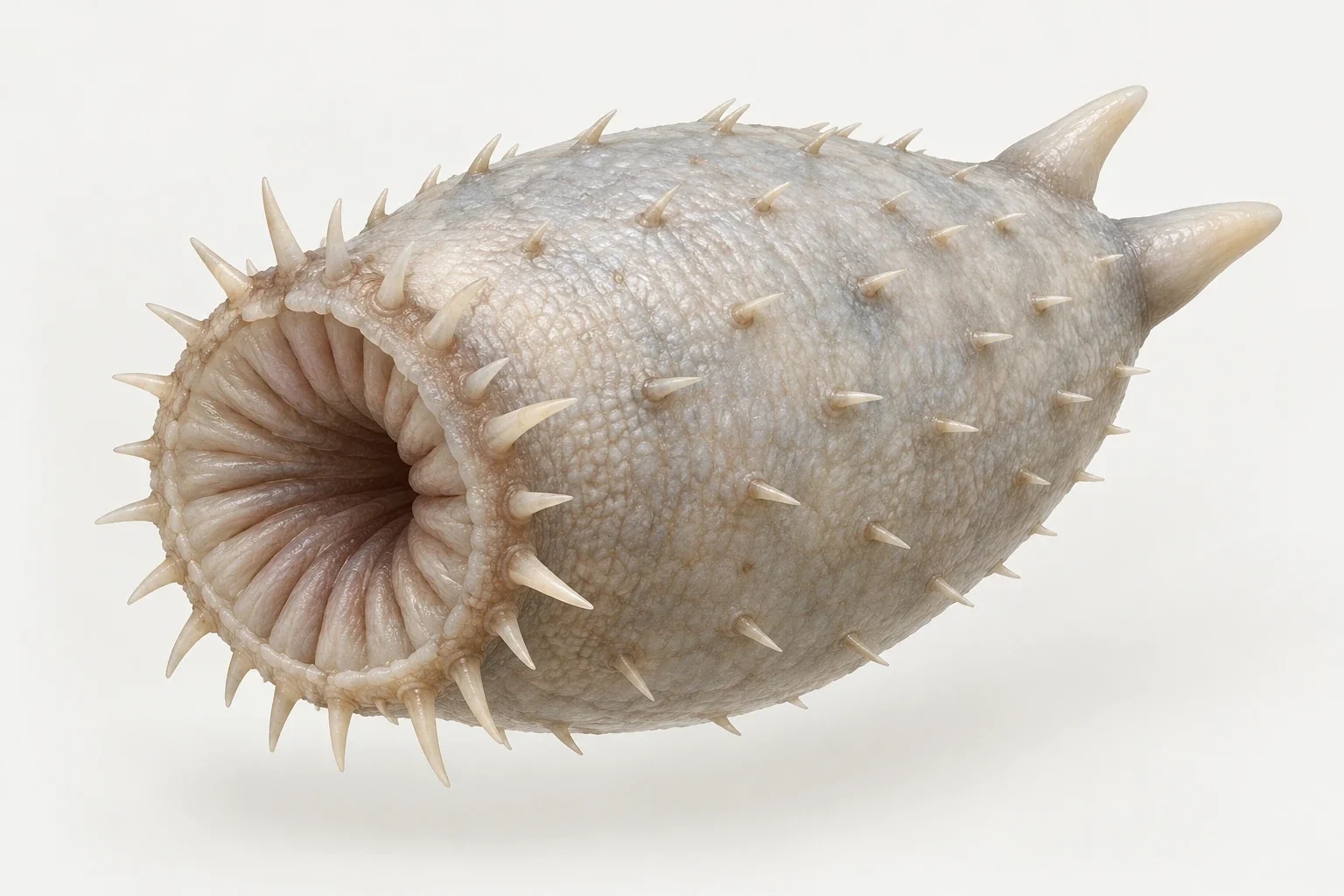
Saccorhytus coronarius - AI-generated scientific interpretation.
Modern AI-generated scientific illustration; diagnostic features follow the cited research. Colour, pose and unpreserved fine details are interpretive; this image is not fossil or photographic evidence.
Overview
Saccorhytus was reconstructed in 2022 as an ellipsoidal, millimetric animal living among bottom sediments. It had a terminal mouth, spinose armour and no identified anus. Its anatomy is unlike a miniature fish: the fossil does not preserve eyes, paired limbs or gill slits that justify restoring such structures.
An earlier interpretation placed it near deuterostomes, the broad group containing chordates and echinoderms. Newly studied specimens changed the anatomical reading. Openings previously taken as pharyngeal pores were instead interpreted as damage where spines had broken away. This correction removed a key character supporting the earlier placement.
Synchrotron tomography supplied multiple X-ray views assembled into three-dimensional models. Comparisons and phylogenetic analyses supported total-group Ecdysozoa, the lineage including arthropods and roundworms. Bristol researchers emphasized that its precise position remained uncertain. Possible prey capture by mouth spines is a functional suggestion, not an observed feeding event; the fossil is not established as a direct human ancestor.
Origins & earliest records
The fossils discussed in the reassessment come from early Cambrian China. Liu and colleagues published the revised anatomy and phylogenetic interpretation in 2022; that publication corrected an interpretation rather than discovering a new first animal.
Evidence & interpretation
Preserved specimens, microscopic structures and tomographic models distinguish intact body projections from damage. Character-based phylogenetic analyses support ecdysozoan affinity but do not resolve every early branch. No anus was identified in the reconstructed anatomy; a detailed digestive physiology is not known.
Selected bibliography
Documented works and useful reading. This is not a list of every appearance.
- 01
Saccorhytus is an early ecdysozoan and not the earliest deuterostome
Selected bibliography; bounded source account, not exhaustive coverage.
- 02
Scientists relieved to discover curious creature with no anus is not earliest human ancestor
Selected bibliography; bounded source account, not exhaustive coverage.
Family, evolution & connections
Taxonomic classification
A hierarchy of classified groups, not a chain of direct ancestors.
Source note: Total-group ecdysozoan placement follows Liu et al. 2022; a precise crown phylum is deliberately not assigned. Earlier deuterostome classification is superseded in this selected account.
- kingdomAnimalia
- cladeEcdysozoa total group
- genusSaccorhytus
- speciesSaccorhytus coronarius
References
Sources supporting this profile. Linked pages have their own scope and editorial standards.
- ResearchSaccorhytus is an early ecdysozoan and not the earliest deuterostomeResearch access: 2026-10-10
- InstitutionalScientists relieved to discover curious creature with no anus is not earliest human ancestorResearch access: 2026-10-10
Image credits
AI-generated scientific interpretationSaccorhytus coronarius - AI-generated scientific interpretation.
Modern AI-generated scientific illustration; diagnostic features follow the cited research. Colour, pose and unpreserved fine details are interpretive; this image is not fossil or photographic evidence.