
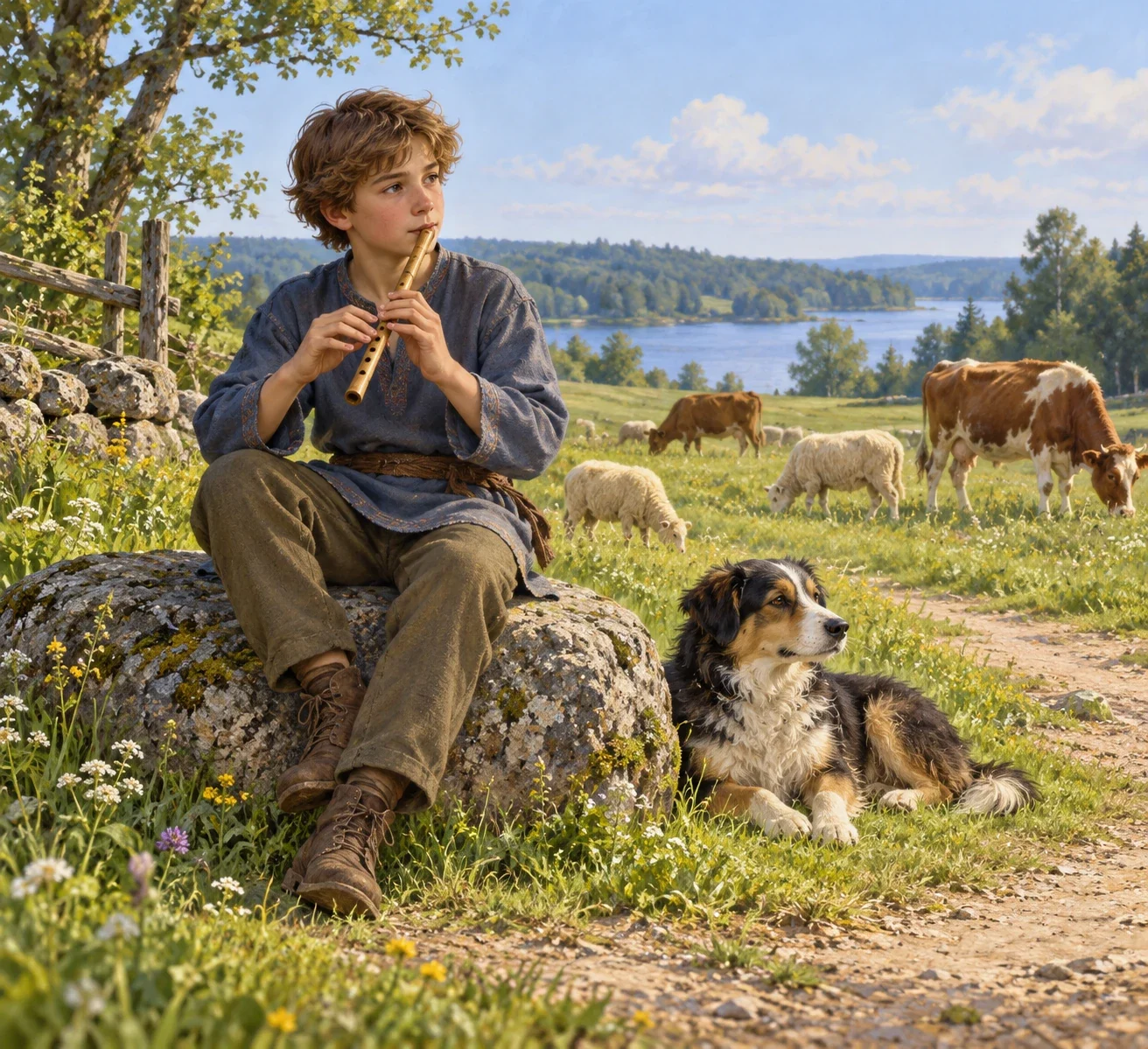
AI interpretation of the Royal Herd-Boy with flute, dog and grazing animals.
Overview
The prince’s mother dies soon after his birth. His father remarries, and the new queen secretly pays an old woman to remove the child. Kind forest-dwelling peasants raise him without understanding his remembered claim to royal birth. He later chooses paid work as a herd-boy. Beside the highway he plays a flute while his dog keeps the animals together, and a passing old man recognizes something unusual in him. When a noblewoman demands his strawberries with insults and orders force against him, he resists. Judges and then the king acquit him, but the queen arranges service with a cruel farm mistress. His resistance there escalates into revenge: he substitutes captive wolves for the herd, and they kill the mistress. He leaves and tries other trades, becoming a gardener’s apprentice at eighteen.
The child-stealer’s deathbed confession sets the king searching. The old man helps recover the prince, who refuses to abandon the gardener’s daughter he loves. His father divides their betrothal ring, saying the halves will reunite if they are destined for each other. After succeeding to the throne, the young king withstands pressure to choose a noble bride. The old man, now identified as a Finnish sorcerer, temporarily transforms the assembled maidens to reveal their inward qualities; the gardener’s daughter appears as a flowering rose-bush with two doves. He restores their human shapes, and the ring halves join without a seam. The king marries her, later brings his stepmother to judgment, spares her life but banishes her, and protects his innocent half-sisters. He provides homes for his bride’s parents and his own foster-father. The ending’s mercy toward his stepmother coexists with the earlier violent revenge; this is not a uniformly gentle hero.
Origins & earliest records
The Royal Herd-Boy, labelled Kreutzwald, in The Hero of Esthonia (1895), volume I, pp.279–303.
Records & interpretation
W. F. Kirby’s 1895 English compilation draws on Esthonian and German publications. Its prose-source introduction identifies Kreutzwald’s 1866 collection and F. Löwe’s 1869 German translation; neither underlying edition was independently consulted here. The selected literary witness is not a verbatim oral performance or a modern community survey.
Selected bibliography
Documented works and useful reading. This is not a list of every appearance.
- 01
The Hero of Esthonia and Other Studies in the Romantic Literature of That Country
Volume I, pp.279–303, complete Royal Herd-Boy account; attached notes151–153.
Family & connections
A source-supported family tree or inspiration record has not yet been compiled for this profile. Related reading below indicates a connection in subject matter, not a proven lineage or creative influence.
References
Sources supporting this profile. Linked pages have their own scope and editorial standards.
- Historical literary folk-tale retelling mediated through Kreutzwald and KirbyKirby1895 — complete Royal Herd-Boy account, notes151–153 and source framingResearch access: 2026-10-23
Image credits
AI-generated literary folklore interpretationAI interpretation of the Royal Herd-Boy with flute, dog and grazing animals.