
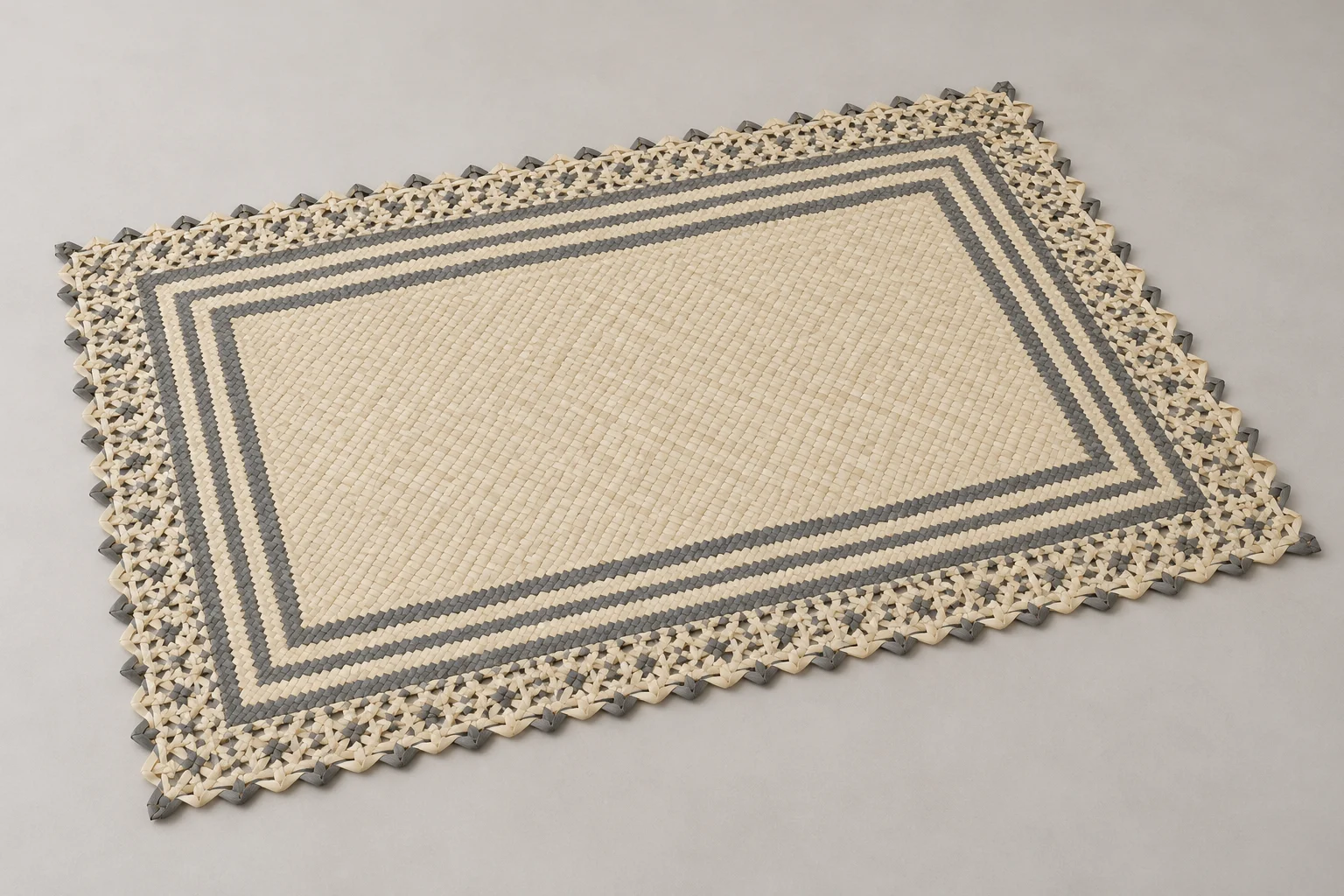
Generated material interpretation of a historical manual; not a photographed or authenticated specimen.
Overview
The 1913 manual identifies Romblon buri mats as a regional product made throughout the Romblon islands and marketed centrally in the town of Romblon. It describes fine white and coloured material, checks, line borders, plaids and patterns formed by floating strips. A characteristic feature is the openwork border. The instructional section explains that gaps are created by turning strips within the weave, with different turns producing different openings. Coloured panels can be joined as work proceeds. Plate XXXIII shows a complete rectangular example with a broad plain centre, several narrow surrounding bands and a wider pierced outer border ending in small repeated projections. The photograph supports the visible arrangement, while the publication’s description supplies the material and technique.
Buri straw came from young unopened palm leaves. A reported Romblon preparation selected leaves by their stage of growth, removed their midribs and alternated boiling, soaking and drying before weaving. The manual also records local dye processes and contrasts the fine Romblon products with coarse packing mats. Its observations were assembled within a government teaching programme: the foreword credits named contributors and American and Filipino teachers, and explicitly aims to change workmanship and design for commercial markets. This is therefore a dated instructional and promotional account, rather than an unmediated statement by all Romblon makers. Its grades of quality and market judgements remain the manual’s assessments. No maker is named for the photographed mat, and neither its precise colours nor present-day production can be established from that monochrome plate.
History & identity
Philippines Bureau of Education, Philippine Craftsman Reprint Series No.1.
Sources & representation
Complete selected foreword, Romblon technique and buri sections read; original 1913 title and complete Plate XXXIII viewed.
Selected bibliography
Documented works and useful reading. This is not a list of every appearance.
- 01
Philippine Mats
Manila: Bureau of Printing. Reprinted from The Philippine Craftsman I,Nos.3–5; Plate XXXIII.
Language & cultural connections
Source-supported language and cultural connections have not yet been compiled for this profile.
References
Sources supporting this profile. Linked pages have their own scope and editorial standards.
- Historical government craft manualPhilippine Mats, original instructional text and platesResearch access: 2026-10-18
Image credits
AI-generatedGenerated material interpretation of a historical manual; not a photographed or authenticated specimen.