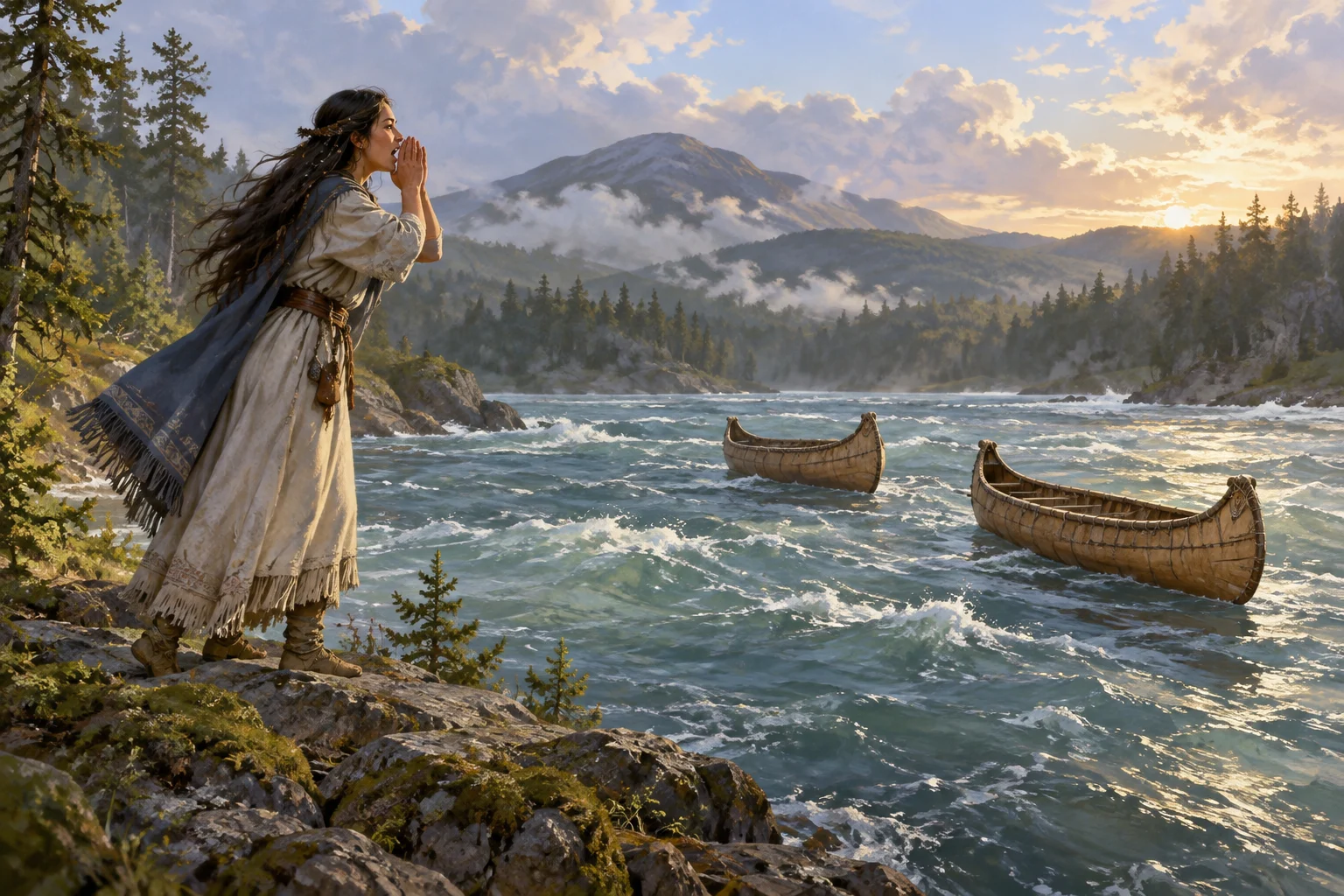
AI interpretation of River-Spirit Daughter of the Spear Journey. One imaginary clothed woman beside a swollen river calling, as two empty canoes appear on the water. Select the canoe-calling witness alone, no simultaneous water-parting or fish tail. Face, garments, canoe design and setting imagined, not authentic regalia or a real-community portrait.
AI-generated unofficial original narrative interpretation. Selected scene: One imaginary clothed woman beside a swollen river calling, as two empty canoes appear on the water. Select the canoe-calling witness alone, no simultaneous water-parting or fish tail. Face, garments, canoe design and setting imagined, not authentic regalia or a real-community portrait. Fine anatomy, garments, objects and setting are modern AI imagined visual details, not an historical reconstruction, community portrait, authentic artifact or evidence of living practice.
Overview
A young traveler sets out with his wife to recover a hostile king's spear. A royal daughter in the destination town shows him the weapon store, gives him access to the sought spear and agrees to leave with him. On their homeward road they meet a swollen river. His existing wife is identified as the river king's daughter: she can swim, calls out, and canoes appear for their crossing. Back home the recovered spear earns the young man a share in the city's rule, and he also marries the companion from the other town. The water helper and the weapon-store companion therefore have different roles.
The appended variant instead brings the river daughter into the scene when the fugitives are halted by pursuing horsemen. She hears their predicament, throws gravel into the stream, and the waters immediately divide. After the travelers cross, the water closes again and the escape succeeds. In note 60 the collector distinguishes Sa(r)rikin Rafi, a stream spirit, from Sa(r)rikin Rua, an official responsible for a ford or ferry, judging the supernatural sense appropriate because of the canoes and division. The two crossing mechanisms are retained as variants; no fish tail or wholly aquatic body is supplied.
Origins & earliest records
The contents attribute this story to M., Mohamma. Tremearne records it in the 1913 second edition and adds explanatory notes and comparisons; the broader collection dates do not date this individual performance.
Records & interpretation
Complete primary main episode and relevant separately labeled comparison read. Tale 60 pp. 323-325; noteLX.4 pp. 493-494 distinguishes spirit title from water official.
Selected bibliography
Documented works and useful reading. This is not a list of every appearance.
- 01
Hausa Superstitions and Customs
Tale 60 pp. 323-325; noteLX.4 pp. 493-494 distinguishes spirit title from water official.
Family & connections
A source-supported family tree or inspiration record has not yet been compiled for this profile. Related reading below indicates a connection in subject matter, not a proven lineage or creative influence.
References
Sources supporting this profile. Linked pages have their own scope and editorial standards.
- Collected primary narrative in translationTremearne 1913 - complete selected taleResearch access: 2026-10-05
Image credits
AI-generated interpretationAI interpretation of River-Spirit Daughter of the Spear Journey. One imaginary clothed woman beside a swollen river calling, as two empty canoes appear on the water. Select the canoe-calling witness alone, no simultaneous water-parting or fish tail. Face, garments, canoe design and setting imagined, not authentic regalia or a real-community portrait.
AI-generated unofficial original narrative interpretation. Selected scene: One imaginary clothed woman beside a swollen river calling, as two empty canoes appear on the water. Select the canoe-calling witness alone, no simultaneous water-parting or fish tail. Face, garments, canoe design and setting imagined, not authentic regalia or a real-community portrait. Fine anatomy, garments, objects and setting are modern AI imagined visual details, not an historical reconstruction, community portrait, authentic artifact or evidence of living practice.