
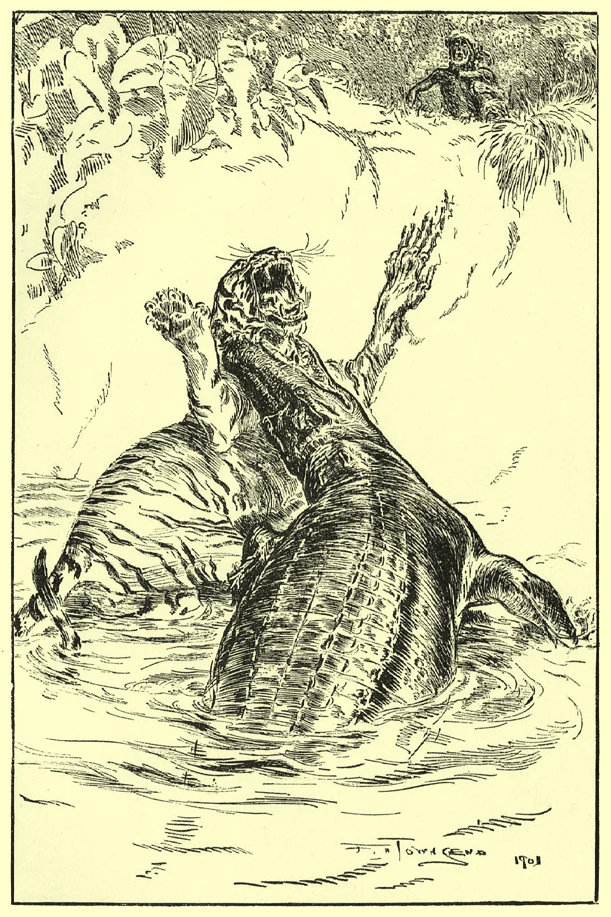
Townsend’s crocodile Buáya seizing the tiger Rīmau in the river
The crocodile catches the tiger after the man’s sneeze startles it into the river. Townsend depicts the grim reversal of their hunting agreement; the supposed four-armed human was the tiger’s mistake, not a separate creature.
Overview
A frightened child sleeps with his head in his father’s lap. Rīmau the tiger misreads the combined bodies as one four-armed, four-legged human with a single head. Buáya the crocodile dismisses the mistake and advises closer inspection, proposing that the tiger keep what it seizes while anything entering the river belongs to the crocodile. Rīmau’s whiskers tickle the father’s nose; the resulting sneeze startles the tiger into the water, where Buáya eats him under their agreement. The supposed many-limbed human is an error of perception, not an additional monster. Skeat records the local setting but doubts the presence of crocodiles so far upriver; the legend is not a verified encounter.
Origins & earliest records
Malay Peninsula; Lĕbih River setting, interior Kĕlantan; narrated to Skeat at a riverside camp
Records & interpretation
Complete relevant tale and attached scholarly notes directly read.
Selected bibliography
Documented works and useful reading. This is not a list of every appearance.
- 01
Fables & Folk-Tales from an Eastern Forest
IX, The Tiger’s Mistake, pp. 22–23; notes pp. 78–79
- 02
Fables & Folk-Tales from an Eastern Forest — IX The Tiger’s Mistake
Fables & Folk-Tales from an Eastern Forest, collected and translated Walter Skeat, Cambridge: University Press,1901. Original title leaf13 visually checked; selected complete tales and all accompanying notes read from historical transcription. Introduction states1899 Cambridge expedition collection and limitation of phraseology, not verbatim unedited speech. Original quoted folios visually checked in Archive fablesfolktalesf00skearich; IIIF canvas positions omit initial leaves, so exact original leaf number matched from image identifier, not array index.
Family & connections
A source-supported family tree or inspiration record has not yet been compiled for this profile. Related reading below indicates a connection in subject matter, not a proven lineage or creative influence.
Primary records and illustrations
Walter Skeat, Fables & Folk-Tales from an Eastern Forest (Cambridge: University Press, 1901)
IX, The Tiger’s Mistake. IX, The Tiger’s Mistake, pp. 22–23; notes pp. 78–79
Complete tale and associated notes directly read. Regional spellings and differing accounts retained; commentary does not establish present-day practice or biological facts. Individual teller not named here.
Located primary passages
Specific passages supporting details in this entry, grouped by their published witness.
Fables & Folk-Tales from an Eastern Forest
Fables & Folk-Tales from an Eastern Forest, collected and translated Walter Skeat, Cambridge: University Press,1901. Original title leaf13 visually checked; selected complete tales and all accompanying notes read from historical transcription. Introduction states1899 Cambridge expedition collection and limitation of phraseology, not verbatim unedited speech. Original quoted folios visually checked in Archive fablesfolktalesf00skearich; IIIF canvas positions omit initial leaves, so exact original leaf number matched from image identifier, not array index. These four tales’ host page labels have not been individually scan-collated; original title and other selected folios checked separately.
- A father and frightened child sleep by the Lĕbih River, the boy’s head in his father’s lap. Rīmau mistakes the overlapping sleepers for one four-limbed-pair, single-headed person and asks Buáya the crocodile about it. Buáya explains there must be two heads and proposes dividing whatever the tiger catches from whatever flees into the river. Returning to inspect, the tiger tickles the father’s nose with its whiskers. A violent sneeze startles it into the river, where Buáya eats it under their own bargain. Skeat reports the tale being placed by a narrator at the very campsite he visited, while questioning whether crocodiles occur so far upstream.
IX The Tiger’s Mistake, complete hosted printed-page labels 22–23; notes78–79
CompleteIX22–23 and notes78–79 read. Apparent many-limbed being is mistaken perception of two ordinary humans, not a genuine composite monster. Local placement is narrator assertion, not proof of occurrence. Collector’s doubt about crocodile distribution retained, without inventing corroboration.
References
Sources supporting this profile. Linked pages have their own scope and editorial standards.
- Historical collected narrative with locality and editorial notesSkeat, Fables & Folk-Tales (Cambridge University Press, 1901), IX, The Tiger’s Mistake, pp. 22–23; notes pp. 78–79Research access: 2026-10-05
Image credits
Historical illustrationTownsend’s crocodile Buáya seizing the tiger Rīmau in the river
The crocodile catches the tiger after the man’s sneeze startles it into the river. Townsend depicts the grim reversal of their hunting agreement; the supposed four-armed human was the tiger’s mistake, not a separate creature.