
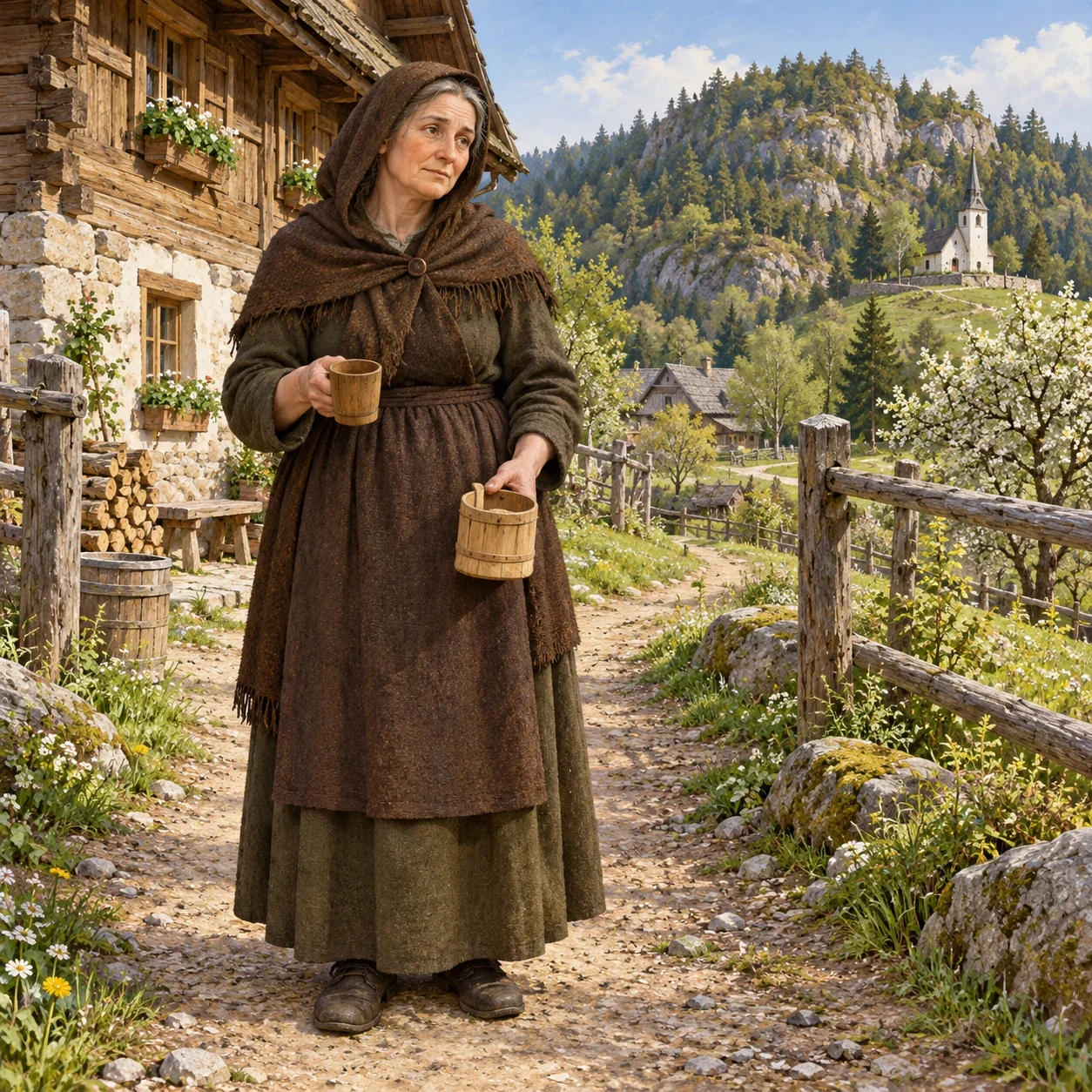
AI-generated interpretation of the Resslared Troll mother seeking provisions. The source supplies her requests for meal, ale and milk but no physical portrait. Age, face, humanlike body, clothes, wooden vessels, cottage, church and landscape are artistic inventions, not ethnographic evidence or a reconstruction of the actual village.
AI-generated interpretation of the Resslared Troll mother seeking provisions. The source supplies her requests for meal, ale and milk but no physical portrait. Age, face, humanlike body, clothes, wooden vessels, cottage, church and landscape are artistic inventions, not ethnographic evidence or a reconstruction of the actual village.
Overview
Hofberg places a Troll community in Räfvakullen, or Fox Hill, near Resslared church, saying that it existed before the church was built. The first part of the chapter concerns an attempt to protect the new bell through prayers. Before the priest has finished, the Trolls take it and sink it in a nearby place called the Troll Hole. A second bell is cast, and a more learned provost performs the blessing. That effort also fails: when the bell is about to sound on the following Sunday, it flies through the tower openings and breaks on the church roof.
The bishop of Skara is called for the third bell. This time the prayers succeed, and the Trolls leave it undisturbed. The narrative grades clerical authority and ritual effectiveness through its three attempts; it does not independently establish a historical miracle, the effectiveness of a present-day practice or the actual construction history of the church. Its sequel also matters: the Trolls thereafter live peaceably with their human neighbours instead of remaining permanent opponents of everything associated with the parish.
During that period of cooperation, the Trolls borrow food and drink from parishioners and repay twice what they receive. Later the original residents die and wealthy but ungenerous newcomers take their place. The mother of the Troll household visits a cottage and asks the housewife for a measure of meal. The woman falsely says that she has none. The visitor next asks for ale because her husband is away and will be thirsty when he returns, and is again refused. Finally she asks for a little milk for a sick child in the mountain. The housewife claims that her cows give no milk.
The Troll woman accepts each answer aloud and leaves. Her human neighbour initially believes that she has escaped the obligation cheaply. Inspection of the larder reveals a different result: the meal containers really are empty, the ale is gone and the previously milk-giving cows now provide none. What had been a dishonest excuse has become the household’s condition. Prosperity does not return, and the inhabitants eventually sell their property and move away. The text does not describe the Troll mother personally emptying every vessel, show a later reconciliation or report the child’s eventual health.
The two sequences belong together in this selected account. Relations move from conflict over church bells to reciprocal support, and then fail through refusal and deception in a prosperous household. The woman is identified through her place within the Troll family, not by a separate personal name or a stated anatomy. This is one source-specific community and its encounters, rather than a separate new creature for each bell, loan or family member. The complete chapter has no attached tale note in Myers’s 1890 English edition; his preface explicitly acknowledges omitted notes. The Swedish original and a complete historical survey of local belief have not been independently examined here.
Origins & earliest records
Herman Hofberg, Swedish Fairy Tales, W. H. Myers translator, Chicago: Belford-Clarke Co.,1890. The Trolls in Resslared, pp115–117.
Records & interpretation
Complete selected chapter read through its ending; no attached tale note. Both retained editorial prefaces consulted; original Swedish apparatus not independently collated.
Selected bibliography
Documented works and useful reading. This is not a list of every appearance.
- 01
Swedish Fairy Tales — The Trolls in Resslared, pp115–117
Complete selected historical English chapter, with editorial mediation distinguished.
Family & connections
A source-supported family tree or inspiration record has not yet been compiled for this profile. Related reading below indicates a connection in subject matter, not a proven lineage or creative influence.
References
Sources supporting this profile. Linked pages have their own scope and editorial standards.
- Historical collected narrative in English translationHofberg/Myers1890 — The Trolls in Resslared, pp115–117Research access: 2026-10-27
Image credits
AI-generated illustrationAI-generated interpretation of the Resslared Troll mother seeking provisions. The source supplies her requests for meal, ale and milk but no physical portrait. Age, face, humanlike body, clothes, wooden vessels, cottage, church and landscape are artistic inventions, not ethnographic evidence or a reconstruction of the actual village.
AI-generated interpretation of the Resslared Troll mother seeking provisions. The source supplies her requests for meal, ale and milk but no physical portrait. Age, face, humanlike body, clothes, wooden vessels, cottage, church and landscape are artistic inventions, not ethnographic evidence or a reconstruction of the actual village.