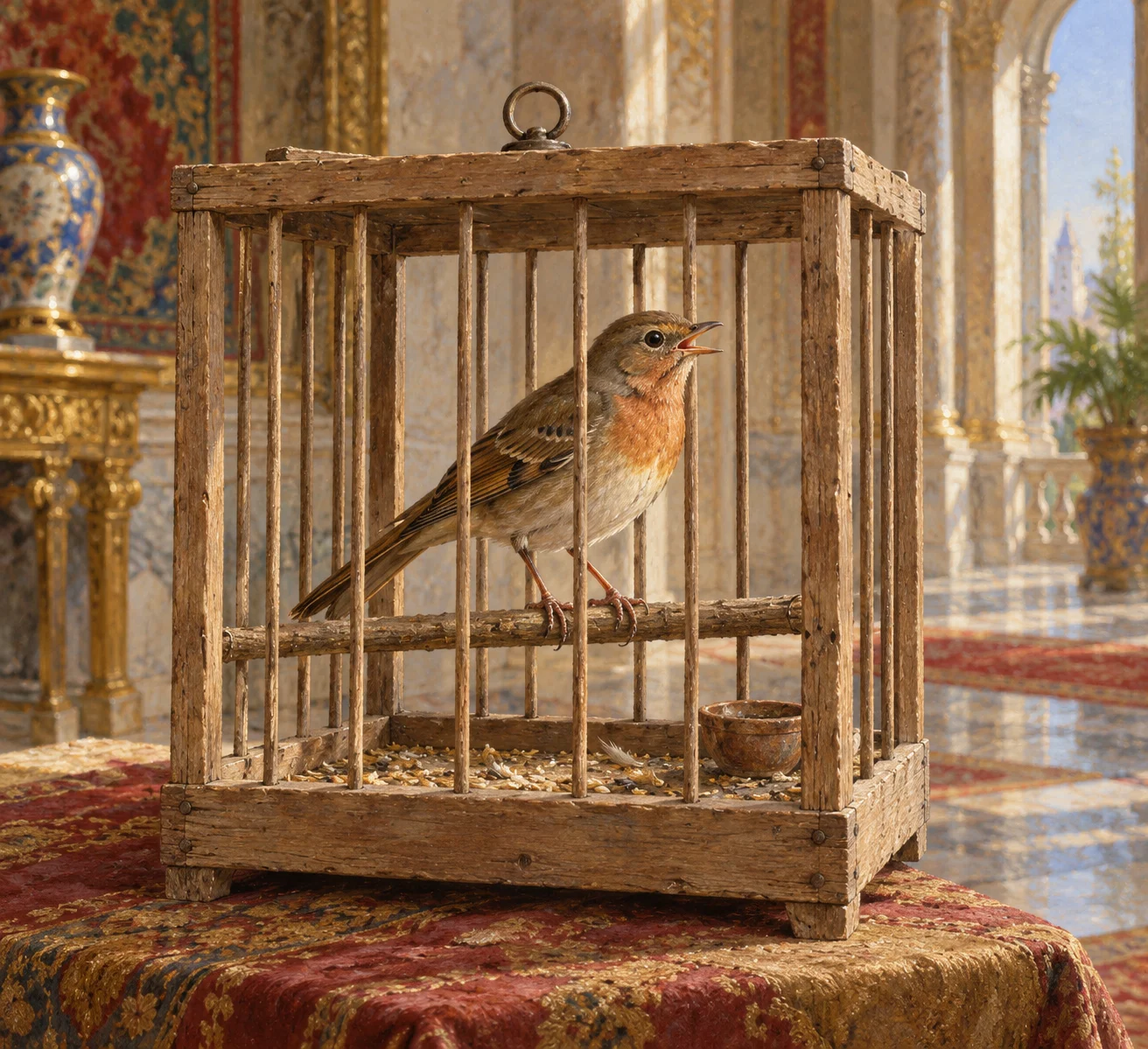
The tale’s singing bird in its humble wooden cage; appearance and setting imagined.
Original narrative illustration; detailed appearance and staging imagined, not an authenticated cultural record.
Overview
The bird gives the three princes’ journey its purpose: its song is said to make a person one year younger. Tillu and Guttu set out first but lose their possessions to a sorceress and remain as her servants. Their youngest brother Giuseppe succeeds only after paying for the burial of an abandoned corpse. The grateful dead man later directs him to a country house made of gold and diamonds. Among the gold and silver cages there, the desired bird occupies a dirty, foul-smelling wooden cage. Following the dead man’s instruction, Giuseppe passes the two guardian lions while their eyes are open and carries the bird away.
The older brothers then throw Giuseppe into the sea and present the bird to their father as their own achievement. It remains silent, even when the king invites distinguished visitors to try to make it sing. When Giuseppe returns in borrowed, coal-stained clothes, the bird recognizes him and begins singing despite his disguise. Its response helps restore the rightful rescuer’s place in the family. After his identity is revealed, Giuseppe asks that his brothers be exiled rather than killed. He offers to make his parents twenty years old, but the king requests thirty instead. The tale ends with that request, without separately describing its fulfilment. No species, colour or detailed bodily form is given for the bird.
Origins & earliest records
Hans Stumme’s 1904 German translation of Maltese narratives dictated in spring 1903. His introduction attributes tales XII–XXII to an unnamed forty-year-old woman of rural origin who had moved frequently and spoke a mixed rural and urban dialect. Her precise village is not supplied. The companion Maltese-language edition has not been independently collated here; the complete German tale and the translator’s introduction are the retained witnesses.
Records & interpretation
Complete tale XII, printed pp. 39–45, including the final age request; original title, introductory narrator attribution and selected narrative pages visually inspected.
Selected bibliography
Documented works and useful reading. This is not a list of every appearance.
- 01
Maltesische Märchen, Gedichte und Rätsel in deutscher Übersetzung
Complete tale XII, printed pp. 39–45; complete introductory remarks retained.
Family & connections
A source-supported family tree or inspiration record has not yet been compiled for this profile. Related reading below indicates a connection in subject matter, not a proven lineage or creative influence.
References
Sources supporting this profile. Linked pages have their own scope and editorial standards.
- Original historical German translation of a collected Maltese narrativeStumme 1904, complete tale XII and introductory attributionResearch access: 2026-10-18
Image credits
AI-generatedThe tale’s singing bird in its humble wooden cage; appearance and setting imagined.
Original narrative illustration; detailed appearance and staging imagined, not an authenticated cultural record.