
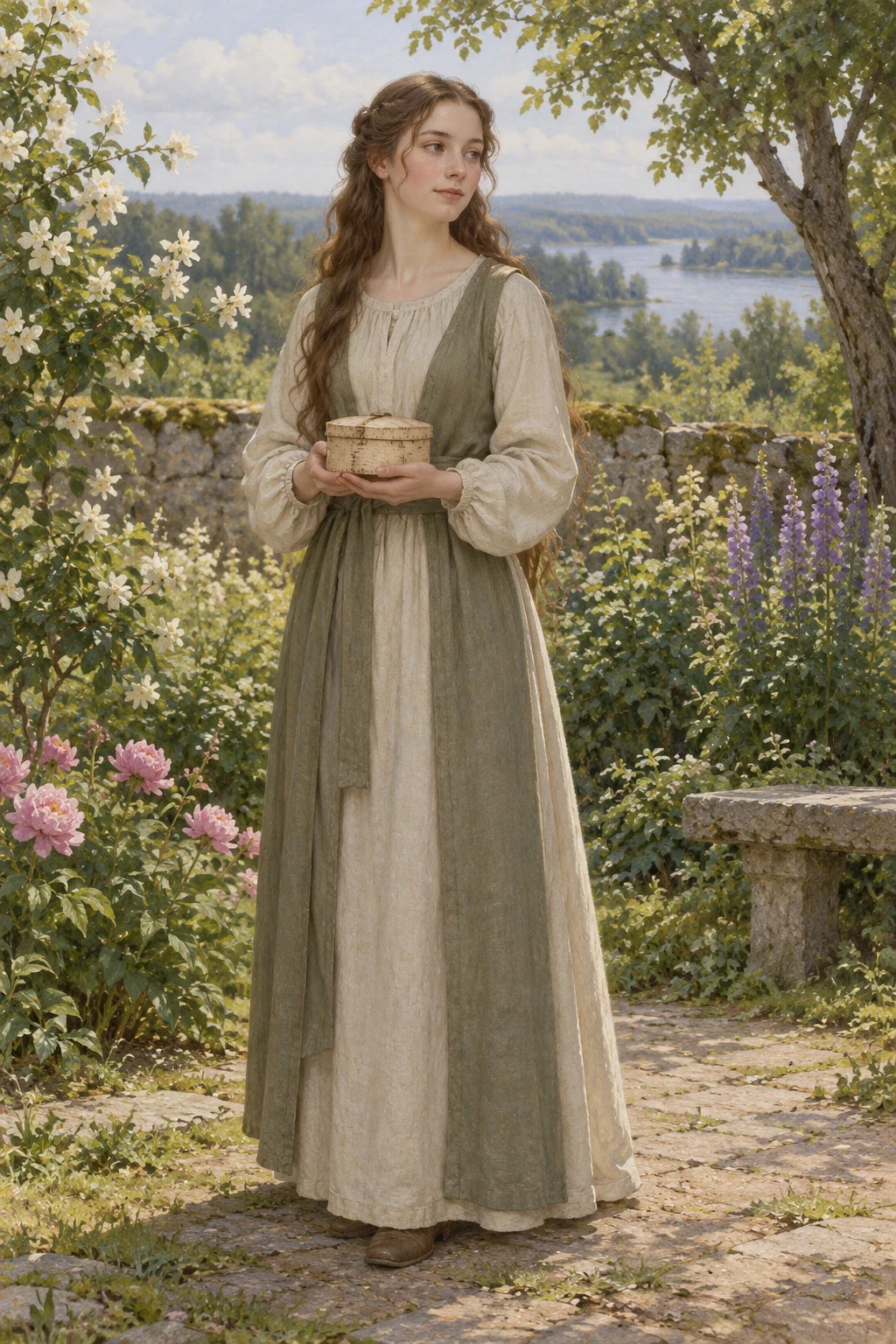
AI-generated narrative interpretation of grown Rebuliina with the little birch-bark casket. Face, hair, clothing, colours and garden are artistic choices, not an authenticated Esthonian person, costume or place.
Egg-born heroine shown as an adult human; no bird anatomy inferred. Historical source mediation preserved.
Overview
A childless queen whose husband is away at war receives a bird’s egg in a little birch-bark box from an old woman on crutches. The visitor tells her to warm it in her bosom for three months. It hatches into a living human-shaped doll half a finger long, which grows in a warm woollen basket without food or drink. Nine months after its birth, the queen bears a son. The royal announcement presents the children as a son and daughter, while their different beginnings remain hidden.
At the christening the visitor appears as a radiant young lady and names the girl Rebuliina; Kirby’s attached note glosses the name as Yolk-Carrie. The boy is named Villem. The godmother tells the queen to keep the box and eggshells beside the children as protection. After the queen’s death, the nurse keeps charge of the girl and gives her the talisman when she is ten. Rebuliina neglects it until a beating by her stepmother drives her to open the box and throw its contents, including a feather, from the window.
The feather summons her godmother, who comforts her and teaches her to obtain necessities from the little box. Later, when war threatens the palace, the godmother says that she can rescue Rebuliina but cannot save everyone. She leads her invisibly through the besieging army and changes her appearance into that of a peasant maiden. The girl finds work at a farm and later with a noble lady, helped by the casket. Villem escapes the defeat, recovers the kingdom with foreign military assistance and succeeds his father, who has died in captivity.
After mourning, the new king invites maidens to a feast. Rebuliina dresses her mistress’s daughters, then receives splendid robes from the casket and regains her former appearance after washing her face. A swallow brings the forgotten box as she reaches the palace. Her godmother appears at midnight and identifies her as the adopted child of the king’s father’s first queen. Villem marries her; the casket disappears, supposedly taken by the godmother. Rebuliina remains a human heroine throughout these changes. Her egg origin does not establish wings, a bird body or an ability to change herself at will.
Origins & earliest records
The tale is explicitly attributed to Kreutzwald in W. F. Kirby’s 1895 compilation. Kirby’s introduction describes Kreutzwald’s 1866 Esthonian collection and F. Löwe’s 1869 German translation, and says that his own selected tales range from full versions to abridgments and notices. This inspected witness is Kirby’s English presentation, not a newly collated Esthonian oral transcript. No individual narrator or exact collection locality is assigned here.
Records & interpretation
Complete selected English narrative, volume I pp.273–279, complete preface and introduction, and attached footnote150 read from the preserved cached publication. No new acquisition.
Selected bibliography
Documented works and useful reading. This is not a list of every appearance.
- 01
The Hero of Esthonia and Other Studies in the Romantic Literature of That Country
Volume I, The Egg-Born Princess, pp.273–279. Note150: Yolk-Carrie.
Family & connections
A source-supported family tree or inspiration record has not yet been compiled for this profile. Related reading below indicates a connection in subject matter, not a proven lineage or creative influence.
References
Sources supporting this profile. Linked pages have their own scope and editorial standards.
- Historical English compiled traditional narrativeKirby1895 — complete Egg-Born Princess, preface, introduction and note150Research access: 2026-10-23
Image credits
AI-generated narrative illustrationAI-generated narrative interpretation of grown Rebuliina with the little birch-bark casket. Face, hair, clothing, colours and garden are artistic choices, not an authenticated Esthonian person, costume or place.
Egg-born heroine shown as an adult human; no bird anatomy inferred. Historical source mediation preserved.