
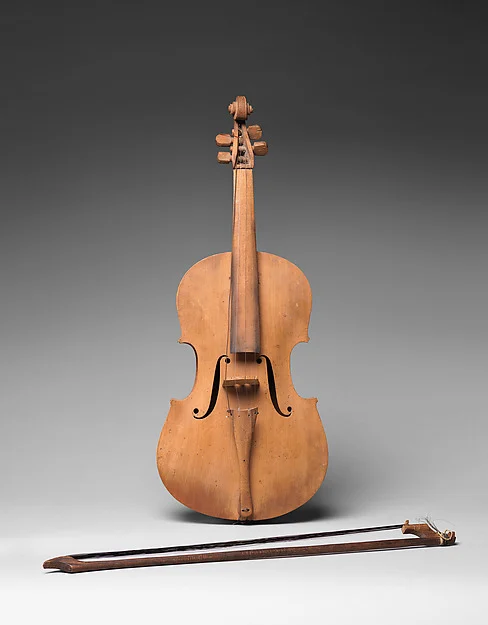
Late-nineteenth-century Rarámuri raberi violin and bow from Chihuahua, Mexico, photographed in the Met’s musical-instrument collection, 89.4.563
This raberi and bow are attributed to Rarámuri makers in Chihuahua and dated to the late nineteenth century. The museum describes the instrument as a local adoption of the European violin form. It is one historical instrument, not a portrait of contemporary Rarámuri people or proof that every community uses the same instruments.
Overview
Rarámuri communities are concentrated in Chihuahua’s Sierra Tarahumara, with smaller populations in neighboring states. The INPI overview records regional self-designations including Rarámuri, Ralámuli and Ralómali. Their language belongs to the Yuto-Nahua family; linguistic classification does not define political citizenship or a biological ancestry. The overview describes rancherías connected through kinship and reciprocal responsibilities, with networks that can cross municipal boundaries. It also identifies local authorities, including the siríame, while acknowledging variation. These arrangements should not be flattened into a single government for all Rarámuri. Agriculture, wage employment and professional work appear together in the account, challenging an image of a community confined to one livelihood or an unchanging past.
Public communication provides another view of contemporary cultural life. INPI dates the foundation of XETAR, La Voz de la Sierra Tarahumara, in Guachochi to 11 November 1982. The station lists eastern and western Rarámuri, Ódhami and Spanish among its broadcast languages. Its written description presents daily information, field production, music and support for community cultural initiatives as parts of its work. It also names Pima and Guarojío audiences. A shared broadcasting institution therefore connects several peoples without making their languages or identities interchangeable. The station’s programme description is evidence of its stated remit; it does not establish that every resident listens or that particular educational outcomes have been measured.
A dated literary announcement makes individual authorship visible. On 26 July 2022, Chihuahua’s cultural authorities named Andrés García Carrillo, a Ralámuli speaker from Basigochi in Guachochi, as the written-category winner of the Erasmo Palma award for Rarámuri olímpico nawánali. The same announcement named a separate O’oba-speaking author in its oral category. Publication and financial support were announced as forthcoming, so the notice alone does not confirm their delivery. It also commemorated Erasmo Palma Fernández’s work across writing, translation, music and cultural promotion. The winning manuscript itself has not been examined here.
The Alberto Beltrán documentation centre separately catalogues Coro rarámuri Rakú Wikaráame, with a 2005 copyright date and CDI production credit. Its description identifies girls living in Chihuahua city and their teachers, and credits Erasmo Palma with numerous song texts. This urban ensemble offers a specific example of cultural expression beyond a rural-only frame. The catalogue supplies attribution and context; neither its recording nor its translated song texts were inspected, and no repertoire is presented as the belief or practice of every Rarámuri person.
History & identity
Regional self-designations and community institutions distinguished from municipal boundaries.
Sources & representation
Complete written overview, station body, dated award notice and recording catalogue read; no audio or literary manuscript inspected.
Selected bibliography
Documented works and useful reading. This is not a list of every appearance.
- 01
Rarámuri olímpico nawánali
Award-winning manuscript announced in2022; publication not verified.
- 02
Coro rarámuri Rakú Wikaráame
Catalogue copyright date; recording unexamined.
Language & cultural connections
These connections link languages or specific cultural works and institutions; they do not establish biological ancestry or ethnic identity.
XETAR - Guachochi radio station
INPI lists eastern and western Raramuri, northern Odhami and Spanish among XETAR's broadcasting languages. This is a regional media association, not a claim of political representation.
References
Sources supporting this profile. Linked pages have their own scope and editorial standards.
- Institutional overviewINPI: Tarahumaras — EtnografíaResearch access: 2026-10-05
- Public broadcasterINPI: XETARResearch access: 2026-10-05
- Dated cultural noticeChihuahua: Erasmo Palma award results,2022Research access: 2026-10-05
- Recording catalogueCID Alberto Beltrán: Rakú WikaráameResearch access: 2026-10-05
Image credits
Contextual cultural object photographLate-nineteenth-century Rarámuri raberi violin and bow from Chihuahua, Mexico, photographed in the Met’s musical-instrument collection, 89.4.563
This raberi and bow are attributed to Rarámuri makers in Chihuahua and dated to the late nineteenth century. The museum describes the instrument as a local adoption of the European violin form. It is one historical instrument, not a portrait of contemporary Rarámuri people or proof that every community uses the same instruments.