
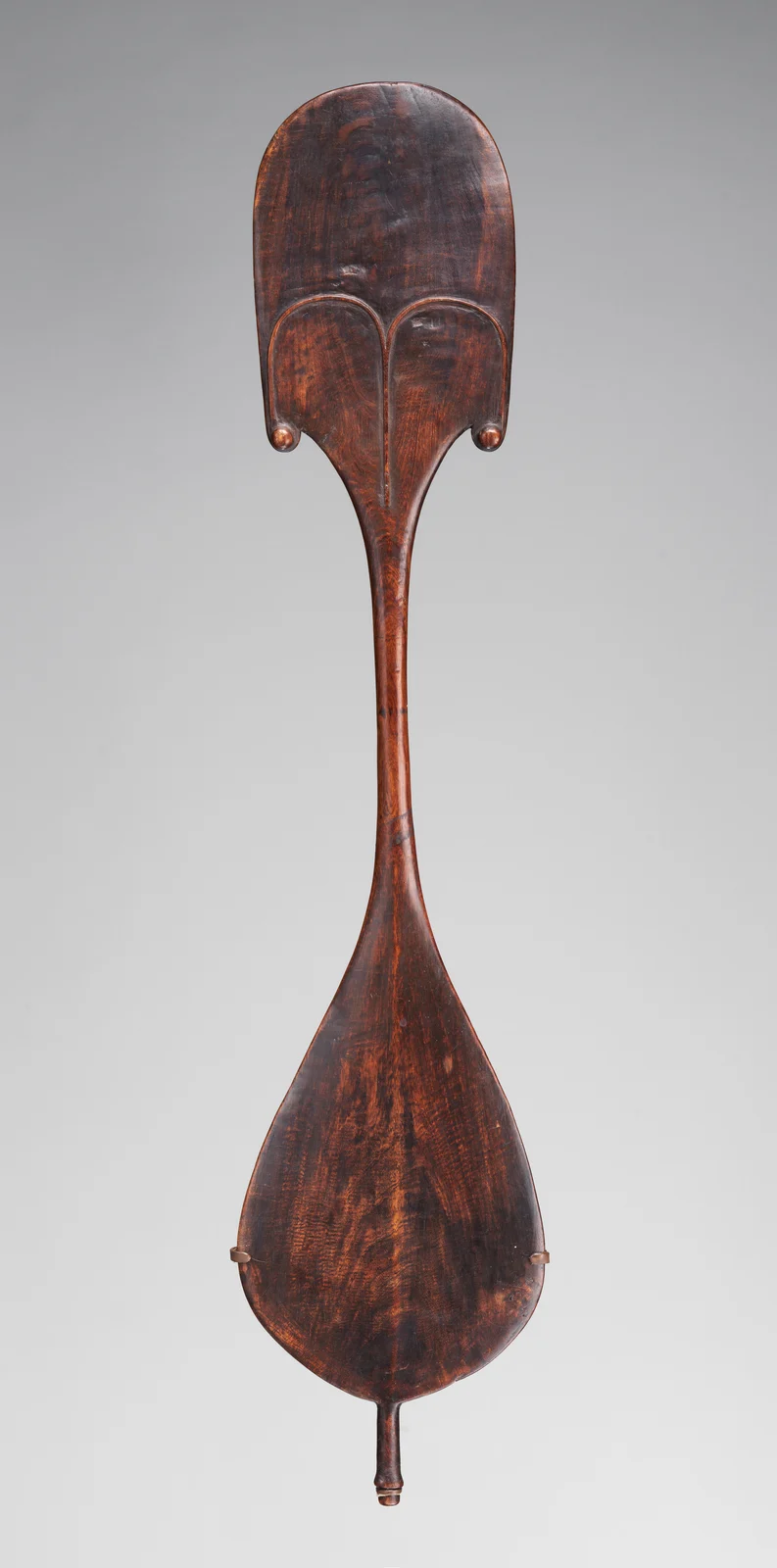
Dark wooden dance paddle with two broad lobes, a carved brow and nose on the upper lobe, and a narrow connecting shaft.
Rapa (dance paddle), early nineteenth century, by an unnamed Rapa Nui artist. This particular wooden work is held by The Met; it does not represent every contemporary Rapa Nui practice.
Overview
Rapa Nui are a living Polynesian people associated with the island of Rapa Nui in the southeastern Pacific, under Chilean administration. The island’s cultural geography belongs to Oceania; its administrative connection to Chile does not make its people a mainland South American culture. Nor does residence on the island establish Indigenous Rapa Nui identity, since its population includes people from different backgrounds. Monumental moai and ceremonial platforms form part of an ancestral cultural landscape, but the people’s present life also includes language education, artistic work, public institutions and debates about responsibility for territory.
Ma’u Henua describes its work as Indigenous management of a living territory. Its institutional history distinguishes the organization’s formation and joint park administration with CONAF in 2016, authorization for transfer in November 2017 and the March 2018 concession for full park administration. These are stages in one management history. The organization identifies conservation, visitor education, employment and reinvestment among its responsibilities. The park is only part of the island: this account does not equate Ma’u Henua’s administrative role with every aspect of Rapa Nui political representation or treat park membership as the definition of the whole people.
Language transmission is sustained through families and organized teaching. A 2018 heritage-service report credits Umanga Hatu Re’o, the Academy of Rapa Nui Language and Culture, with requesting entry of the oral tradition into Chile’s intangible-heritage register. It records school immersion beginning in 1999 and the academy’s creation in 2004, with legal recognition in 2006. Jackeline Rapu Tuki, identified as the academy’s president in that report, emphasized the relationship between language and belonging. The national registration is distinct from a UNESCO inscription; the report described a possible future international nomination, not its completion.
Kai-kai combines figures made with string and accompanying spoken or chanted narration. A museum report documents the first festival named for teacher Isabel Pakarati Tepano, held on 30 May 2026. Eleven participants from different generations presented work with Rapa Nui and Spanish narration. Tehira Ávila Pakarati, Isabel’s daughter, chaired a jury whose responsibilities included language, narrative quality and staging. The event honoured Isabel’s teaching and the families continuing it. This is a documented instance of intergenerational transmission; the report’s linked performance video has not been used here as a directly inspected narrative, and no recitation is reproduced.
Contemporary carving also reworks relationships with older collections. The museum’s 2023 exhibition account describes Alejandro, or Tevo, Pakarati’s fifteen wooden replicas based on documented objects held in museums and galleries elsewhere. It identifies family teaching by his father and uncles as part of his training and distinguishes inherited forms from his own innovations. These are a named artist’s works and an exhibition’s interpretation, rather than evidence that every modern carving is an ancient object or that all Rapa Nui artists share one fixed style.
Community engagement with written sources also appears in the museum’s literary reports. Its July 2017 account names Julio Hotus and José Miguel Ramírez as presenters of Manuscrito de Pua Arahoa, crediting Hotus with its Spanish interpretation. It records the participation of local Rapa Nui people, guides and educators, and the distribution of copies to educational institutions. This documents a particular publication and its reception; the manuscript itself has not been examined here, so its origin narrative is not treated as independently established history. A separate 2021 report describes Konturi Atan and Javier Corvalán’s Escuela y Memoria en Rapa Nui, based on school registers from 1939–1967. It places that publication within a book week involving schools, authors, the library and a community book fair. Neither book has been read for this profile; the reports identify routes into locally engaged historical authorship.
History & identity
Polynesian island histories precede modern Chilean administrative and heritage institutions. No exact initial settlement date or universal archaeological ancestry is assigned here.
Sources & representation
UNESCO selected geography and population context; complete Ma’u Henua body,2018registration report,2026festival Spanish account and2023exhibition text read. No performance-video or Rapa Nui-language translation claim. Complete2017 manuscript-launch and2021 book-week reports read; both books unexamined.
Selected bibliography
Documented works and useful reading. This is not a list of every appearance.
- 01
‘Āriŋa o te Tupuna: Rostros del Pasado
Complete exhibition text read; fifteen contemporary replicas distinguished from the older objects. Individual artwork inspection not claimed.
- 02
Festival de Figuras Narradas Kai-kai “Isabel Pakarati Tepano”
Complete Spanish report published11June2026 about30Mayfestival; linked performance not viewed or quoted.
- 03
Manuscrito de Pua Arahoa
Publication described in museum report; manuscript and book unexamined.
- 04
Escuela y Memoria en Rapa Nui. Los libros de registro escolar 1939–1967
Bibliographic lead from book-week report; book and registers unexamined.
Language & cultural connections
Source-supported language and cultural connections have not yet been compiled for this profile.
References
Sources supporting this profile. Linked pages have their own scope and editorial standards.
- World Heritage referenceUNESCO: Rapa Nui geographical contextResearch access: 2026-10-05
- Indigenous community organizationMa’u Henua: institutional history and missionResearch access: 2026-10-05
- National heritage report with named community representativeHeritage Service:2018 oral-tradition registrationResearch access: 2026-10-05
- Museum event reportRapa Nui Museum:2026 Kai-kai festivalResearch access: 2026-10-05
- Museum exhibition accountRapa Nui Museum: Tevo Pakarati2023 exhibitionResearch access: 2026-10-05
- Museum literary reportMuseo de Rapa Nui: Manuscrito Pua ArahoaResearch access: 2026-10-06
- Museum literary reportMuseo de Rapa Nui: Semana del Libro en Rapa NuiResearch access: 2026-10-06
Image credits
Contextual cultural object photographDark wooden dance paddle with two broad lobes, a carved brow and nose on the upper lobe, and a narrow connecting shaft.
Rapa (dance paddle), early nineteenth century, by an unnamed Rapa Nui artist. This particular wooden work is held by The Met; it does not represent every contemporary Rapa Nui practice.