
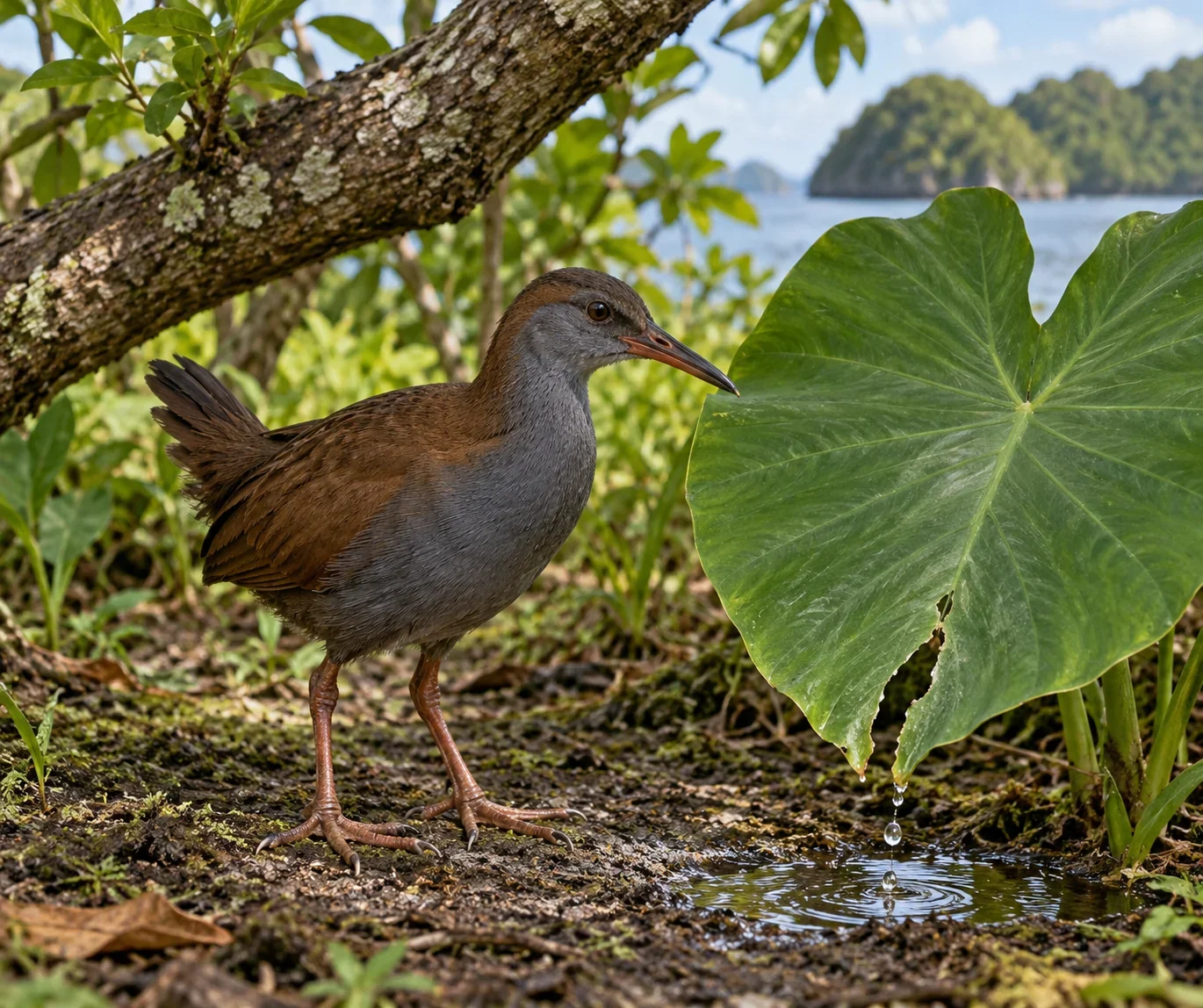
Imagined animal form for The rail in Palau’s water-of-life account.
Unofficial AI interpretation of the selected narrative animal form. Exact species, appearance and scene arrangement imagined. Contextual staging; not the complete narrated water-to-tree action.
Overview
The rail opposes Obagat’s plan for enduring human life in the Pelew account presented by Roland B. Dixon. Obagat proposes putting stones in human breasts so that people can be strong and lasting like stone and need no food. The bird instead advises that people should receive breath, leaving them subject to disease and death. This disagreement establishes the rail as an active agent in the tale’s explanation of mortality, rather than an incidental animal beside its divine characters.
Obagat then sends his son to obtain water of life as another means of securing human immortality. The son brings the liquid in a taro leaf. The rail causes a tree branch to strike and tear the leaf, so that the water spills onto the tree instead of reaching its intended human recipients. The tree receives the lasting life while people remain mortal. The account attributes both the earlier advice and the later obstruction to the same bird; it does not describe an accidental spill unconnected with the dispute.
Dixon places this narrative among several Micronesian explanations of death, but gives it specifically to the Pelew group. His adjacent central-Caroline account assigns a different mortality decision to Olofat, so those agents and mechanisms remain separate. The retained English witness names the bird only as a rail and supplies no exact species or plumage. A whole-bird interpretation with a torn taro leaf and branch therefore depicts the stated animal role while leaving its biological identification and appearance imagined. The 1916 compilation is the witness followed here, with its historical mediation retained.
Origins & earliest records
Roland B. Dixon, Oceanic Mythology, 1916. Selected historical English presentation; print date is not the tradition’s origin.
Records & interpretation
Retained selected original narrative inspected. Distinct agents, variants and transformation episodes are qualified in the prose.
Selected bibliography
Documented works and useful reading. This is not a list of every appearance.
- 01
Oceanic Mythology
Historical comparative compilation; selected collected narrative.
Family & connections
A source-supported family tree or inspiration record has not yet been compiled for this profile. Related reading below indicates a connection in subject matter, not a proven lineage or creative influence.
References
Sources supporting this profile. Linked pages have their own scope and editorial standards.
- Historical comparative compilation of collected narrativesOceanic Mythology
Image credits
Unofficial modern AI interpretationImagined animal form for The rail in Palau’s water-of-life account.
Unofficial AI interpretation of the selected narrative animal form. Exact species, appearance and scene arrangement imagined. Contextual staging; not the complete narrated water-to-tree action.