
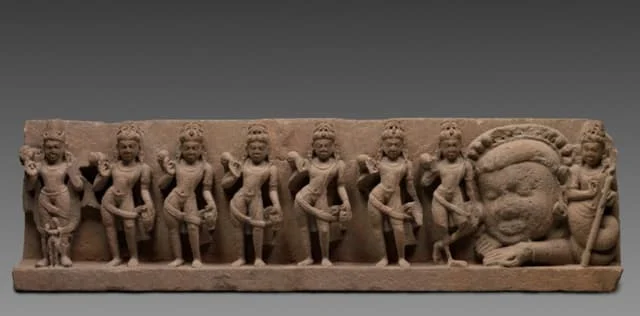
Navagraha relief with Rāhu’s disembodied head second from the right, Central India, 700s
Rāhu is the large disembodied head second from the right in this eighth-century Central Indian planetary relief. The Cleveland museum identifies it with the eclipse-devouring narrative. This sculpture is a separate historical witness from LACMA’s earlier relief and does not supply anatomy for Parker’s Sri Lankan earth-diver story.
Overview
LACMA’s record identifies Rāhu among the nine planetary deities and explains the eclipse narrative through a disembodied head that devours the Sun and Moon. It relates the familiar cupped-hand gesture to the theft of immortality during the Churning of the Ocean. The astronomical identification with the ascending lunar node is a separate interpretive strand recorded by the museum.
The museum’s earthenware relief from Uttar Pradesh, dated about 500–550, has bulging eyes, fangs and grasping hands. Horizontal forehead marks are interpreted as a Shaiva affiliation. The catalogue suggests that it may once have formed part of a protective planetary set above a temple doorway; that installation remains a possibility, rather than a securely reconstructed original setting.
Parker’s North-western Province earth-making tale gives Rāhu a different, constructive role. After the flood, Saman directs Vishnu to this Asura chief, who first orders a lotus seed planted in the waters. Once it sprouts, Rāhu travels down its stalk for seven days, gathers a handful of sand and takes another seven days to return. Vishnu uses that sand to establish the earth. The narrative does not specify Rāhu’s anatomy or tell an eclipse-devouring episode, so the disembodied museum form is not imposed on this earth-diver. Parker’s comparison with other South Asian texts is editorial, not proof that this role is unique worldwide.
Origins & earliest records
South Asian religious iconography
Records & interpretation
Custodial object record and complete separately attributed Sri Lankan creation narrative read.
Selected bibliography
Documented works and useful reading. This is not a list of every appearance.
- 01
Rahu, The Demon of Eclipses
M.83.221.1; object or collection date kept distinct from tradition origin.
- 02
Village Folk-Tales of Ceylon, Volume I
No. 1, The Making of the Great Earth, pp. 47–49; comparison pp. 49–50
Family & connections
A source-supported family tree or inspiration record has not yet been compiled for this profile. Related reading below indicates a connection in subject matter, not a proven lineage or creative influence.
Primary records and illustrations
Rahu, The Demon of Eclipses
Identified museum collection. M.83.221.1
Identified custodial record read; image bytes have not been independently inspected for this row. Complete Parker1910No1pp47–49 and commentary read, source https://www.gutenberg.org/cache/epub/56614/pg56614-images.html#s1 . Added earth-diver role with seven-day outward and return journeys, retaining old custodial anatomy only for its own witness.
References
Sources supporting this profile. Linked pages have their own scope and editorial standards.
- Museum or custodial collection recordRahu, The Demon of Eclipses — custodial recordResearch access: 2026-10-05
- Historical collected oral narrative translationParker, Rāhu as earth-diver in No.1Research access: 2026-10-05
Image credits
Historical sculpture photographNavagraha relief with Rāhu’s disembodied head second from the right, Central India, 700s
Rāhu is the large disembodied head second from the right in this eighth-century Central Indian planetary relief. The Cleveland museum identifies it with the eclipse-devouring narrative. This sculpture is a separate historical witness from LACMA’s earlier relief and does not supply anatomy for Parker’s Sri Lankan earth-diver story.