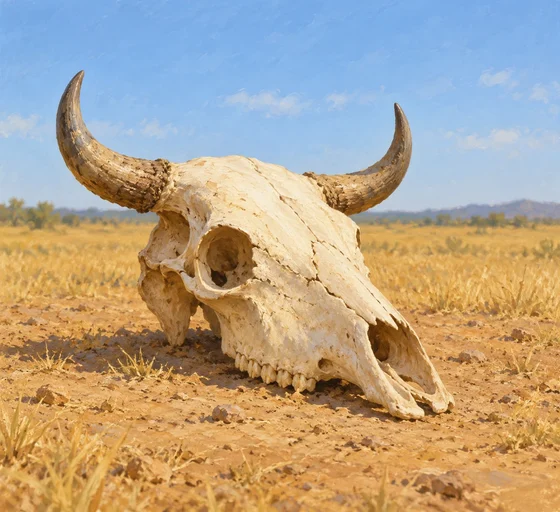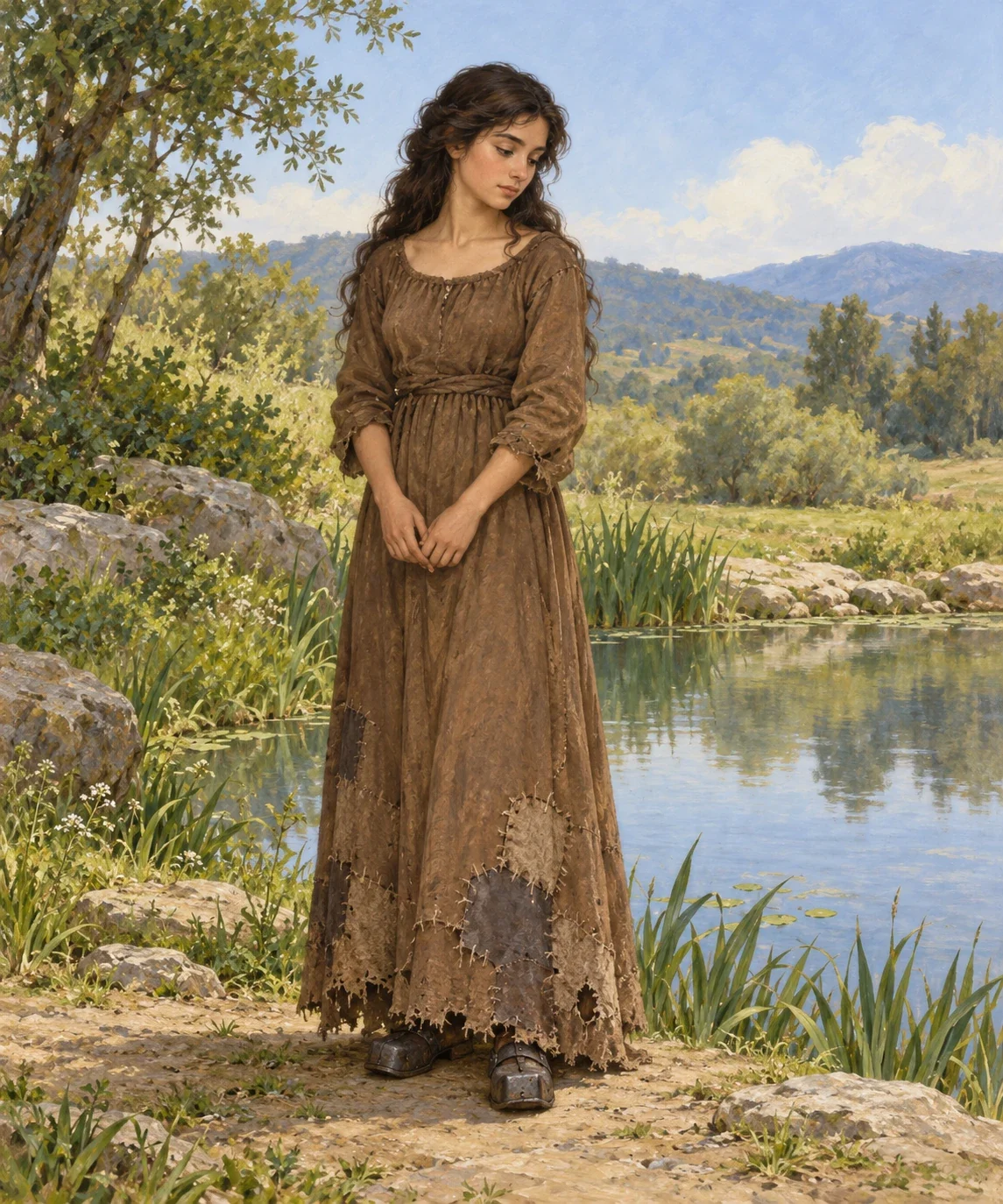
AI narrative interpretation of The Ragged Princess in Alvarado’s Bull-Prince Tale in Andrade’s Folk-Lore from the Dominican Republic (1930).
AI narrative interpretation of the disguised princess in Angélica Alvarado’s tale recorded by Andrade. Adult casting, face, gown construction, colors, iron-shoe design and quiet pond-side pose are invented; this is no authenticated Dominican costume or contributor portrait.
Overview
An old witch transforms a prince into a being described as half bull and half human after he rejects her. The princess, his earlier sweetheart, offers to accompany him when he demands that his father find him a young woman. She consults an older friend who knows some magic and receives a candle with instructions not to let its wax fall on him. A drop reaches his foot; he wakes angrily, predicts that she will wear out iron shoes without reaching the land of gold, and disappears.
The princess has the shoes made and searches for many days. Two old men give her maize and beans that can become golden ducks and geese, but cannot tell her the destination. An old woman described as mother of all birds summons her birds. The last to return, an exhausted eagle, knows the land and agrees to carry the princess there if given enough food for the long flight.
After the eagle leaves her in the land of gold, she exchanges her new clothes for old torn ones and asks for work at the prince’s palace. He does not recognize the beggar-like figure. She takes the name printed first as Señora Graposa and elsewhere as Seña or Señá Garaposa and similar forms. Her work is to take the ducks to a pond. She kills one duck, provoking the prince’s wife, and that night uses the maize to produce golden ducklings. The printed quantities change between the gift, its use and the wife’s demand; they are not harmonized here.
She refuses to sell the golden birds for money, asking instead to spend a night beside the prince. His wife accepts but gives him a sleeping preparation. The princess’s appeal about the iron shoes and the land of gold is not heard. She then offers the golden geese for a second night. This time the prince distrusts the preparation and does not drink it. Hearing her repeated words, he recognizes and embraces her. A renewed union is celebrated the next day; the narrator identifies her as the person who broke his enchantment.
This is Alvarado’s unnamed princess, who adopts a ragged disguise and a name printed with varying spellings. Higüey identifies contributor context; the land of gold is not assigned to a modern country. Her face, adult casting and exact clothing design are interpretive rather than a portrait of Alvarado.
Origins & earliest records
Tale 182, El Prínsipe Toro, attributed to Angélica Alvarado under Higüey, in Andrade’s Folk-Lore from the Dominican Republic (1930), pp.235–236. The contributor entry on p.4 lists Alvarado as twenty-five and able to read and write; it does not establish the fictional princess’s age or appearance.
Records & interpretation
Complete original Spanish tale 182, its footnote and final Alvarado/Higüey attribution read and checked on native PDF254–255. Native p.4/PDF23 confirms the contributor entry. Printed spelling and bird-count variations are preserved rather than silently regularized.
Selected bibliography
Documented works and useful reading. This is not a list of every appearance.
- 01
Folk-Lore from the Dominican Republic
Memoirs of the American Folk-Lore Society, volume XXIII. Material collected in 1927; original Spanish narratives and original English editorial context, rather than a modern translation. Native title reads 1930 despite OCR errors. Contributor names and locality headings are retained as printed; no modern community authorization is asserted.
Family & connections
A source-supported family tree or inspiration record has not yet been compiled for this profile. Related reading below indicates a connection in subject matter, not a proven lineage or creative influence.
References
Sources supporting this profile. Linked pages have their own scope and editorial standards.
- Original collected Spanish narrative with contributor attribution and comparative footnoteAndrade, tale 182, El Prínsipe Toro, pp.235–236; Alvarado entry p.4Research access: 2026-10-21
Image credits
AI-generatedAI narrative interpretation of The Ragged Princess in Alvarado’s Bull-Prince Tale in Andrade’s Folk-Lore from the Dominican Republic (1930).
AI narrative interpretation of the disguised princess in Angélica Alvarado’s tale recorded by Andrade. Adult casting, face, gown construction, colors, iron-shoe design and quiet pond-side pose are invented; this is no authenticated Dominican costume or contributor portrait.