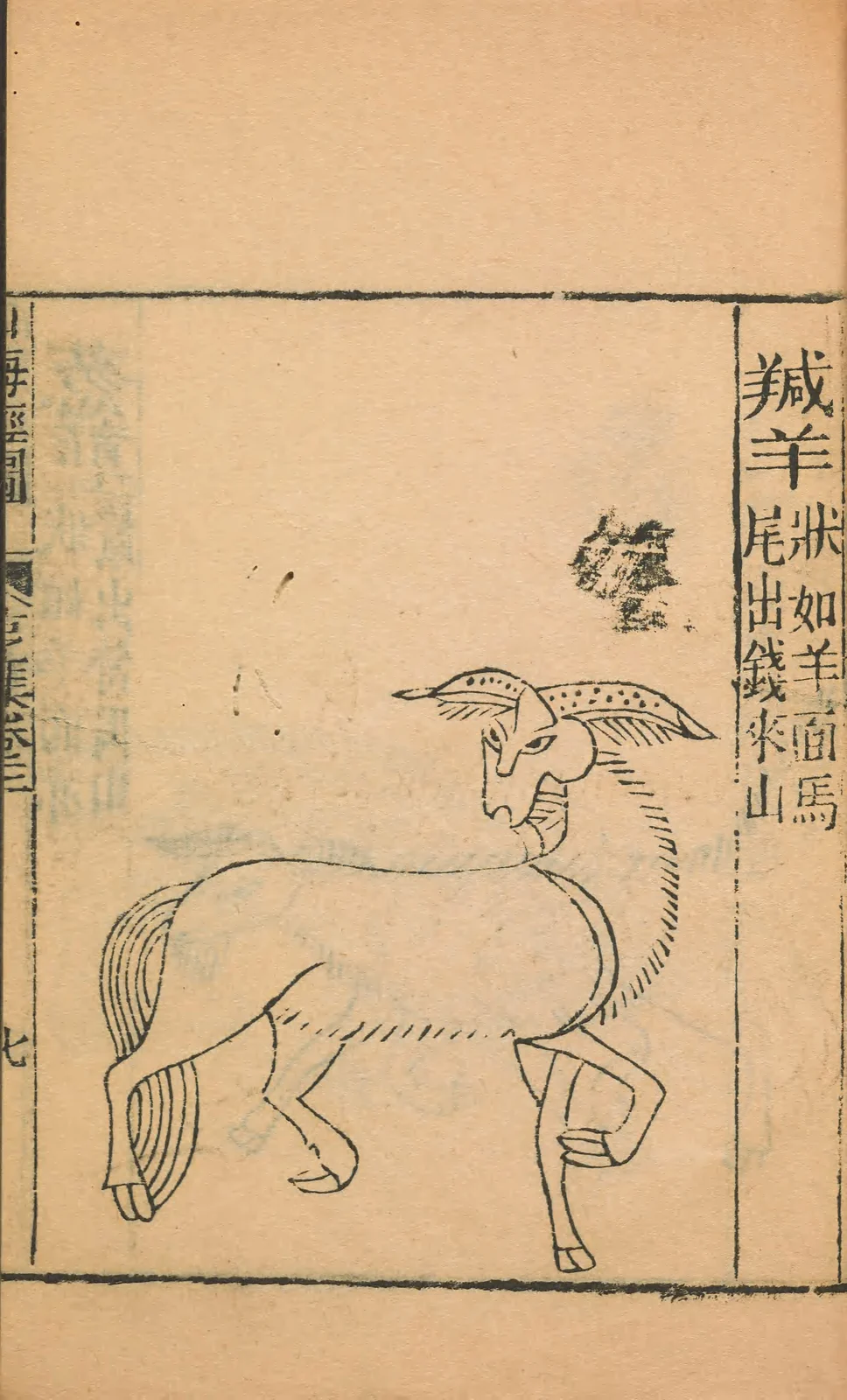
Qianyang of Mount Qianlai, anonymous1667 Shanhaijing illustration
Printed羬羊 caption gives sheep shape, horse tail and錢來山. Humanlike facial treatment is pictorial, not asserted as base passage/caption wording. Physical Smithsonian edition1667; ancient text composition is earlier. Anonymous illustrator; GuoPu commentator and WuZhongheng editor, neither asserted as artist.
Overview
The Mount Qianlai notice describes Qianyang as sheep-like with a horse’s tail. It attributes a treatment for damaged or cracked skin to its fat. That medicinal statement belongs to the historical text; the entry does not turn it into practical health advice.
The inspected 1667 plate depicts a long-haired sheep body and horse-like tail beneath prominent horns, with a face treated in a markedly human-like way. Its caption states the sheep form, horse tail and Mount Qianlai location. The human-like facial treatment is visible in this illustration, but is not claimed as wording of the base mountain notice.
Origins & earliest records
Chinese mountains-and-seas textual geography
Records & interpretation
Actual named primary paragraph and labelled 1667 plate directly inspected.
Selected bibliography
Documented works and useful reading. This is not a list of every appearance.
- 01
Shanhaijing, 西山經
Western first sequence, Mount Qianlai (錢來山); base text distinguished from commentary and later illustration.
- 02
Shan hai jing: er shi san juan, illustrated physical volume 2
Actual IIIF canvas index 16, zero based; printed label inspected.
Family & connections
A source-supported family tree or inspiration record has not yet been compiled for this profile. Related reading below indicates a connection in subject matter, not a proven lineage or creative influence.
Primary records and illustrations
Shan hai jing: er shi san juan (Smithsonian digitized edition)
Physical volume 2; Shan hai jing tu illustration sequence. IIIF canvas index 16 (zero based); labelled creature plate, no printed page number asserted
Actual downloaded page bytes inspected in image-worker contact sheet. The inspected 1667 plate depicts a long-haired sheep body and horse-like tail beneath prominent horns, with a face treated in a markedly human-like way. Its caption states the sheep form, horse tail and Mount Qianlai location. The human-like facial treatment is visible in this illustration, but is not claimed as wording of the base mountain notice.
References
Sources supporting this profile. Linked pages have their own scope and editorial standards.
- Primary Chinese text transcriptionShanhaijing primary mountain noticeResearch access: 2026-10-05
- Primary illustrated editionSmithsonian digitized illustrated volume 2Research access: 2026-10-05
Image credits
Historical illustrationQianyang of Mount Qianlai, anonymous1667 Shanhaijing illustration
Printed羬羊 caption gives sheep shape, horse tail and錢來山. Humanlike facial treatment is pictorial, not asserted as base passage/caption wording. Physical Smithsonian edition1667; ancient text composition is earlier. Anonymous illustrator; GuoPu commentator and WuZhongheng editor, neither asserted as artist.