
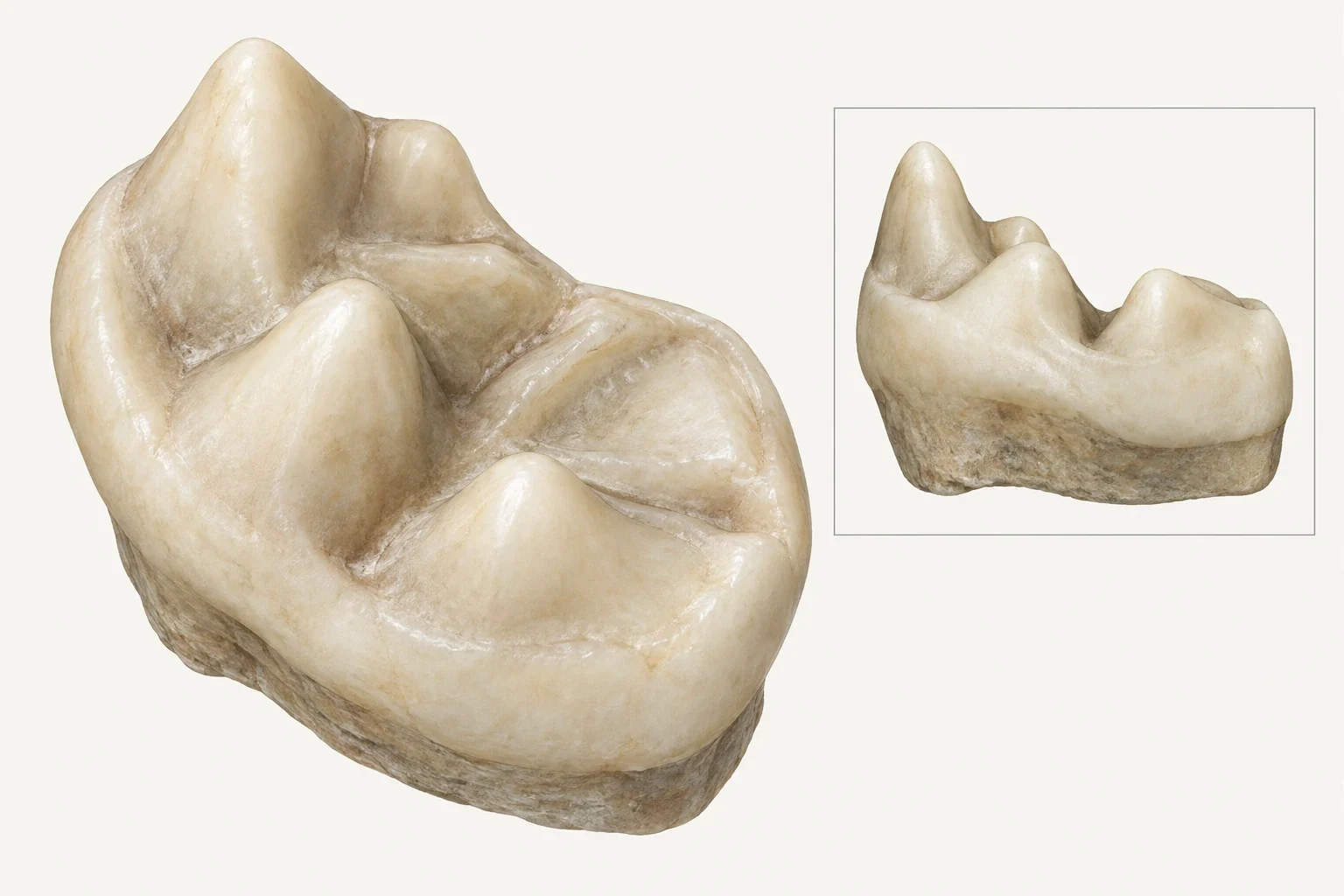
Purgatorius mckeeveri - AI-generated scientific interpretation.
Modern AI-generated conceptual molar illustration informed by the diagnostic dental discussion; not a replica of UCMP150021, a fossil photograph or evidence of unpreserved body anatomy. Fine topography is interpretive.
Overview
Purgatorius mckeeveri is known through dental fossils from northeastern Montana. It co-occurs with P. janisae at the Harley’s Point locality, showing that more than one purgatoriid species occupied this early post-extinction fauna. Its molars differ through relatively taller trigonids, inflated cusps and rounded crests.
Wilson Mantilla and colleagues constrained the locality with stratigraphy and geochronology, favouring an occurrence roughly 105–139 thousand years after the Cretaceous-Paleogene boundary. The coexistence of differentiated species supports an earlier origin for the lineage, but a post-boundary tooth is not itself a preserved Cretaceous primate.
The authors compared tooth shape to infer different contributions of insects and plant foods to the diets of the two species. The dietary interpretation is not stomach-content evidence. University of Washington reporting describes three distinctive teeth used in recognizing the new species and separates those observations from a complete life restoration.
Placement near the primate stem is useful but not equivalent to a modern monkey. Subsequent fossil-calibration review records differing analyses of Purgatorius, including placements outside Placentalia and within crown Euarchonta. A precise ancestral link to humans is not demonstrated. The generated illustration is consequently limited to a conceptual molar, avoiding a species-specific body invented from teeth.
Origins & earliest records
Named in 2021 for the McKeever family associated with the discovery area and support of fieldwork. The occurrence is early Paleocene; the naming date does not measure lineage origin.
Evidence & interpretation
Diagnostic teeth, locality correlations and geological dating support the selected occurrence. Dental shape supplies a comparative dietary proxy. Deeper phylogenetic placement and inferred pre-boundary origin remain analyses rather than direct observations.
Selected bibliography
Documented works and useful reading. This is not a list of every appearance.
- 01
Earliest Palaeocene purgatoriids and the initial radiation of stem primates
Selected bibliography; bounded source account, not exhaustive coverage.
- 02
Scientists describe earliest primate fossils
Selected bibliography; bounded source account, not exhaustive coverage.
- 03
Primate Fossil Calibrations
Selected bibliography; bounded source account, not exhaustive coverage.
Family, evolution & connections
Taxonomic classification
A hierarchy of classified groups, not a chain of direct ancestors.
Source note: Purgatoriid identity is retained; a formal crown-primate order or unqualified placental placement is omitted because cited analyses differ.
- kingdomAnimalia
- phylumChordata
- classMammalia
- familyPurgatoriidae
- genusPurgatorius
- speciesPurgatorius mckeeveri
References
Sources supporting this profile. Linked pages have their own scope and editorial standards.
- InstitutionalEarliest Palaeocene purgatoriids and the initial radiation of stem primatesResearch access: 2026-10-10
- InstitutionalScientists describe earliest primate fossilsResearch access: 2026-10-10
- InstitutionalPrimate Fossil CalibrationsResearch access: 2026-10-10
Image credits
AI-generated scientific interpretationPurgatorius mckeeveri - AI-generated scientific interpretation.
Modern AI-generated conceptual molar illustration informed by the diagnostic dental discussion; not a replica of UCMP150021, a fossil photograph or evidence of unpreserved body anatomy. Fine topography is interpretive.