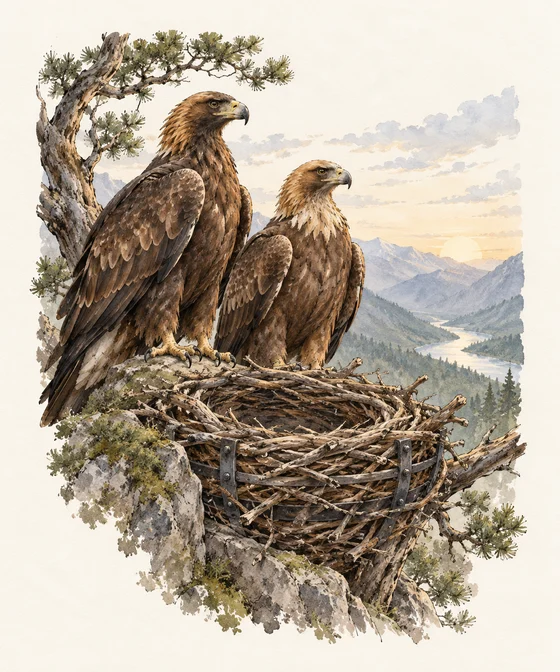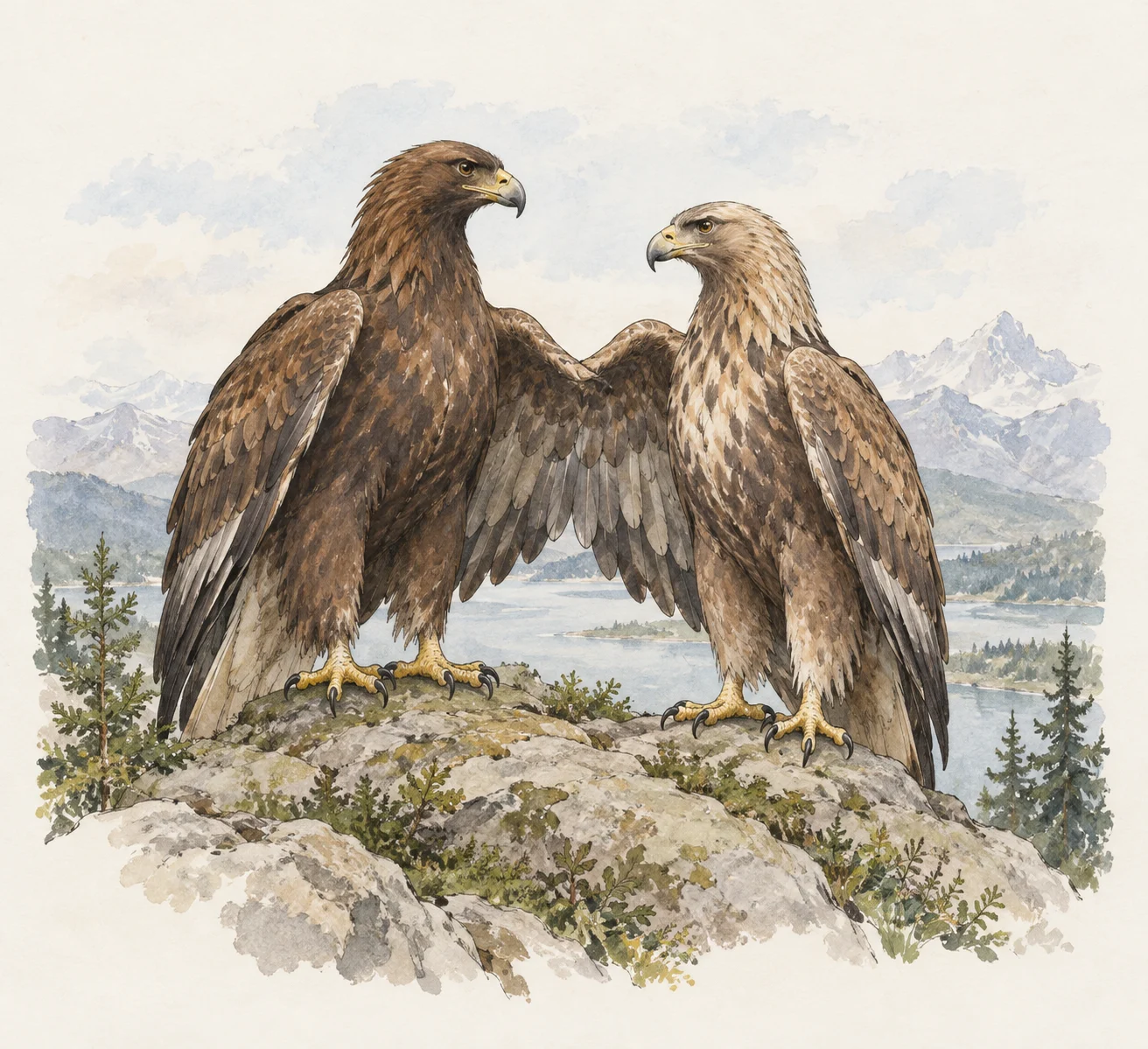
Two imagined eagles stand with their inner wings touching, representing the young birds who carry their rescuer in Punchkin.
Original AI interpretation of The grateful eagles in Punchkin. Undescribed appearance and setting are imagined; not historical artwork or ethnographic reconstruction. Full frame; delivery compression may be applied.
Overview
On his journey to secure Punchkin’s hidden parrot, Balna’s son rests beneath a tree containing an eagle nest. He wakes to see a large serpent approaching its two young birds and kills the serpent with his sword. The adult eagles return from hunting. The mother says that the serpent has destroyed their young for many years, promises the boy help whenever he needs it, and offers the two surviving eaglets as his servants. The account supplies an explicit parent-and-young family, without giving any of the four birds an individual name.
The two eaglets cross their wings to support the prince and carry him to the distant ring of palms. Many thousands of sleeping genii make an approach on foot impossible. The birds descend over them, allowing the boy to overturn the six water-pots and take the caged green parrot. They lift him away as the guards wake and howl, then return him to the family’s tree. His escape depends on the birds’ flight rather than a battle against the genii.
The prince gives the young birds back to their parents, thanking them and promising to ask again if he needs help. He continues to Punchkin’s palace on foot; the eagles are not present for the final confrontation. This grateful family is distinct from the eagles who abduct and foster Surya Bai in another tale from the same collection. It is also distinct from Panch-Phul Ranee’s living wooden parrots, despite the shared image of two birds joining their wings into a seat.
Origins & earliest records
Told by Anna Liberata de Souza and collected in English by Mary Frere; introduction and notes by Bartle Frere.
Records & interpretation
Complete I27–43, footnotes25–36 and short related endnote read; full introductory provenance checked.
3D model
An original procedural model made for the Mythscribe World Builder. It is an interpretation based on this entry, not a historical source or a depiction from the records cited here.

Procedural folklore creature kit · 38,301 triangles · 2.7 MB
Opens mythscribe.cloud in a new tab. Sign-in is required.
Selected bibliography
Documented works and useful reading. This is not a list of every appearance.
- 01
Old Deccan Days; or, Hindoo Fairy Legends Current in Southern India
I, Punchkin, pp.27–43; footnotes25–36 and related endnote338; Philadelphia: J.B. Lippincott & Co. Full narrative and notes read.
Family & connections
A source-supported family tree or inspiration record has not yet been compiled for this profile. Related reading below indicates a connection in subject matter, not a proven lineage or creative influence.
Primary records and illustrations
Old Deccan Days; or, Hindoo Fairy Legends Current in Southern India
Philadelphia: J.B. Lippincott & Co.,1870. I, Punchkin, pp.27–43; footnotes25–36 and related endnote338
Complete frere1870-1.txt and frere1870-notes1.txt; family persecution, abduction, son’s search, eagle rescue, parrot seizure and final restorations/reunion read. Black-dog reversal not separately narrated; eagle parents receive their young back before final confrontation.
References
Sources supporting this profile. Linked pages have their own scope and editorial standards.
- Historical collected oral narrative in EnglishOld Deccan Days — I, Punchkin, pp.27–43; footnotes25–36 and related endnote338Research access: 2026-10-06
Image credits
Modern literary interpretationTwo imagined eagles stand with their inner wings touching, representing the young birds who carry their rescuer in Punchkin.
Original AI interpretation of The grateful eagles in Punchkin. Undescribed appearance and setting are imagined; not historical artwork or ethnographic reconstruction. Full frame; delivery compression may be applied.