
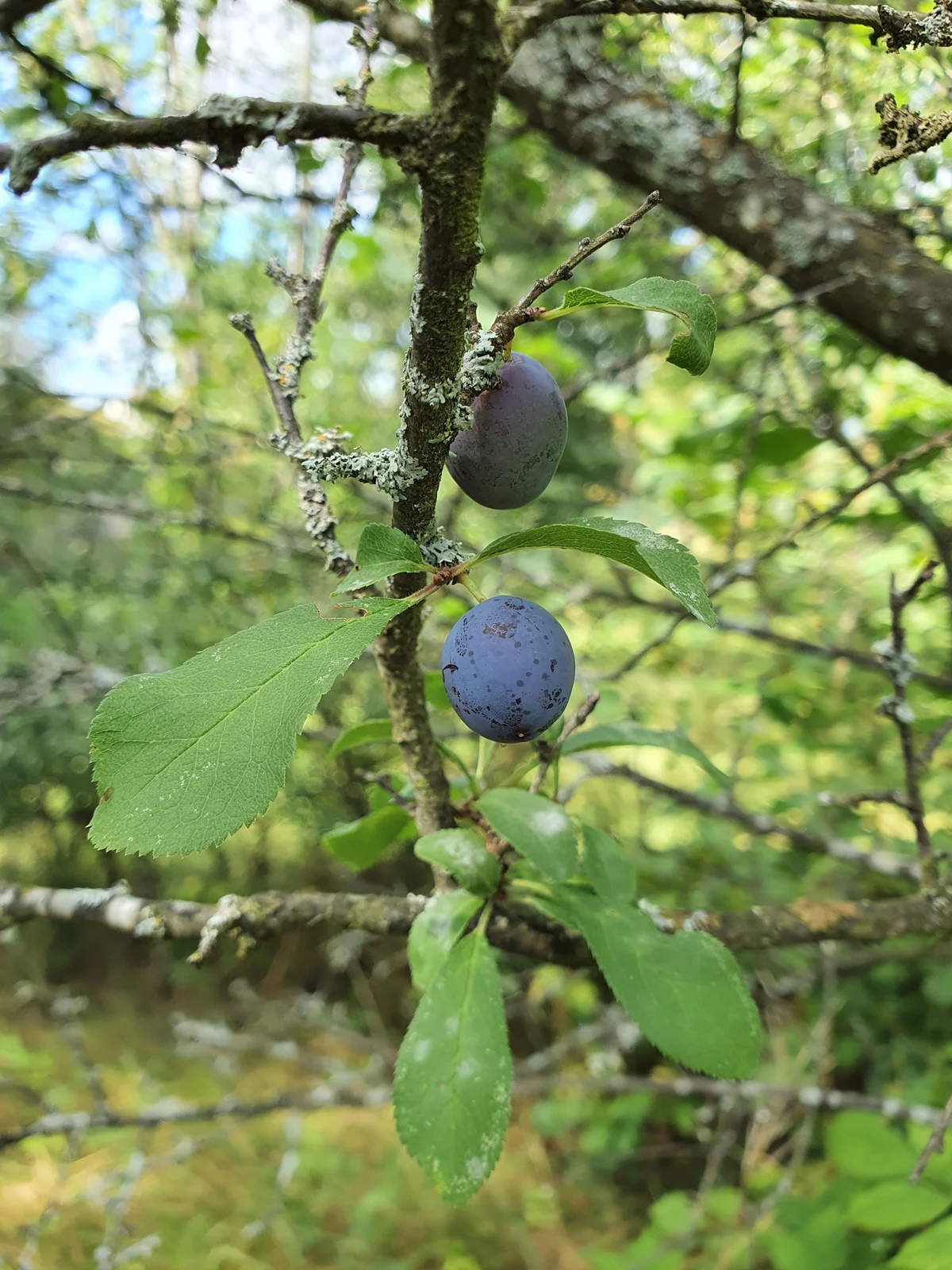
Blackthorn branch bearing green leaves and blue-purple sloes.
Identified as Prunus spinosa in the photographer’s record; no locality or cultivar is specified.
Overview
Kew accepts Prunus spinosa in Rosaceae, native from Europe to Central Asia and Iran and in northwestern Africa, including Greece. Its 1753 publication is naming history only.
Blackthorn is a deciduous, densely branched shrub with suckers and thorn-tipped twigs. Alternate leaves are finely toothed. White flowers precede leaves; waxy purple fruit ripens blue-black around a stone. Botanically, it is a drupe.
It occupies scrub, forest edges, clearings and other woodland-grassland transitions. Early flowering provides resources for pollinators, and the thorny thickets offer shelter and nest sites. Hybridisation and cultivated relatives complicate its ancestry, and no parentage of domestic plums is asserted here.
Origins & earliest records
Formally published in Species Plantarum (1753), p. 475, per Kew.
Evidence & interpretation
Kew naming and distribution; European Atlas morphology and ecology.
Selected bibliography
Documented works and useful reading. This is not a list of every appearance.
- 01
Species Plantarum
Selected bibliography; original place of publication (p. 475) as recorded by Kew.
- 02
Prunus spinosa in Europe: distribution, habitat, usage and threats
Selected bibliography; European Atlas of Forest Tree Species account.
Family, evolution & connections
Taxonomic classification
A hierarchy of classified groups, not a chain of direct ancestors.
Source note: Family placement follows Kew.
- FamilyRosaceae
- SpeciesPrunus spinosa
References
Sources supporting this profile. Linked pages have their own scope and editorial standards.
- Taxonomic databasePrunus spinosa L. | Plants of the World OnlineResearch access: 2026-10-07
- Reference atlasPrunus spinosa in Europe: distribution, habitat, usage and threatsResearch access: 2026-10-07
Image credits
Attributed specimen/habitat photographBlackthorn branch bearing green leaves and blue-purple sloes.
Identified as Prunus spinosa in the photographer’s record; no locality or cultivar is specified.