
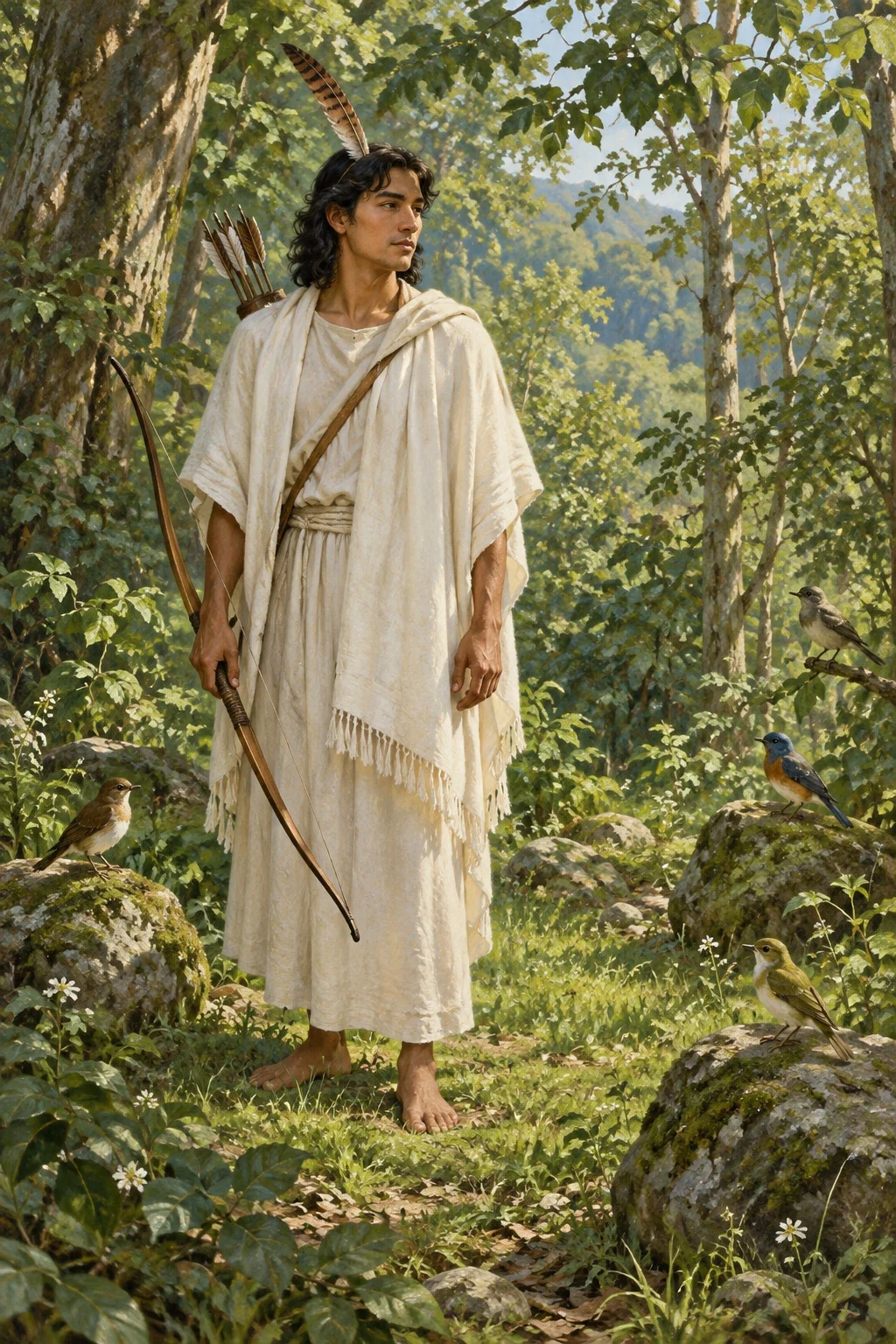
AI narrative interpretation of Prince Nazul during his later youthful wandering years.
Face, underlying garment, feather construction, bird species and woodland arrangement are imagined after the cited authored literary narrative.
Overview
Nazul appears in the third book of Mediz Bolio’s La tierra del faisán y del venado. The author’s explanation, quoted in Alfonso Reyes’s prologue, calls the work a stylization of Maya spirit and experience, thought in Maya and written in Spanish. Nazul is therefore presented here as the figure in that particular authored narrative, rather than as a representative of every Maya tradition.
His mother arrives from the eastern sea in a golden canoe and is received by priests and rulers. The account leaves both her origin and name unresolved, and offers alternative explanations for her disappearance after nursing her child: return by sea or death at the shore. It does not provide grounds for supplying her with a hidden name or a definite divine identity.
Raised in a temple, Nazul begins wandering near the threshold of manhood. He carries a white mantle, a strong bow and arrows, and a tall pheasant feather above his forehead. The author gives him water-colored eyes, bare feet unharmed by stones or thorns, and a copper-colored complexion described in radiant poetic language. These are features of the literary portrait, not ethnographic measurements or a historical costume record.
Birds gather to listen when Nazul sings, and he adorns his forehead with fresh flowers. Although armed, he does not kill animals. His explanation of hunting and warfare refers to an enemy and quarry that his hearers do not understand. He also lets a rattlesnake cross his path unharmed. The text leaves the precise meaning of his figurative enemy unstated.
His visit interrupts warfare in the neighboring land of the coch-huahes, and the narrative follows his instruction there with an abundant maize harvest. At Chichén, Itzel, a young woman dedicated to the sacred fire, is overwhelmed at seeing him and later dies. Nazul’s words at her flower-covered burial place interpret her death through the image of dew dissolving in sunlight. This is his statement within the story, not proof that he deliberately kills her.
Nazul founds Zac-quí beside clear water in a broad underground grotto, gathering companions whom the narrator calls good and prudent. He lives among ceiba trees, teaches during the day and speaks with the stars at night. People see him shoot arrows into dark storm clouds; the arrows open them and rain falls onto dry fields.
At Ek-Balam he tries to reform a city that the narrator condemns for violence and sorcery. Its people answer him with hostility. After he leaves and weeps on a hill, the sky darkens and a fiery star falls, followed by a flood that leaves a lagoon. The story gives this destruction a moral and supernatural explanation; the profile does not adopt it as archaeology or characterize the historical inhabitants of Ek-Balam through it.
Nazul and Sazilakab are associated by the narrator’s knowledgeable voices with the Sun and Moon. One evening both enter the forest separately while sunset and moonrise unfold; neither returns. The conclusion relates Zac-quí’s later descendants to children of Sun and Moon while leaving further matters to those who know silence. This profile follows Mediz Bolio’s 1922 literary Nazul narrative. It does not identify his unnamed mother, equate him with a separately named deity, or treat the book’s imagined ancient events as verified Maya history.
Origins & earliest records
Book III of Antonio Mediz Bolio’s La tierra del faisán y del venado (Buenos Aires: Contreras y Sanz, 1922), narrative printed pp. 89–108.
Records & interpretation
The complete Spanish narrative supports Nazul’s appearance, journeys, teachings, city foundation, rain arrows and disappearance. The prologue identifies the book as an authored literary stylization, not a transcript of a named oral narrator.
Selected bibliography
Documented works and useful reading. This is not a list of every appearance.
- 01
La tierra del faisán y del venado, Book III
The complete Spanish narrative supports Nazul’s appearance, journeys, teachings, city foundation, rain arrows and disappearance. The prologue identifies the book as an authored literary stylization, not a transcript of a named oral narrator.
Family & connections
A source-supported family tree or inspiration record has not yet been compiled for this profile. Related reading below indicates a connection in subject matter, not a proven lineage or creative influence.
References
Sources supporting this profile. Linked pages have their own scope and editorial standards.
- Primary authored literary folklore narrative, Spanish originalMediz Bolio, La tierra del faisán y del venado, Buenos Aires first edition (1922), complete selected bookResearch access: 2026-10-21
Image credits
AI-generatedAI narrative interpretation of Prince Nazul during his later youthful wandering years.
Face, underlying garment, feather construction, bird species and woodland arrangement are imagined after the cited authored literary narrative.