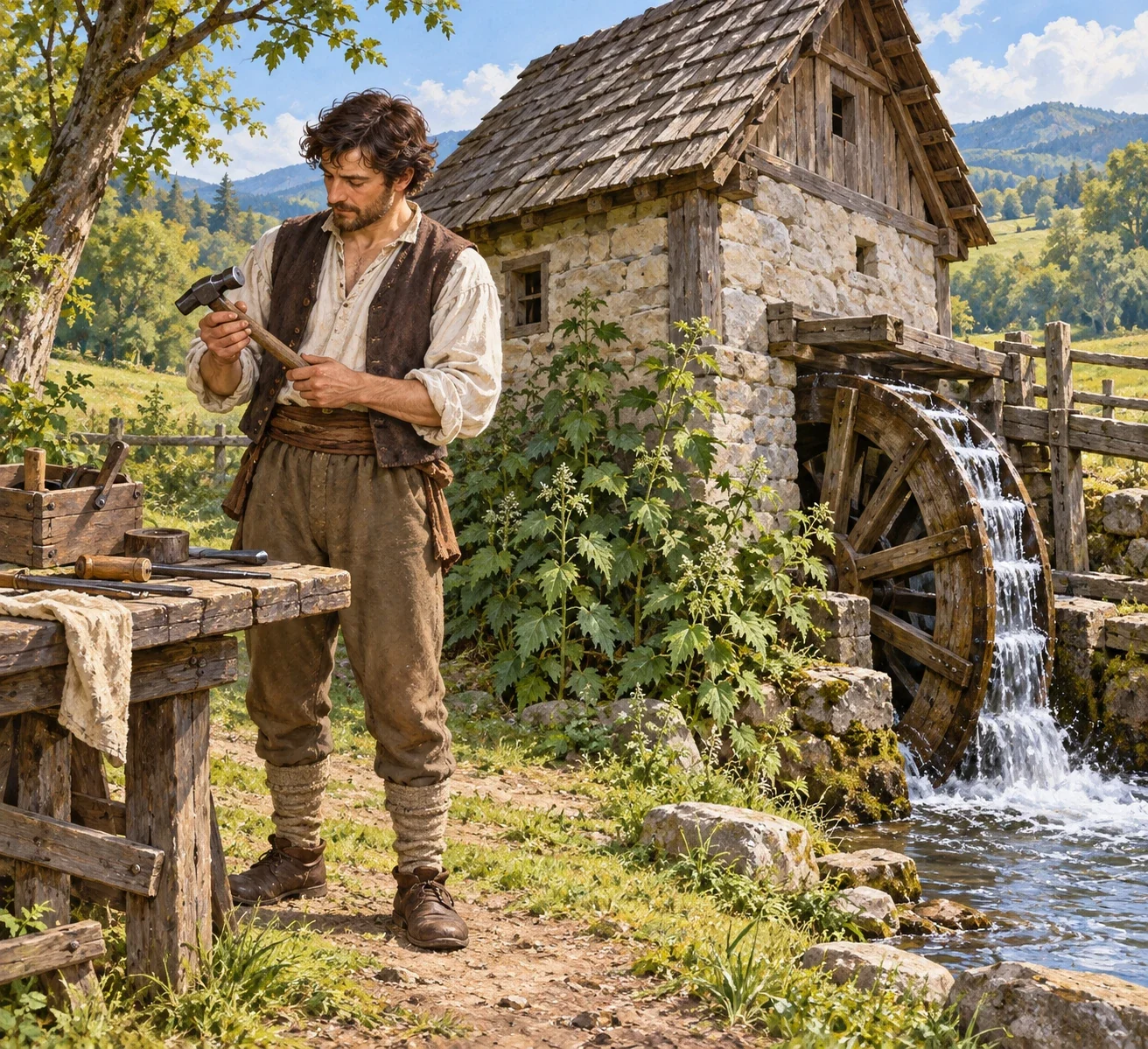
AI-generated interpretation of the miller later called Prince Csihan beside his repaired nettle-covered mill, before the fox’s royal staging. Appearance, clothes, tools, mill construction and landscape are editorial choices, not a verified historic site or authenticated community costume.
AI-generated interpretation of the miller later called Prince Csihan beside his repaired nettle-covered mill, before the fox’s royal staging. Appearance, clothes, tools, mill construction and landscape are editorial choices, not a verified historic site or authenticated community costume.
Overview
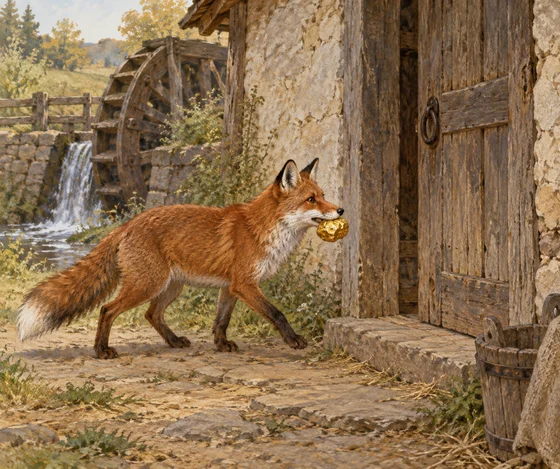
Csihan begins as a miller whose dissatisfaction sends him away from his former occupation. He carries his tools in search of another mill and eventually repairs a ruined, nettle-covered building beside the Gagy below Martonos. The work leaves his clothes worn out, and no customers come. When a fox pursued by royal hunters asks for shelter, the miller hides it under a torn sack and drives the dogs away. That act creates the obligation on which his later advancement depends; the narrative has not introduced him as a prince by birth.
The fox repays him with copper, gold and a diamond, then approaches King Yellow Hammer as a messenger seeking a wife for Prince Csihan. The miller accepts the new title and participates in the performance. The fox presents the gold as a small part of his supposed wealth. On the journey to the royal court it has him destroy his old clothes and bathe in the river, then tells the king that a richly equipped party has suffered a water accident. The king provides princely clothing and welcomes him as a prospective son-in-law. The wedding follows a manufactured appearance of wealth rather than proof of an inherited realm.
After the marriage, the princess wishes to visit her husband’s lands, exposing the gap between his title and his circumstances. The fox again supplies the answer. It persuades herdsmen to identify another owner’s cattle as Csihan’s and frightens the Vasfogu Bába with a false warning that the French are approaching. The fox leads her to a lake, eventually pushes her in and drowns her. Csihan and his wife occupy her castle and gain her property. His new estate depends on the fox’s deception and killing.
The final episode tests whether Csihan will continue to acknowledge the creature responsible for his rise. The fox pretends to be gravely ill; disturbed by its groans, Csihan orders it thrown onto a dungheap. When he passes, it threatens to expose him as the miller he was. Terrified, he promises it the same food he eats, a permanent place of honour and recognition as his greatest benefactor. He orders it back to the castle and never neglects it again. The restored friendship therefore follows a threat and a renewed obligation, not an uncomplicated demonstration that wealth has made him generous.
Csihan is the human recipient and accomplice of a clever animal’s assistance. His initial kindness and later ingratitude belong to the same character, while the closing promise gives the selected account its lasting settlement. He does not himself acquire fox anatomy, a magical disguise or a demonstrated hereditary royal identity. Similarity to Puss in Boots in the editors’ comparisons does not make Csihan another name for every protagonist in that tale family.
Origins & earliest records
W. Henry Jones and Lewis L. Kropf published the selected English translation in The Folk-Tales of the Magyars (London, published for the Folk-Lore Society by Elliot Stock, 1889). The notes explicitly credit John Kriza’s Wild Roses. The preface describes an effort to translate literally despite linguistic and dialect difficulties, and the introduction names Kriza’s collection among the principal sources. These are editorial statements, not independent collation of the original Hungarian text. No individual oral teller is credited for the selected account. A Magyar/Székely collection association is supported; a precise collection village or exclusive present-day national border is not established. This account is tale I, pp.1–6; its note credits Kriza xvii.
Records & interpretation
The complete selected tale, including its ending, and its complete comparative notes were read from the preserved English witness. The complete original preface and title, the selected collection-and-translation discussion and its relevant footnotes were also read. The whole long introduction and every other narrative in the book were not read for this packet. Comparative notes are kept separate from the selected hero’s actions; their cited publications were not independently consulted. Historical racial, nationalist and origin theories are attributed editorial framing rather than accepted contemporary facts.
Selected bibliography
Documented works and useful reading. This is not a list of every appearance.
- 01
The Folk-Tales of the Magyars
Tale I, pp.1–6, complete associated comparative notes; Kriza xvii attribution. Original title/preface and selected collection/translation discussion.
Family & connections
A source-supported family tree or inspiration record has not yet been compiled for this profile. Related reading below indicates a connection in subject matter, not a proven lineage or creative influence.
References
Sources supporting this profile. Linked pages have their own scope and editorial standards.
- Historical English translation of collected narrativeJones and Kropf 1889, complete tale I and associated notesResearch access: 2026-10-23
Image credits
AI-generated illustrationAI-generated interpretation of the miller later called Prince Csihan beside his repaired nettle-covered mill, before the fox’s royal staging. Appearance, clothes, tools, mill construction and landscape are editorial choices, not a verified historic site or authenticated community costume.
AI-generated interpretation of the miller later called Prince Csihan beside his repaired nettle-covered mill, before the fox’s royal staging. Appearance, clothes, tools, mill construction and landscape are editorial choices, not a verified historic site or authenticated community costume.