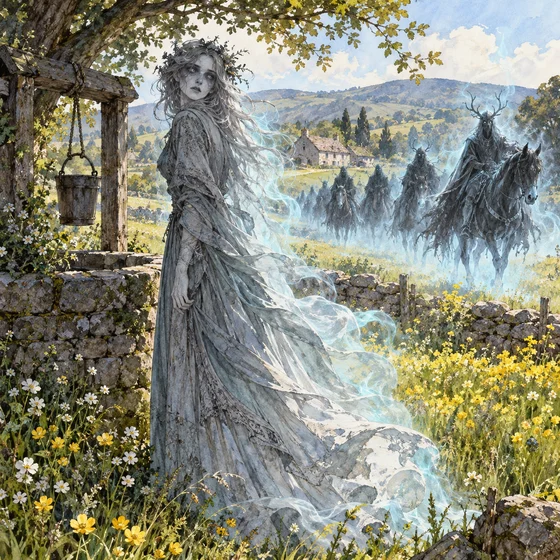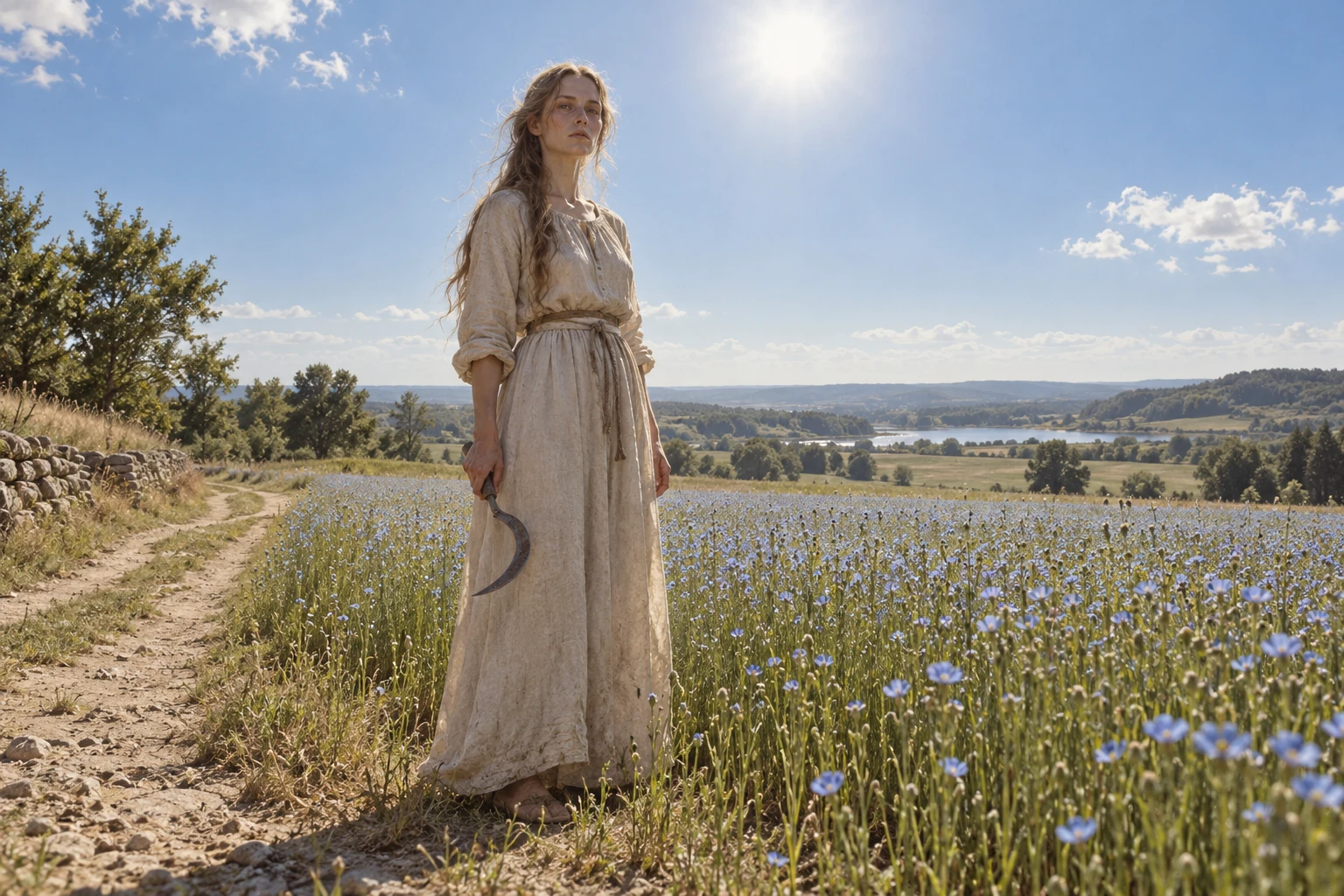
AI-generated contextual interpretation of the Lusatian midday field spirit reported by Ralston in 1872. Her face, clothing, posture, flowers and landscape are imagined; the account specifies no appearance or costume. This is not a historical photograph, traditional community image or Witcher character design.
The historical report supplies the midday field setting and sickle, but not a physical description. No violent incident is shown.
Overview
Ralston’s 1872 discussion describes a midday field spirit under the name Poludnitsa. Among the Lusatians, he says, she is called Prezpolnica or Pripolnica. She appears in the fields exactly at midday, carrying a sickle, and addresses women who remain there instead of returning home for their midday rest. The encounter is tied to agricultural work and the interruption of that work at noon.
Her questions concern the cultivation and spinning of flax. An unsatisfactory answer has a deadly consequence: Ralston says that she cuts off the answerer’s head or divides her neck. This is a short account of a recurring encounter pattern, not the full story of a named individual. It supplies no dialogue, successful reply, rescue episode or physical description of the spirit.
Ralston then compares her with the dæmon Meridianus and mentions a Russian expression associated with drawing one’s last breath. These are his comparative and linguistic comments, not proof of one origin or a universal Slavic belief. His footnote cites Grimm’s Deutsche Mythologie, page 1114. This profile represents Ralston’s secondhand Lusatian attribution; the earlier German account has not been independently collated.
Origins & earliest records
W. R. S. Ralston, The Songs of the Russian People, as Illustrative of Slavonic Mythology and Russian Social Life. London: Ellis & Green, 1872, pp.147–148, note 9 citing Grimm, D. M. 1114.
Records & interpretation
Complete local Poludnitsa paragraph, its comparative continuation and applicable note 9 read in the retained text and original rendered pages. It ends before the separate Archangel Midnight Sisters report. No independent Grimm reading, field interview, full-book reading or Erben text is claimed.
Selected bibliography
Documented works and useful reading. This is not a list of every appearance.
- 01
The Songs of the Russian People, as Illustrative of Slavonic Mythology and Russian Social Life
Complete Poludnitsa/Lusatian unit pp.147–148, with note 9. Adjacent Vila, Midnight Sisters and Water King discussions remain separate.
Family, evolution & connections
Noonwraith (The Witcher)
Ralston’s Lusatian report describes a spirit appearing in the fields at midday with a sickle, questioning women about flax work and punishing an unsatisfactory answer. This is a particular historical midday field-spirit context. The comparison does not equate regional traditions, provide the game creature’s history or establish that its designers consulted Ralston or Grimm.
References
Sources supporting this profile. Linked pages have their own scope and editorial standards.
- Historical English secondhand folklore discussionRalston, The Songs of the Russian People (1872), Poludnitsa/Lusatian account, pp.147–148 and note 9Research access: 2026-10-25
Image credits
Modern contextual folklore interpretationAI-generated contextual interpretation of the Lusatian midday field spirit reported by Ralston in 1872. Her face, clothing, posture, flowers and landscape are imagined; the account specifies no appearance or costume. This is not a historical photograph, traditional community image or Witcher character design.
The historical report supplies the midday field setting and sickle, but not a physical description. No violent incident is shown.