
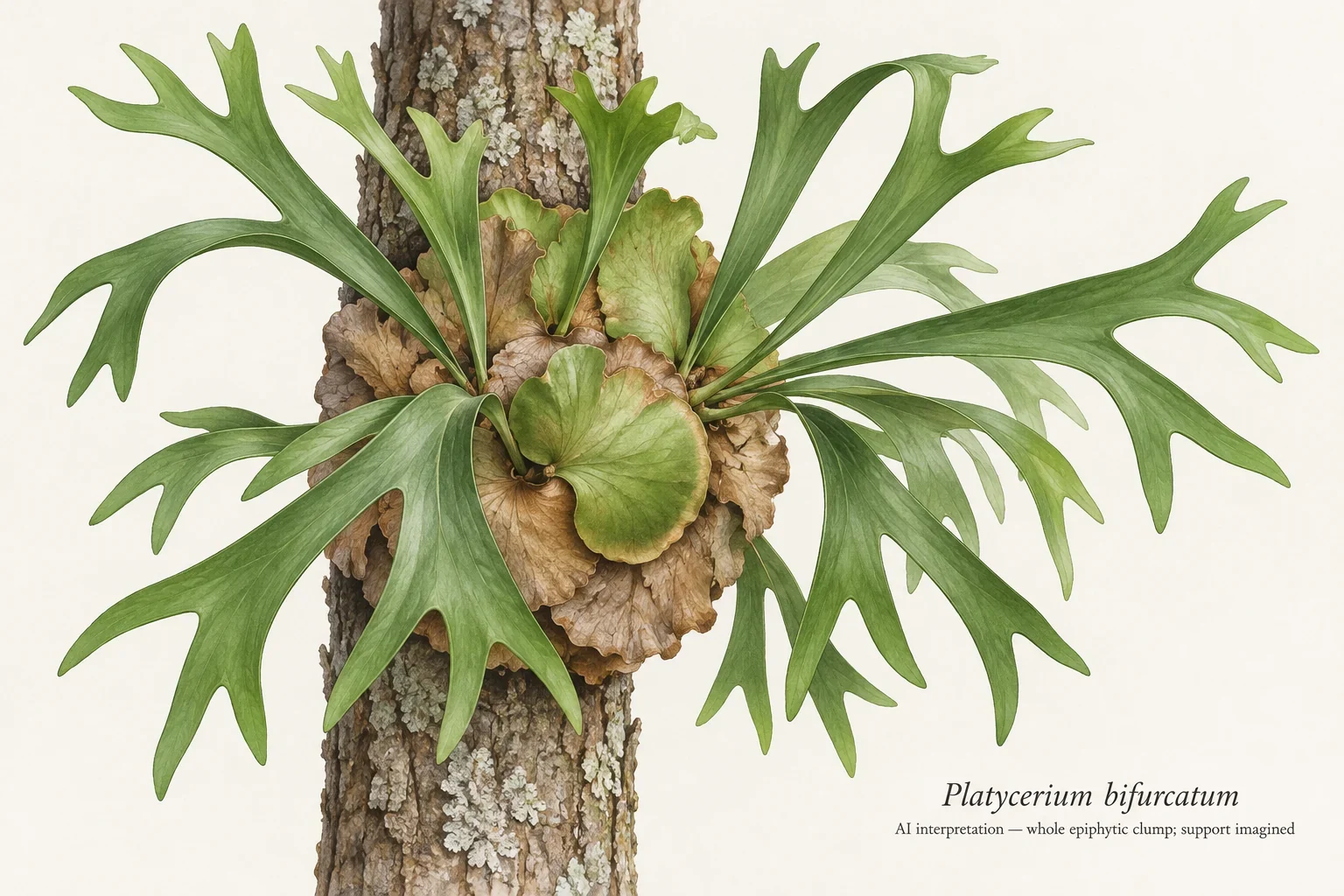
AI elkhorn fern with nest and forked fronds.
AI interpretation of an entire epiphytic fern clump; support imagined.
Overview
The Australian botanical account describes clumps made of many plantlets on tree trunks and branches. Each has a nest leaf against the bark; neighbouring leaves overlap and become brown and papery with age. Protruding fertile fronds divide repeatedly into two segments.
The spore-producing regions lie beneath the terminal fertile segments, where the Australian account describes a tan, velvety surface. The nest leaves are sterile. These two frond functions explain the silhouette without confusing spores with flowers or seeds.
NParks independently records a short rhizome, heart-shaped sterile fronds and forked fertile fronds. Its distribution includes Java, New Guinea and eastern Australia. The Australian account records cultivation and naturalisation outside the native range; a tree-growing habit is distinct from root parasitism.
Origins & earliest records
Australian and Singapore botanical institutions document morphology and horticultural occurrence.
Evidence & interpretation
The accounts agree on epiphytic growth and two frond types; descriptions distinguish fertile tips from sterile nest leaves.
Selected bibliography
Documented works and useful reading. This is not a list of every appearance.
- 01
- 02
Family, evolution & connections
Taxonomic classification
A hierarchy of classified groups, not a chain of direct ancestors.
Source note: Polypodiaceae placement follows the botanical accounts; leaf function is not a new phylogenetic result.
- FamilyPolypodiaceae
- GenusPlatycerium
References
Sources supporting this profile. Linked pages have their own scope and editorial standards.
- Institutional accountAustralian botanical accountResearch access: 2026-10-11
- Institutional accountFlora and Fauna WebResearch access: 2026-10-11
Image credits
AI-generated interpretationAI elkhorn fern with nest and forked fronds.
AI interpretation of an entire epiphytic fern clump; support imagined.