
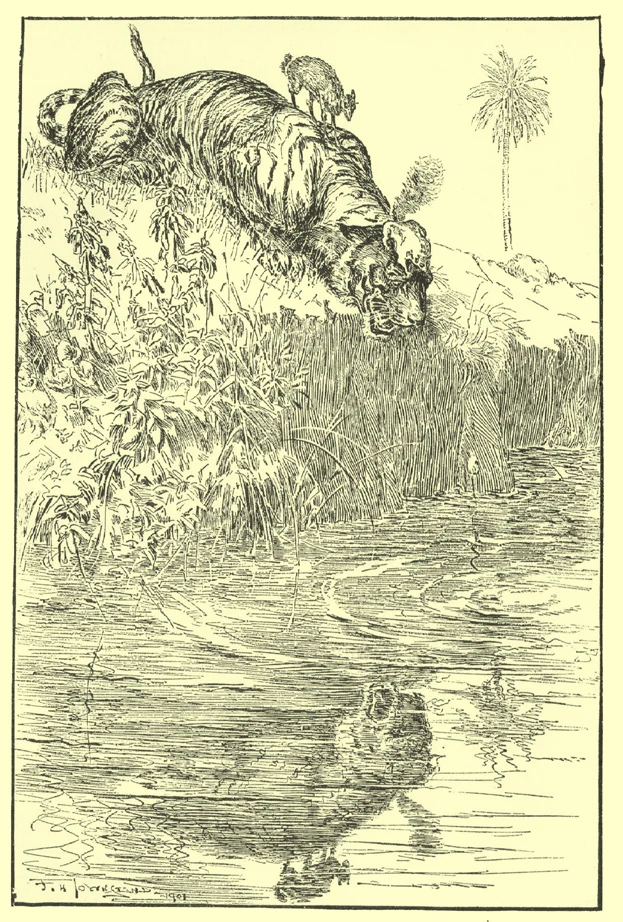
Townsend’s P’lando’ and Kuwis riding the tiger toward its reflection
The mouse-deer and small squirrel ride the tiger as it looks into the river. The reflected tiger is the same animal; the illustration accompanies the deception before its fatal attack on the reflection, rather than depicting a second supernatural tiger.
Overview
P’lando’ offers to deliver daily prey to a tiger that terrorizes a salt-lick, but none of the other animals agrees to come. After three days he brings only Kuwis, a small flying squirrel, and reports that another tiger carrying a squirrel blocks the way. They ride the tiger to a river, Kuwis on its muzzle and the mouse-deer on its hindquarters. P’lando’ points out the reflection as their rival; the tiger attacks the image and immediately drowns. The rival is an optical reflection, not a second supernatural tiger or independent shadow spirit. The source identifies Kuwis by a regional common name without securely establishing a modern species.
Origins & earliest records
Malay Peninsula; Ulu Kedah
Records & interpretation
Complete relevant tale and attached scholarly notes directly read.
Selected bibliography
Documented works and useful reading. This is not a list of every appearance.
- 01
Fables & Folk-Tales from an Eastern Forest
XII, The Tiger and the Shadow, pp. 28–29; notes pp. 79–80
- 02
Fables & Folk-Tales from an Eastern Forest — XII The Tiger and the Shadow
Fables & Folk-Tales from an Eastern Forest, collected and translated by Walter Skeat; Cambridge: University Press, 1901. Original title leaf13 visually checked. Complete selected named tale, conclusion, footnotes and corresponding source notes read from Elfinspell historical transcription; individual page ranges in this batch are host body labels, not independently scan-collated. Introduction states collection during1899 expedition with some limitation of original phraseology; no unedited original-language transcript claimed.
Family & connections
A source-supported family tree or inspiration record has not yet been compiled for this profile. Related reading below indicates a connection in subject matter, not a proven lineage or creative influence.
Primary records and illustrations
Walter Skeat, Fables & Folk-Tales from an Eastern Forest (Cambridge: University Press, 1901)
XII, The Tiger and the Shadow. XII, The Tiger and the Shadow, pp. 28–29; notes pp. 79–80
Complete tale and associated notes directly read. Regional spellings and differing accounts retained; commentary does not establish present-day practice or biological facts. Individual teller not named here.
Located primary passages
Specific passages supporting details in this entry, grouped by their published witness.
Fables & Folk-Tales from an Eastern Forest
Fables & Folk-Tales from an Eastern Forest, collected and translated by Walter Skeat; Cambridge: University Press, 1901. Original title leaf13 visually checked. Complete selected named tale, conclusion, footnotes and corresponding source notes read from Elfinspell historical transcription; individual page ranges in this batch are host body labels, not independently scan-collated. Introduction states collection during1899 expedition with some limitation of original phraseology; no unedited original-language transcript claimed.
- An old tiger kills an animal daily at a salt lick. P’lando’ offers to deliver prey so it need not hunt, but cannot persuade any animals to go. After three days he returns with Kuwis, a small flying squirrel, and claims another tiger with a squirrel on its muzzle blocked the way. The tiger goes to confront the supposed rival, carrying Kuwis on its muzzle and P’lando’ on its hindquarters. At the river P’lando’ points to its reflection. It leaps at the supposed rival and drowns. Skeat places the tale in Ulu Kedah and compares it to a European shadow fable.
XII The Tiger and the Shadow, complete hosted page labels 28–29; notes79–80
CompleteXII28–29 and notes79–80 read. Reflected tiger is no second living creature. Companion animals’ final dismount or escape is not explicitly narrated. No exact modern flying-squirrel species or independent proof of borrowed Aesopic origin asserted.
References
Sources supporting this profile. Linked pages have their own scope and editorial standards.
- Historical collected narrative with locality and editorial notesSkeat, Fables & Folk-Tales (Cambridge University Press, 1901), XII, The Tiger and the Shadow, pp. 28–29; notes pp. 79–80Research access: 2026-10-05
Image credits
Historical illustrationTownsend’s P’lando’ and Kuwis riding the tiger toward its reflection
The mouse-deer and small squirrel ride the tiger as it looks into the river. The reflected tiger is the same animal; the illustration accompanies the deception before its fatal attack on the reflection, rather than depicting a second supernatural tiger.