
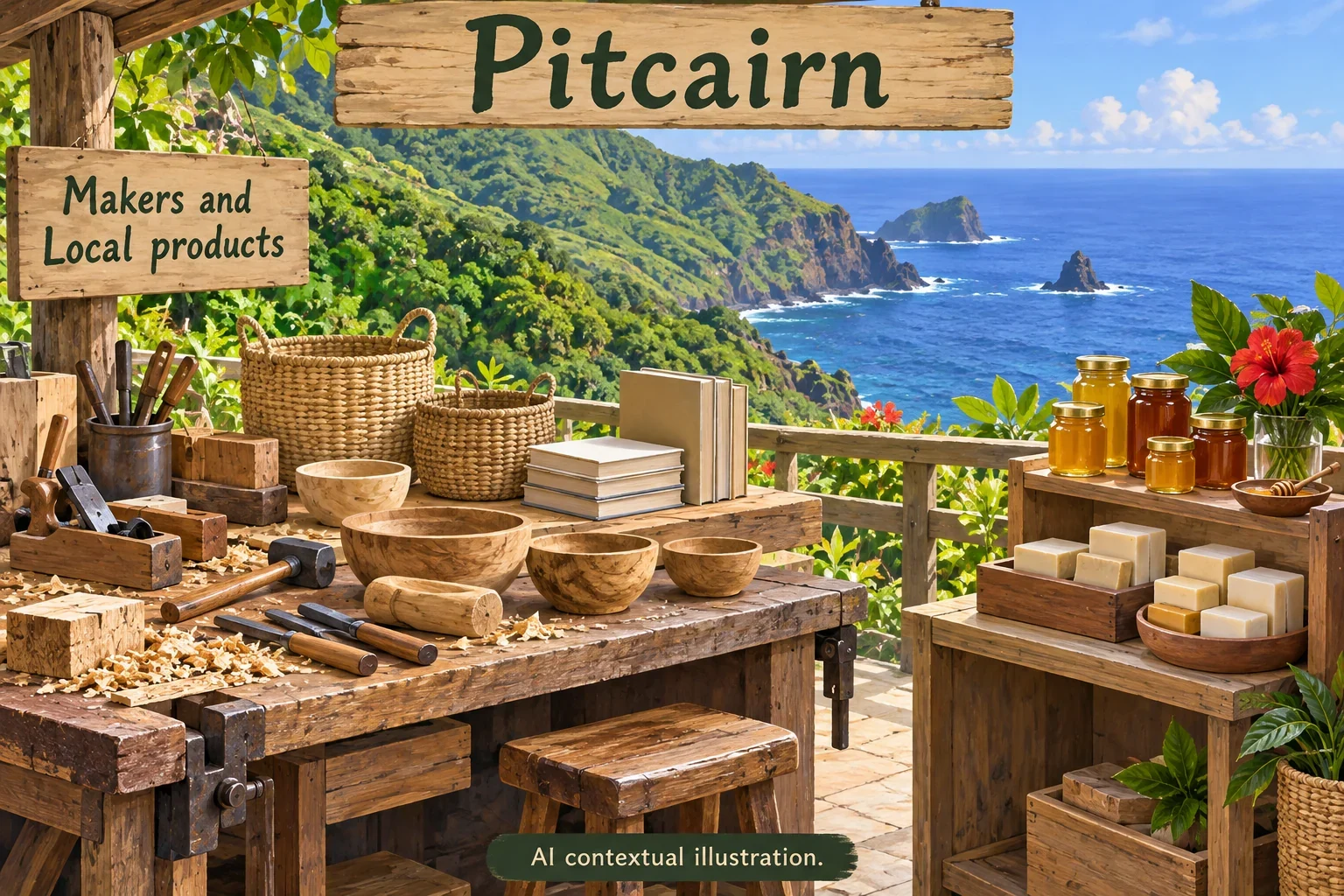
AI concept of Pitcairn makers and local island products.
Setting, tools and layout imagined; not ethnographic evidence.
Overview
The government’s history describes the present community’s Anglo-Tahitian origins in the settlement established in 1790 by Bounty mutineers and Tahitian women and men, while acknowledging earlier Polynesian habitation. It records coercion and violence against the Tahitian settlers rather than an uncomplicated founding romance. The account also traces the 1856 move to Norfolk Island and households’ subsequent return to Pitcairn.
The island’s tourism institution presents resident makers and local services as part of contemporary community life. Its public catalogue lists wooden objects, woven baskets, books, soaps and honey products, while the Adamstown museum interprets Polynesian history, the Bounty and later settlement. Guided walks, local catering and shared fishing also appear in the account. These are selected public activities, not a description of every islander’s life.
History & identity
Earlier Polynesian habitation preceded the community’s 1790 settlement history.
Sources & representation
Selected native community passages retained.
Selected bibliography
Documented works and useful reading. This is not a list of every appearance.
- 01
- 02
Language & cultural connections
Source-supported language and cultural connections have not yet been compiled for this profile.
References
Sources supporting this profile. Linked pages have their own scope and editorial standards.
- Community institutional accountHistoryResearch access: 2026-10-11
- Community institutional accountLocal Services & ActivitiesResearch access: 2026-10-11
Image credits
AI contextual interpretationAI concept of Pitcairn makers and local island products.
Setting, tools and layout imagined; not ethnographic evidence.