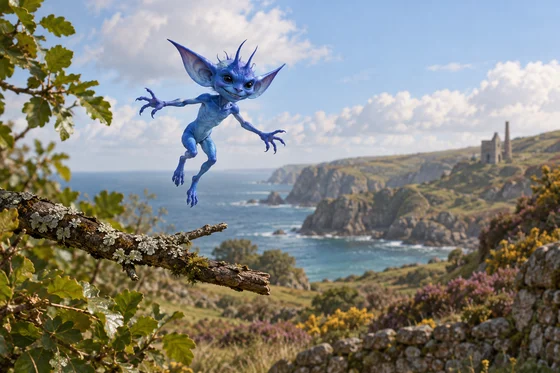
AI-generated contextual interpretation of the deceptive-light motif in Hunt’s Cornish Piskie account; terrain and light details are imagined.
No standard fairy body or authenticated Cornish landscape is asserted. The distant light and reflected glow interpret the selected motif; no game design or source art is reused.
Overview
Robert Hunt places Piskies, also called Pigseys, among five classes of Cornish fairy in The Elfin Creed of Cornwall. This is one collector’s classification, rather than proof that everyone in Cornwall used the same divisions. Hunt explicitly distinguishes the Cornish Piskie from the Pixy of East Devon and Somerset. He also treats Spriggans as a separate class, despite noting resemblances between them. His regional distinctions should remain visible when these names are compared.
Hunt describes the Piskie as mischievous and unsociable. Its characteristic deception leads travellers towards bogs through an apparent cottage-window light or the appearance of a man carrying a lantern. This passage concerns misleading appearances, rather than a fixed anatomical description.
The chapter reports an inside-out garment as protection. Hunt describes people travelling between villages at night with a jacket or cloak reversed. An appended note from Drew and Hitchins describes a lost traveller turning a garment, commonly a stocking, to dispel the condition of being piskay-led. These are attributed historical precautions, not instructions whose supernatural effectiveness is established. Hunt also records a local expression comparing laughter to a Piskie’s, and credits the beings with riding colts and chasing cows. Together these details present a troublesome presence in travel and farm life. They do not form a complete named encounter or establish a single timeless Cornish belief.
Origins & earliest records
Robert Hunt, Popular Romances of the West of England, third edition, revised and enlarged, Chatto and Windus1903; complete selected chapter The Elfin Creed of Cornwall.
Records & interpretation
Complete selected chapter and notes a–e read from the cached historical transcription. Collector classification, reported belief and quoted earlier commentary are distinguished. No supernatural event verification or earlier-edition collation is claimed.
Selected bibliography
Documented works and useful reading. This is not a list of every appearance.
- 01
Popular Romances of the West of England
Third edition; complete selected chapter The Elfin Creed of Cornwall, including notes a–e.
Family, evolution & connections
Cornish pixie (Harry Potter)
Hunt’s Cornish Piskies mislead travellers towards bogs through apparent cottage-window light or a lantern-bearing appearance. He records reversed garments as a reported precaution and distinguishes them from Devon Pixies and Spriggans. This collector-specific account is compared with Cornish pixie (Harry Potter) through the shared regional name; no creator consultation or direct borrowing route is established.
References
Sources supporting this profile. Linked pages have their own scope and editorial standards.
- Historical folklore collectionRobert Hunt, The Elfin Creed of Cornwall, Popular Romances of the West of England, third edition1903Research access: 2026-10-24
Image credits
AI-generated contextual interpretationAI-generated contextual interpretation of the deceptive-light motif in Hunt’s Cornish Piskie account; terrain and light details are imagined.
No standard fairy body or authenticated Cornish landscape is asserted. The distant light and reflected glow interpret the selected motif; no game design or source art is reused.