
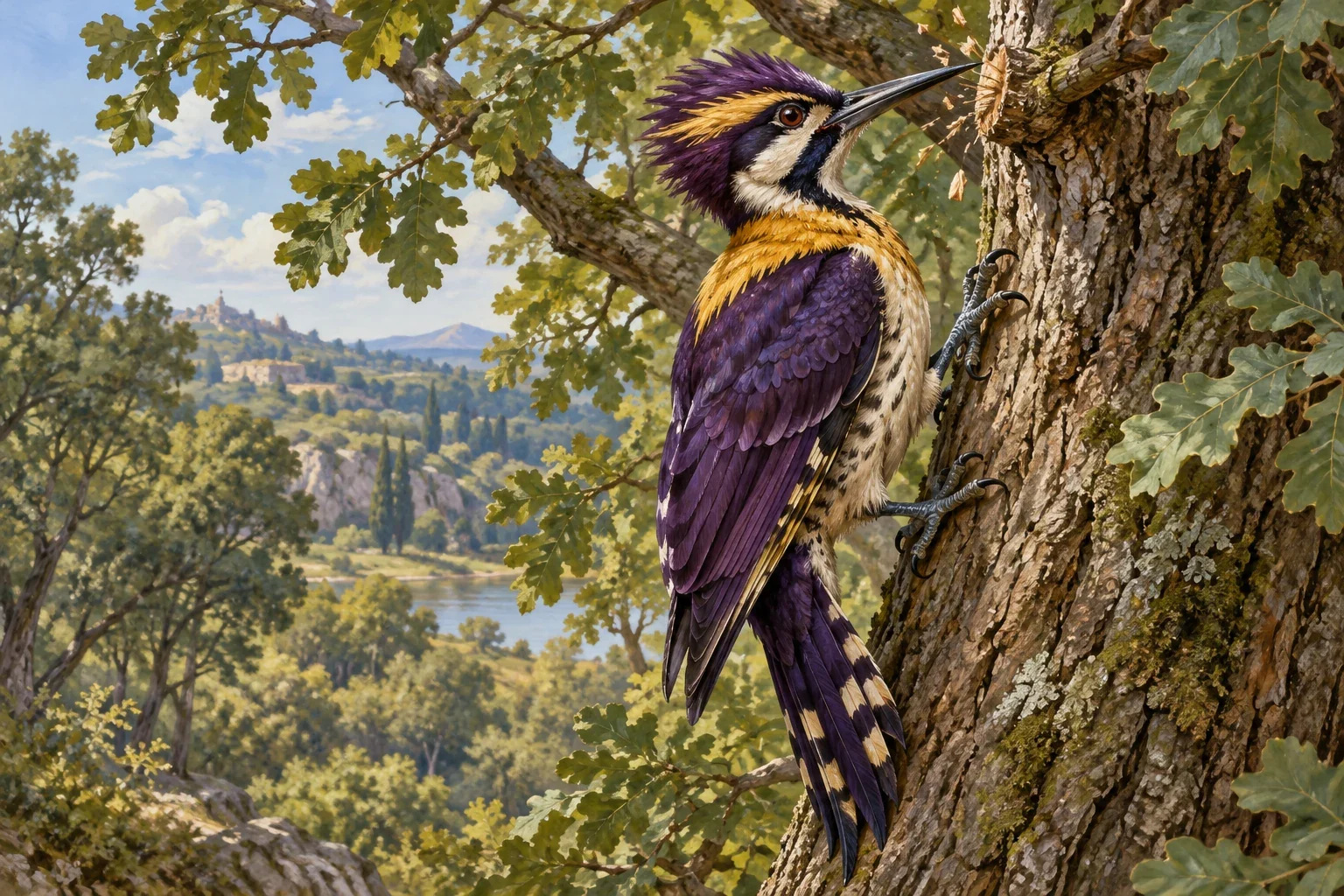
AI-generated illustration of Picus as Ovid’s purple-winged, gold-necked woodpecker, striking an oak. The colours and oak follow the account; anatomy, remaining plumage, pose, woodland, distant settlement and light are artistic choices. No modern woodpecker species or historical landscape reconstruction is asserted.
AI-generated illustration of Picus as Ovid’s purple-winged, gold-necked woodpecker, striking an oak. The colours and oak follow the account; anatomy, remaining plumage, pose, woodland, distant settlement and light are artistic choices. No modern woodpecker species or historical landscape reconstruction is asserted.
Overview
Ovid introduces Picus through a question about an image. During his stay with Circe, Macareus sees a youthful marble statue bearing a woodpecker on its head and adorned with garlands. One of four handmaids assigned to the household’s rites tells him whose likeness it is. Her account, subsequently reported by Macareus, identifies Picus as Saturn’s son and a king in Ausonia. The nesting matters: the transformation is not presented as something Macareus personally watched happen.
Picus is admired by the nymphs of Latium but has chosen Canens, daughter of Janus and Venilia. Her name is associated with singing, and her voice moves woods and rocks, calms wild animals, arrests rivers and holds birds. While she sings at home, Picus rides out to hunt boars in the Laurentine countryside. He carries two javelins and wears a purple cloak fastened with gold. These garments later explain the colours of his altered body.
Circe sees him while gathering plants and wants him as a lover. Unable to approach through his mounted speed and escort, she creates an insubstantial boar and sends it into woodland too dense for a horse. Picus dismounts and follows the apparent prey. Circe then obscures the sky and paths, separating him from his attendants, before asking him to accept her. He refuses because he intends to remain faithful to Canens. The narrator makes the transformed king’s resistance a refusal of Circe’s demands, not a voluntary choice to become an animal.
After turning twice west and twice east, Circe touches him three times with her wand and repeats three charms. Picus finds that he moves with unfamiliar speed and has wings. Angry at becoming a bird of the Latian woods, he strikes oak branches with a hard beak. His cloak supplies the purple of his wings, and the golden fastening becomes the golden plumage around his neck. The episode identifies the result as a woodpecker but does not establish a modern biological species.
The attendants later confront Circe and demand their king back. After terrifying them with apparitions and disturbances in the landscape, she changes them into different wild animals. The account gives them no individual animal identities. Canens, meanwhile, searches without food or sleep for six days and nights. On the Tiber’s bank she sings her grief and gradually disappears into air; the place receives her name. Macareus then closes his account of the year with Circe and explains why he remained behind on a later shore.
Riley’s explanation separates its conjectural history from the poem’s magical sequence. It discusses Picus as a deified Italian king associated with bird divination and proposes reasons for the woodpecker story. Those antiquarian interpretations do not replace the selected narrative’s phantom hunt, refused courtship and punitive transformation. Canens’s fate is retained here as the conclusion of the same complete account, not detached into a duplicate fragment.
Origins & earliest records
Ovid, Metamorphoses XIV, in Henry T. Riley’s prose translation, George Bell & Sons1893. The selected story is told by Circe’s unnamed handmaid to Macareus within his later narration.
Records & interpretation
Complete XIV fableVI,320–440, synopsis, explanation and notes28–36, together with the preceding statue/handmaid frame314–319. The biological identity of the bird and the commentary’s historical theories are not independently established.
Selected bibliography
Documented works and useful reading. This is not a list of every appearance.
- 01
Metamorphoses, Book XIV, Fable VI
Complete320–440 plus314–319 frame, explanation and notes28–36 in retained1893 edition.
Family & connections
A source-supported family tree or inspiration record has not yet been compiled for this profile. Related reading below indicates a connection in subject matter, not a proven lineage or creative influence.
References
Sources supporting this profile. Linked pages have their own scope and editorial standards.
- Historical translation with separately identified commentaryMetamorphoses, Book XIV, Fable VI — retained public-domain textResearch access: 2026-10-27
Image credits
AI-generated illustrationAI-generated illustration of Picus as Ovid’s purple-winged, gold-necked woodpecker, striking an oak. The colours and oak follow the account; anatomy, remaining plumage, pose, woodland, distant settlement and light are artistic choices. No modern woodpecker species or historical landscape reconstruction is asserted.
AI-generated illustration of Picus as Ovid’s purple-winged, gold-necked woodpecker, striking an oak. The colours and oak follow the account; anatomy, remaining plumage, pose, woodland, distant settlement and light are artistic choices. No modern woodpecker species or historical landscape reconstruction is asserted.