
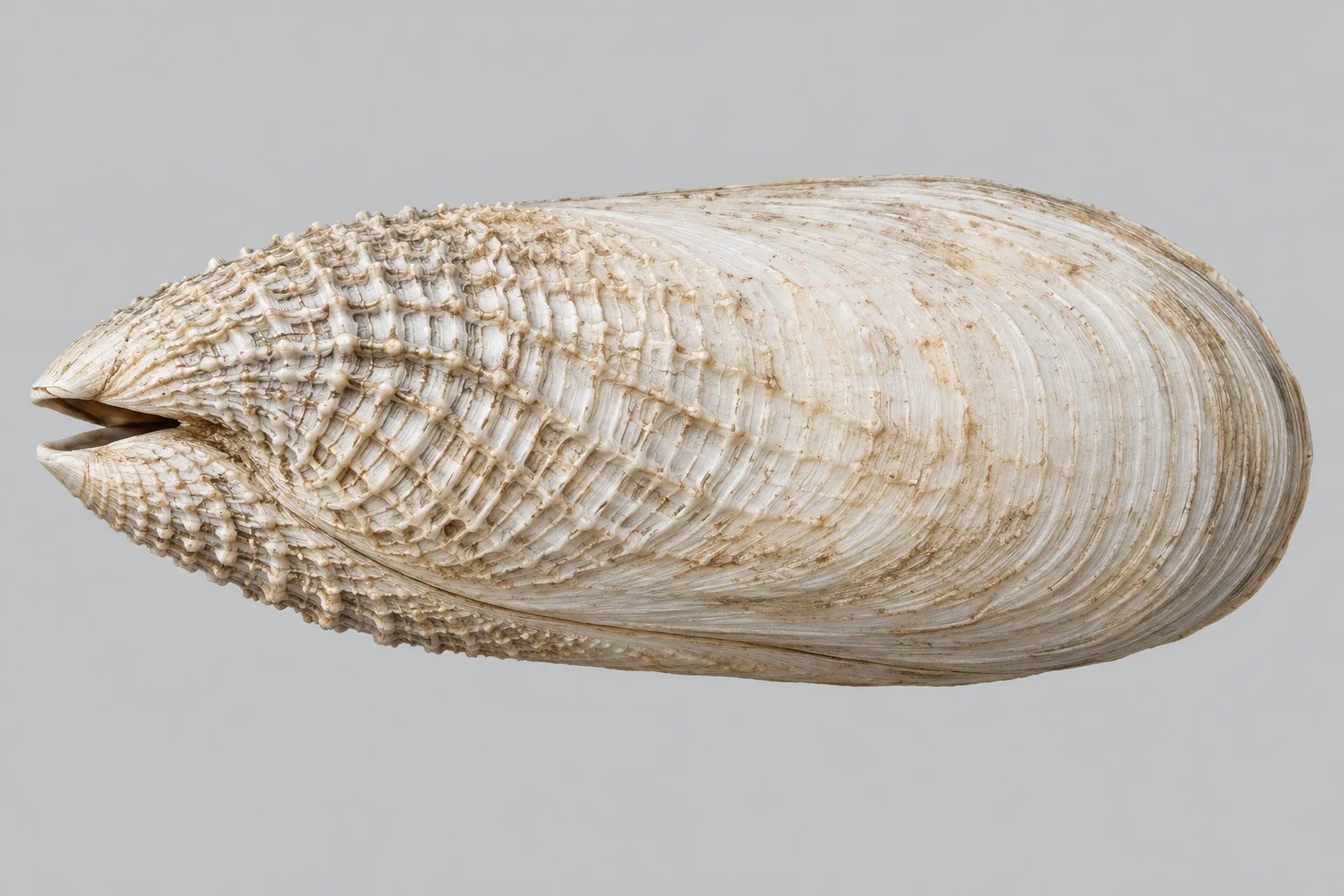
AI interpretation: common piddock shell.
Overview
The common piddock has a thin, elongated shell reaching twelve centimetres, a beaked front, intersecting sculpture and four dorsal accessory plates. It burrows into soft rock, clay and peat from the lower shore to thirty-five metres.
It suspension-feeds through joined siphons. Free-swimming veligers attach temporarily at settlement; adults remain in enlarging burrows. MarLIN records separate sexes and summer spawning, with external fertilization considered probable.
Furneaux illustrates Pholas dactylus from the ventral and dorsal sides and names the common piddock beneath the family discussion. He describes rasp-like shell sculpture and accessory pieces, then examines how such a fragile animal can excavate stone. Rather than crediting an acid secretion, he explains slow back-and-forth shell movement driven by the foot. His argument includes sandstone, which would not be explained by the proposed acid action.
The account follows the consequences of confinement: excavation continues as the animal grows; a soft rock face wearing away requires the animal to deepen its shelter, and sediment produced by boring must be expelled. These observations belong to his historical discussion of piddocks, not a measured experiment on every population of this species. His figures and named example anchor the context, while modern species-specific features above distinguish Pholas dactylus from the smaller piddocks he also discusses.
Origins & earliest records
Marine
Evidence & interpretation
Institutional account.
Selected bibliography
Documented works and useful reading. This is not a list of every appearance.
- 01
- 02
The Sea Shore
Selected piddock account, p.198-201; historical grouping retained as context.
Family & connections
A source-supported family tree or inspiration record has not yet been compiled for this profile. Related reading below indicates a connection in subject matter, not a proven lineage or creative influence.
Look for a taxonomic record and classified relativesReferences
Sources supporting this profile. Linked pages have their own scope and editorial standards.
- Institutional accountPholas dactylusResearch access: 2026-10-21
- Historical natural historyThe Sea ShoreResearch access: 2026-10-21
Image credits
AI-generatedAI interpretation: common piddock shell.