
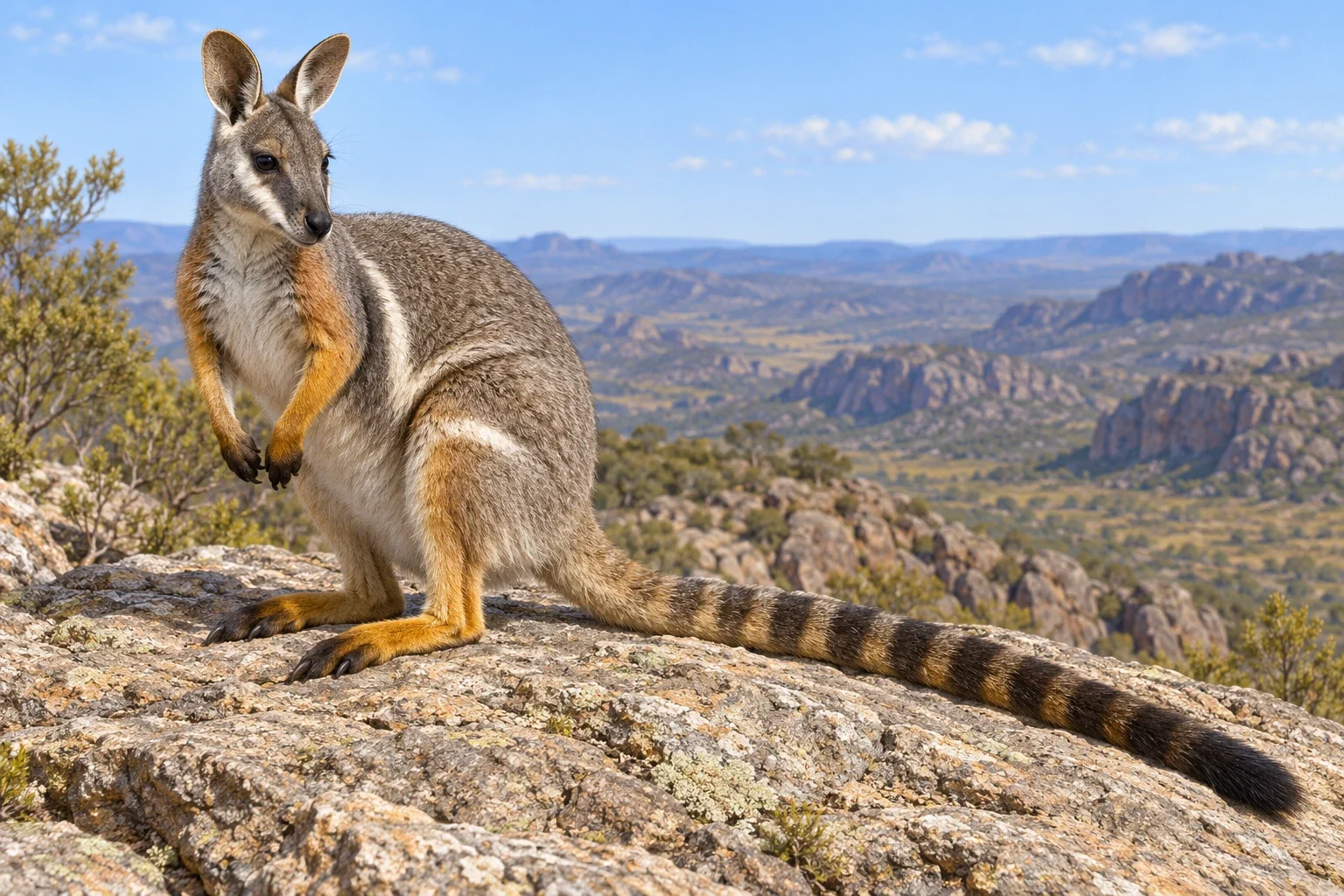
AI-generated natural-history study.
Interpretive portrait; no authenticated specimen claim.
Overview
The yellow-footed rock-wallaby combines grey-fawn fur and pale side and cheek stripes with orange-yellow limbs. Its long, cylindrical tail carries darker bands. Australian Wildlife Conservancy describes the tail as a counterbalance, while coarse pads on the hind feet improve grip on rock.
It browses grasses, herbs and low shrubs and shelters in rocky crevices during daytime heat. AWC describes joeys spending roughly six to seven months in the pouch, then using a cave or crevice while their mother forages. Its Buckaringa work includes goat and fox control, with repeated counts used as an index of the protected population.
Adelaide Zoo describes a different conservation role: yellow-footed rock-wallabies have fostered joeys of the threatened Victorian brush-tailed rock-wallaby. The fostered young belong to another species, rather than being yellow-footed joeys. This husbandry programme illustrates how related marsupials can contribute to recovery work; it does not make the two rock-wallabies interchangeable in identity or wild ecology.
Origins & earliest records
Rocky slopes and crevices
Evidence & interpretation
Institutional accounts and observed photographs.
Selected bibliography
Documented works and useful reading. This is not a list of every appearance.
- 01
- 02
Family & connections
A source-supported family tree or inspiration record has not yet been compiled for this profile. Related reading below indicates a connection in subject matter, not a proven lineage or creative influence.
Look for a taxonomic record and classified relativesReferences
Sources supporting this profile. Linked pages have their own scope and editorial standards.
- Conservation-manager species accountYellow-footed Rock-wallabyResearch access: 2026-10-23
- Institutional species accountYellow-footed Rock-wallabyResearch access: 2026-10-23
Image credits
AI-generated interpretive illustrationAI-generated natural-history study.
Interpretive portrait; no authenticated specimen claim.