
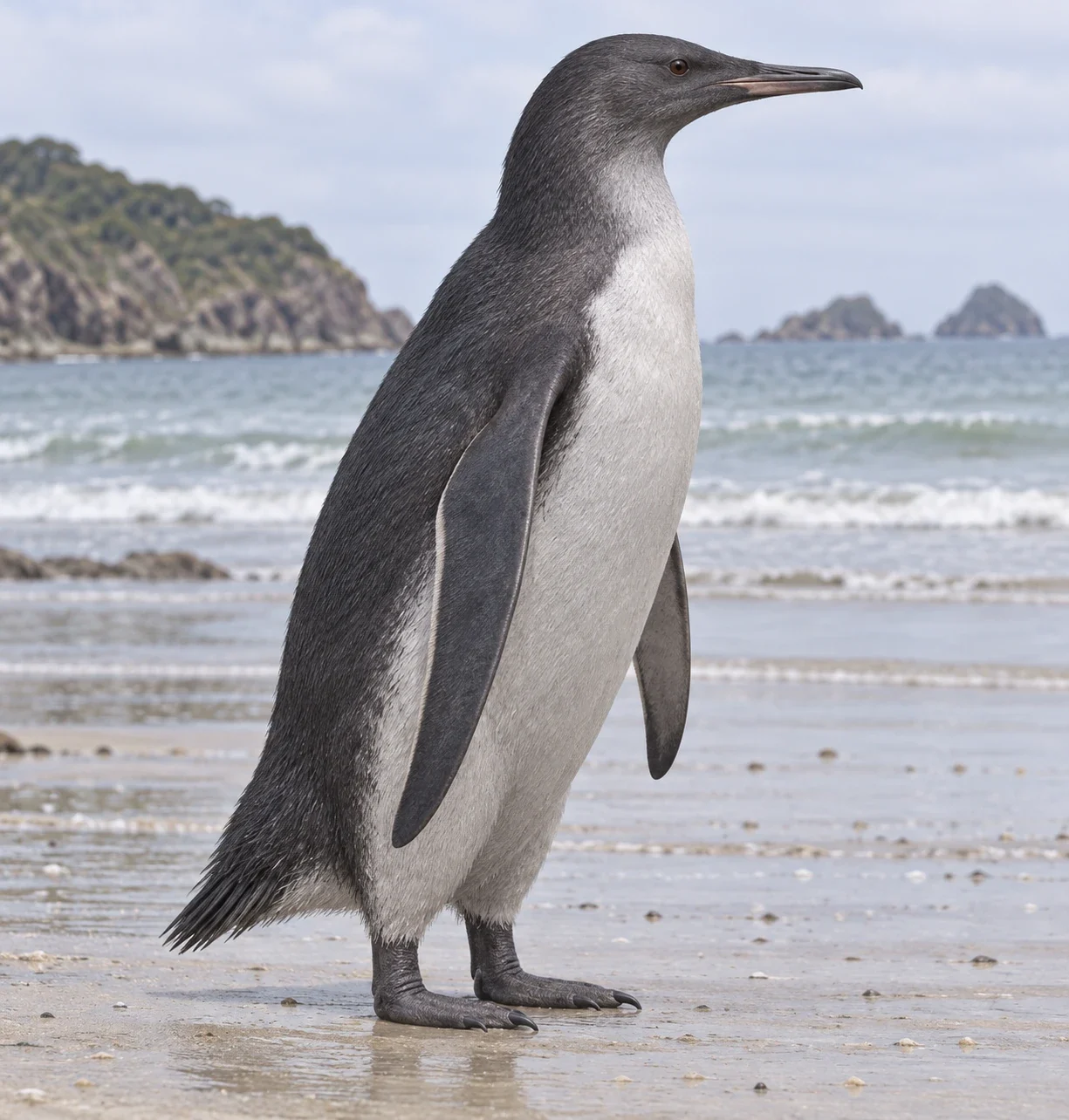
Petradyptes stonehousei - AI-generated scientific interpretation.
Modern AI reconstruction informed by preserved body, flipper and leg bones. Skull, bill, feet and plumage are hypothetical because these are not represented in the selected species specimens; not fossil or photographic evidence.
Overview
Petradyptes stonehousei lived in Paleocene New Zealand and was larger than the living emperor penguin. The selected account estimates about fifty kilograms, rather than measuring a preserved living mass. Five specimens document body, flipper and leg bones; the skull and feet are not represented in the museum summary.
The fossils were enclosed in concretions and prepared from rock, preserving different parts of the skeleton. Their present beach occurrence follows uplift and erosion, not evidence that the birds died in their current dry-land location. The remains belong to the Museum of New Zealand Te Papa Tongarewa collection.
The original study compared flipper bones and recovered Petradyptes among early stem penguins. Its flipper retained features closer to the ancestral flying-bird condition than the highly modified apparatus of living penguins. Different phylogenetic analyses disagreed on some ordering among early genera, so this profile does not convert a diagram into a direct chain of ancestors.
The species name honours penguin researcher Bernard Stonehouse. External reconstruction must be conservative: a bill, feet and plumage pattern are chosen for illustration rather than observed in these specimens. Neither a modern emperor colour scheme nor precise breeding behaviour is supplied from analogy. The selected museum species account lists no breeding or ecological observations for this extinct animal.
Origins & earliest records
Named by Ksepka and colleagues in 2023 from the late Paleocene Moeraki Formation near Oamaru. The museum account records five specimens found in 2015–2018; different reporting scopes should not be collapsed into a single collection date.
Evidence & interpretation
Partial skeletons and comparative flipper anatomy establish the species account. Size follows comparative estimates, and relationships follow phylogenetic analyses. Missing skull and foot material limits life restorations; breeding and specific prey remain unknown.
Selected bibliography
Documented works and useful reading. This is not a list of every appearance.
- 01
Stonehouse’s penguin
Selected bibliography; bounded source account, not exhaustive coverage.
- 02
Largest-known fossil penguin provides insight into the early evolution of sphenisciform body size and flipper anatomy
Selected bibliography; bounded source account, not exhaustive coverage.
Family, evolution & connections
Taxonomic classification
A hierarchy of classified groups, not a chain of direct ancestors.
Source note: New Zealand Birds Online lists family incertae sedis; no Spheniscidae crown-family assignment is inserted. Selected dated species interpretation follows the describing study.
- kingdomAnimalia
- phylumChordata
- classAves
- orderSphenisciformes
- genusPetradyptes
- speciesPetradyptes stonehousei
References
Sources supporting this profile. Linked pages have their own scope and editorial standards.
- InstitutionalStonehouse’s penguinResearch access: 2026-10-10
- InstitutionalLargest-known fossil penguin provides insight into the early evolution of sphenisciform body size and flipper anatomyResearch access: 2026-10-10
Image credits
AI-generated scientific interpretationPetradyptes stonehousei - AI-generated scientific interpretation.
Modern AI reconstruction informed by preserved body, flipper and leg bones. Skull, bill, feet and plumage are hypothetical because these are not represented in the selected species specimens; not fossil or photographic evidence.