
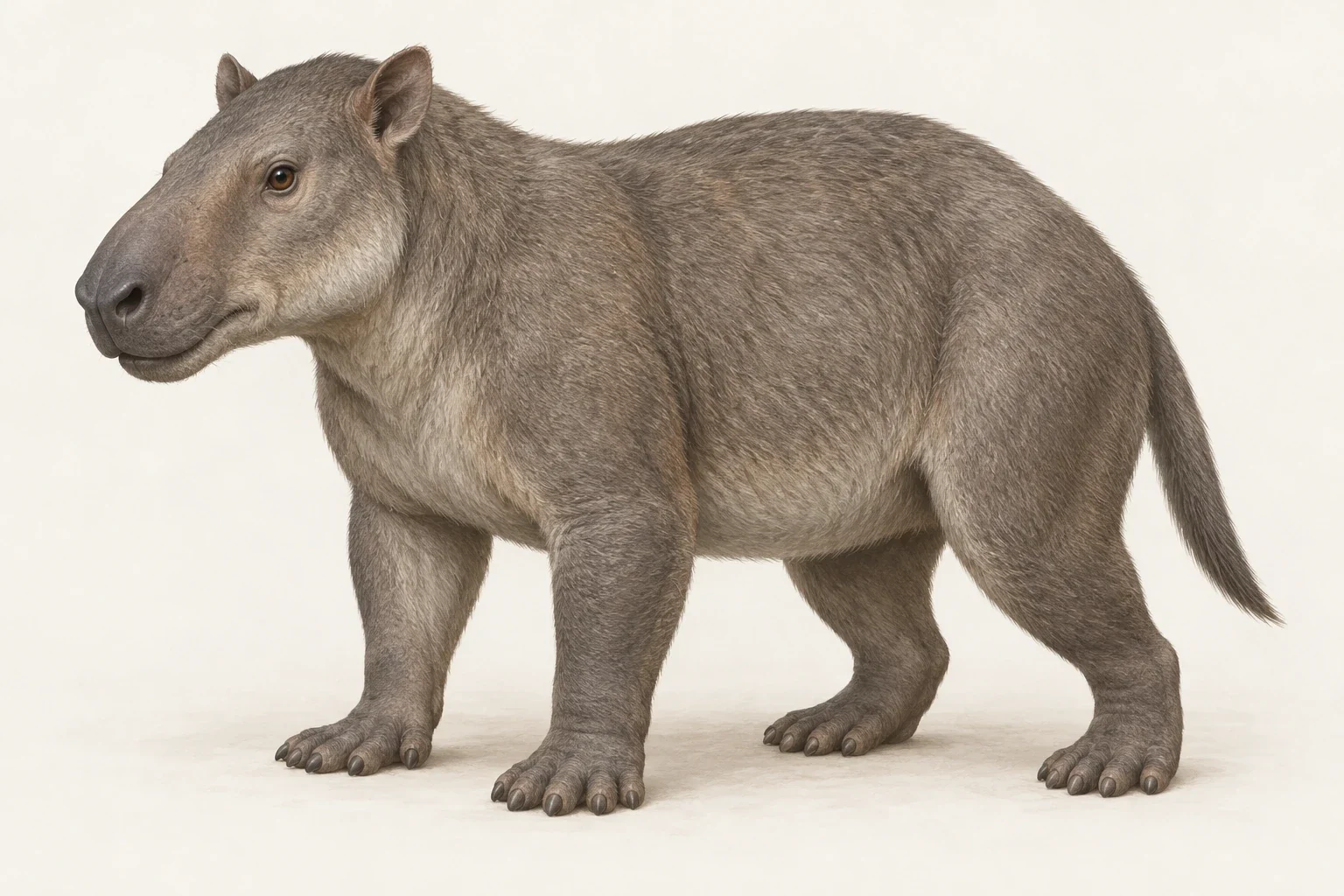
Periptychus carinidens - AI-generated scientific interpretation.
Modern AI-generated scientific illustration. Diagnostic anatomy follows selected research; colour, pose and unpreserved external detail are interpretive. Not fossil or photographic evidence.
Overview
Periptychus belongs to a radiation of mammals that expanded after the end-Cretaceous extinction. Its anatomical combination has no exact living counterpart. Shelley and colleagues reconstructed it as a stout-limbed animal of roughly twenty kilograms with a broad face, moderately elongated deep snout and relatively small braincase. It stood plantigrade, placing much of the sole on the ground rather than standing exclusively on hoof tips.
The premolars are unusually large compared with the molars and carry strongly ridged enamel. These distinctive teeth help identify the species, but tooth shape alone cannot enumerate everything it ate. The animal also had strong limb attachments and an ankle permitting some movement. The published functional assessment emphasizes terrestrial locomotion while recognizing possible climbing or digging abilities suggested by the forelimb.
The 2018 study combined newly available cranial and postcranial fossils from New Mexico with older collection material. Different specimens preserve different regions; the authors noted that no single complete skull was known. A composite anatomical account is therefore stronger than a drawing based on one jaw, yet it must retain gaps where bones remain poorly represented.
The historical term condylarth grouped many ungulate-like early mammals. It does not guarantee that Periptychus was a horse, pig or direct ancestor of modern hoofed mammals. Its specialized dentition and robust body should be discussed within Periptychidae and the debated relationships of early placentals. Coat pattern, external ears and a life scene remain restoration choices.
Origins & earliest records
Cope named Periptychus carinidens in 1881. The 2018 reassessment designated the type material and described fossils from the Nacimiento Formation, San Juan Basin, New Mexico; fossil age and naming date are separate.
Evidence & interpretation
Collection specimens support detailed comparisons of skull, teeth and limb bones. Functional claims follow joints and muscle attachment anatomy, rather than preserved behaviour. The mass estimate is approximate, and the specimen assemblage does not provide a complete soft-tissue restoration.
Selected bibliography
Documented works and useful reading. This is not a list of every appearance.
- 01
The osteology of Periptychus carinidens: A robust, ungulate-like placental mammal from the Paleocene of North America
Selected bibliography; bounded source account, not exhaustive coverage.
Family, evolution & connections
Taxonomic classification
A hierarchy of classified groups, not a chain of direct ancestors.
Source note: Selected ranks follow the 2018 osteological study. Condylarth is a historical grouping, not supplied as a secure natural order; deeper placental relationships remain debated.
- kingdomAnimalia
- phylumChordata
- classMammalia
- cladePlacentalia
- familyPeriptychidae
- genusPeriptychus
- speciesPeriptychus carinidens
References
Sources supporting this profile. Linked pages have their own scope and editorial standards.
- ResearchThe osteology of Periptychus carinidens: A robust, ungulate-like placental mammal from the Paleocene of North AmericaResearch access: 2026-10-10
Image credits
AI-generated scientific interpretationPeriptychus carinidens - AI-generated scientific interpretation.
Modern AI-generated scientific illustration. Diagnostic anatomy follows selected research; colour, pose and unpreserved external detail are interpretive. Not fossil or photographic evidence.