
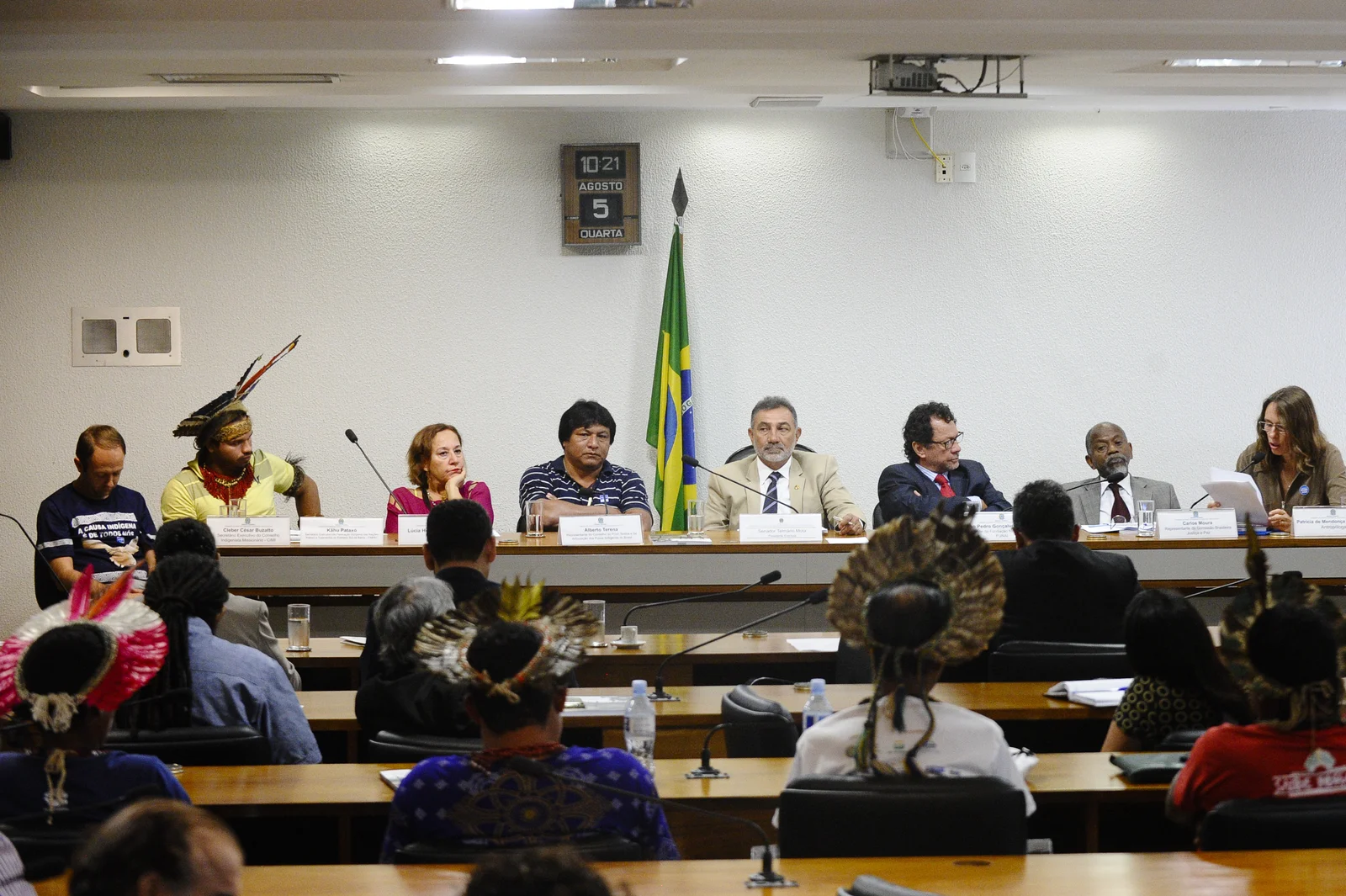
Kâhu Pataxó, wearing a yellow shirt and feather headdress, sits second from the left in a panel of eight speakers at a Brazilian Senate hearing, with audience members in the foreground.
Kâhu Pataxó, identified as Finpat’s executive secretary, at a Brazilian Senate human-rights hearing on 5 August 2015. Finpat’s stated remit includes Pataxó and Tupinambá communities in southern Bahia; this occasion does not represent every community or political position.
Overview
Pataxó communities live in Bahia and Minas Gerais, with important historical connections to the far south of Bahia. Instituto Socioambiental’s account identifies a range of villages and territories rather than a single settlement. Barra Velha and Coroa Vermelha are among the communities it discusses, alongside distinct locations in Minas Gerais. Its overview also describes efforts to renew Patxohã and older ceremonial practices after long pressures to hide or abandon them. Language renewal is part of continuing community life; it does not imply that Pataxó identity disappeared whenever people used Portuguese or lived outside a particular village.
Research and teaching are undertaken by Pataxó people themselves. A 2018 Universidade Federal do Sul da Bahia report identifies Atxohã as a group researching Pataxó language and culture. With a university extension programme, the Museu do Índio–Funai and Associação Filmes de Quintal, it organized the course Pensando a Língua, taught by linguist Bruna Franchetto. The report presents this collaboration within a community effort to recover and develop language use. It documents a particular educational partnership, not the replacement of community knowledge by an outside scholar or proof of uniform language proficiency across every Pataxó community.
Practical demands accompany these cultural goals. Porto Seguro’s municipal account of a February 2023 assembly at Barra Velha records teachers and leaders raising school staffing, furniture, building and repair needs. Education coordinator Ângelo Pataxó emphasized multilingual teaching and the need for recruitment specifically serving Indigenous teachers. He also pointed to partnerships for producing teaching materials, including work involving Atxohã. His comments concern local educational practice and demands at that meeting; they do not establish that every requested improvement was delivered. They show educators negotiating the material conditions in which language and learning can continue.
Contemporary art provides another named perspective. The University of São Paulo’s 2024 profile of Arissana Pataxó Braz connects her early artistic references with childhood memories in Porto Seguro and her later move to Coroa Vermelha. It records her entry into fine-arts study at UFBA in 2005, art-education activities and her first solo exhibition, Sob o olhar Pataxó, in 2007. Her work in different media places Indigenous experience within the contemporary world. The institutional biography documents one artist’s trajectory; her work does not stand for a uniform Pataxó aesthetic, and the linked video and individual artworks are not treated here as independently inspected testimony.
History & identity
Historical community connections in Bahia coexist with distinct settlements in Minas Gerais; institutional project dates do not define the beginning of the people.
Sources & representation
ISA introduction and complete location section; full 2018 university course report, March2023 municipal article and 2024 artist biography read. No course-observation, linked-video or full-book claim.
Selected bibliography
Documented works and useful reading. This is not a list of every appearance.
- 01
Pensando a Língua (PROEXT)
Complete 9August2018 written report read; no linked teaching materials inspected.
- 02
Arissana Pataxó Braz
Complete institutional biography read, published February and updated October2024; linked video not viewed.
Language & cultural connections
Source-supported language and cultural connections have not yet been compiled for this profile.
References
Sources supporting this profile. Linked pages have their own scope and editorial standards.
- Indigenous-peoples research referenceISA: Pataxó introduction and locationResearch access: 2026-10-05
- Participating university project reportUFSB: Atxohã language courseResearch access: 2026-10-05
- Municipal report with named Indigenous educatorPorto Seguro: educational assemblyResearch access: 2026-10-05
- Artist’s institutional biographyUSP: Arissana Pataxó biographyResearch access: 2026-10-05
Image credits
Documentary photograph of a named Pataxó representative at a dated public hearingKâhu Pataxó, wearing a yellow shirt and feather headdress, sits second from the left in a panel of eight speakers at a Brazilian Senate hearing, with audience members in the foreground.
Kâhu Pataxó, identified as Finpat’s executive secretary, at a Brazilian Senate human-rights hearing on 5 August 2015. Finpat’s stated remit includes Pataxó and Tupinambá communities in southern Bahia; this occasion does not represent every community or political position.