
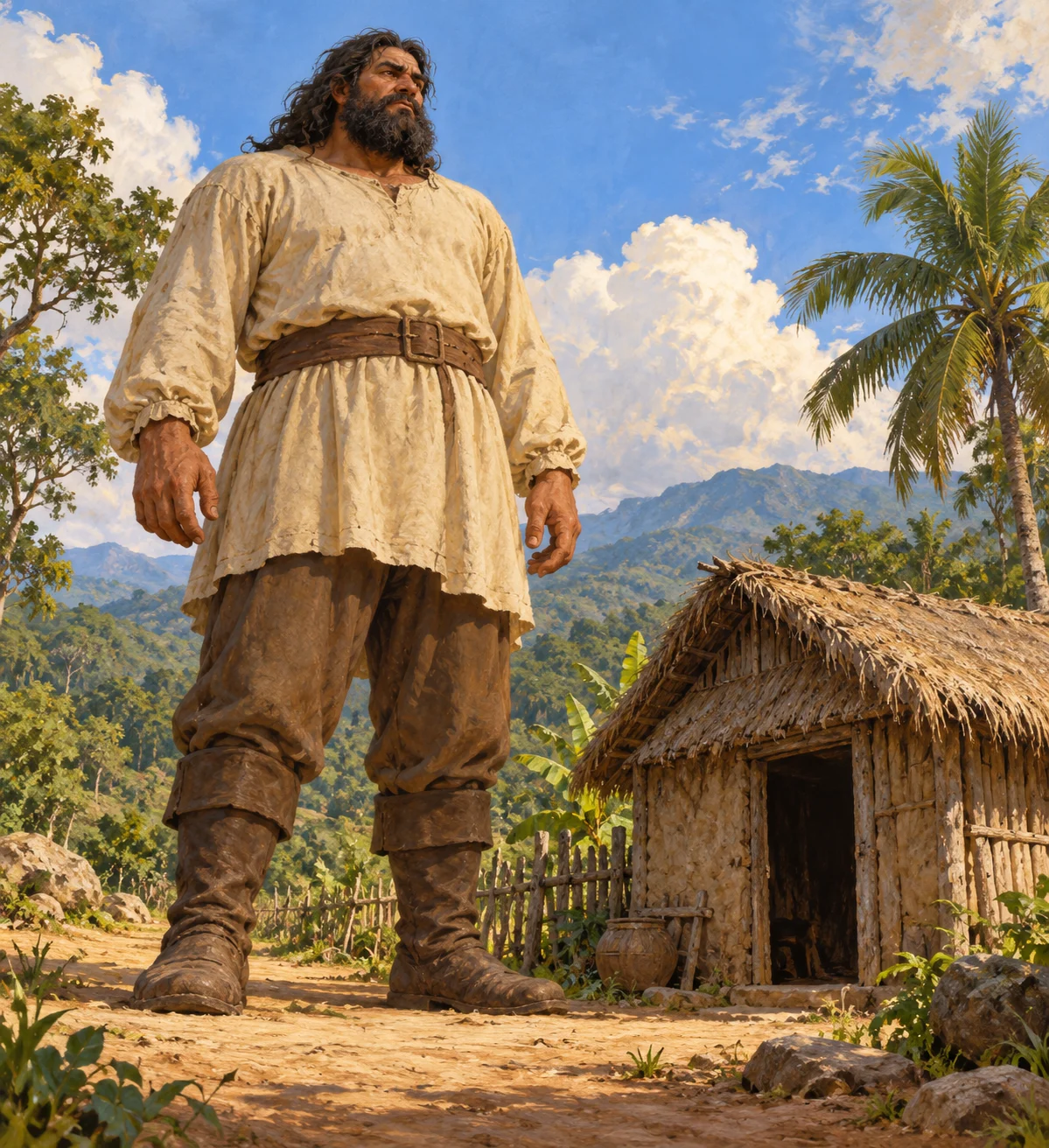
Pata de Barro before the confrontation; giant form, clothing and hut are contextual interpretations.
Original narrative illustration; visual particulars not specified in the tale remain imagined, not authenticated ethnography.
Overview
The giant is introduced as the terror of the district. A king promises his daughter Elsa to whoever kills him and brings back his head. Juan Pirulí, son of the poor farmer Periquillo, decides to attempt the task despite his father’s warning. According to that warning, anyone approaching the giant’s hut is immediately strangled; the father also repeats reports that the giant keeps enchanted princesses. Those claims frame the danger but are not independently confirmed episodes of imprisonment in this telling. Juan has three dogs given to him by a fairy, and the narrator identifies them as angels. He tells his father to release them when their chains begin to bleed.
A dwarf supplies a multicoloured feather and instructions for summoning the Fairy of Light near the hut. She appears as a girl in a pearl-adorned carriage drawn by a beetle and explains that the dogs will bring the giant’s death. Far away, the farmer sees blood issuing from their chains and eyes and lets them go. They attack the giant and knock him down; Juan cuts off his head. The dogs name themselves Innocence, Light and Hope, then disappear. Juan presents the head to the king, is acclaimed as the district’s deliverer and marries Elsa. The story thus resolves the giant’s threat through supernatural assistance, not a detailed account of Juan’s physical strength.
Origins & earliest records
El gigante Pata de Barro is tale109 in Andrade’s original 1930 collection, signed Consuelo Rubirosa, Seibo. His contributor list identifies Rubirosa as an eighteen-year-old country girl working at the village inn. The collection’s place labels often refer to surrounding rural districts as well as towns, so the signature does not locate the fictional kingdom.
Records & interpretation
Complete Spanish tale109, printed pp.143–144, through the dogs’ self-identification, disappearance and fulfilled marriage promise; contributor43 on p.3; complete preface and collection-method discussion on pp.24–27.
Selected bibliography
Documented works and useful reading. This is not a list of every appearance.
- 01
Folk-lore from the Dominican Republic
Memoirs of the American Folk-Lore Society, XXIII. New York: American Folk-Lore Society; G. E. Stechert and Co., agents. Original Spanish narrative texts with English editorial context.
Family & connections
A source-supported family tree or inspiration record has not yet been compiled for this profile. Related reading below indicates a connection in subject matter, not a proven lineage or creative influence.
References
Sources supporting this profile. Linked pages have their own scope and editorial standards.
- Historical primary tale collection; selected Spanish texts read in the original editionAndrade1930 — original edition, selected narratives and collection contextResearch access: 2026-10-18
Image credits
AI-generatedPata de Barro before the confrontation; giant form, clothing and hut are contextual interpretations.
Original narrative illustration; visual particulars not specified in the tale remain imagined, not authenticated ethnography.