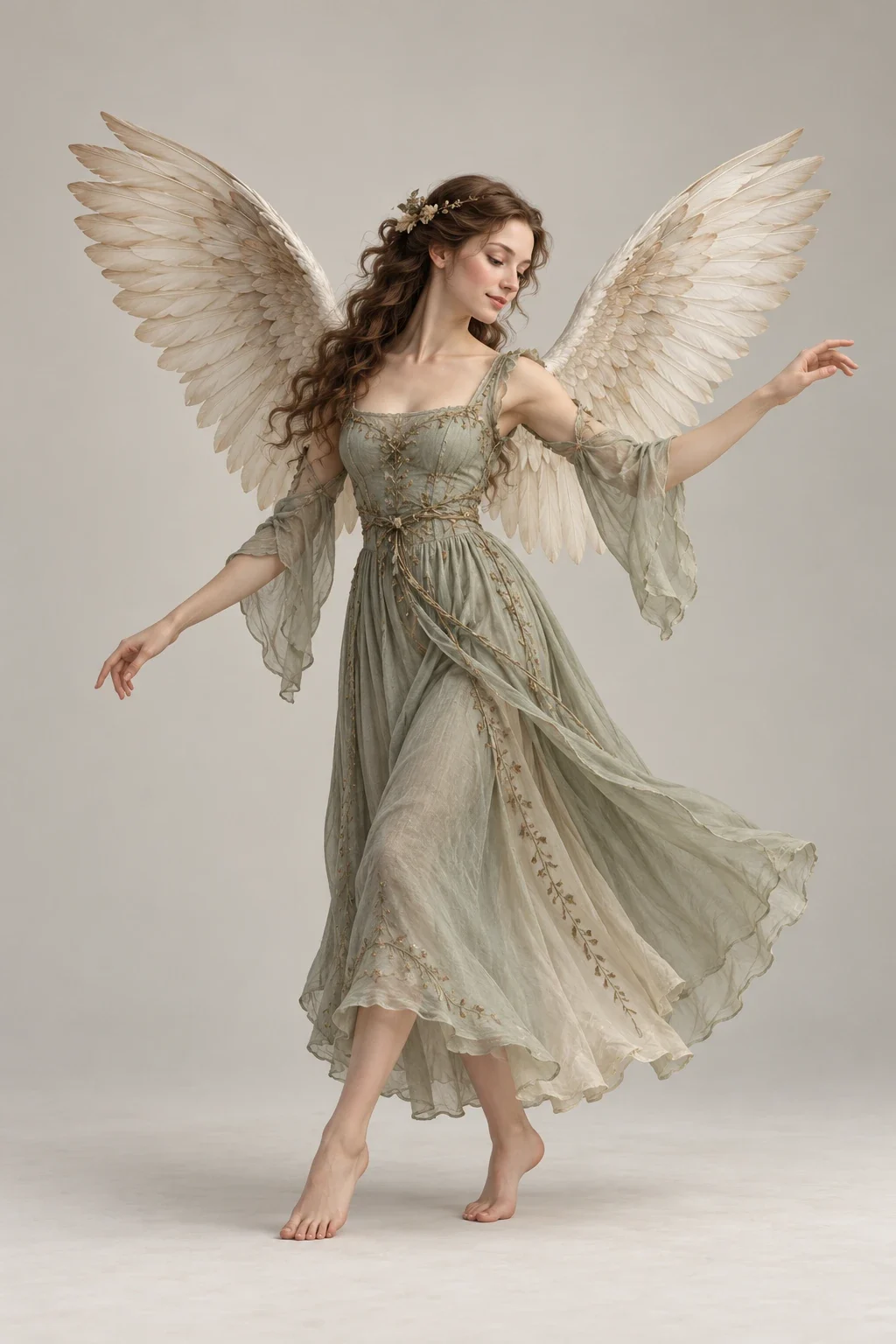
AI interpretation of The Winged Juda of Muršo’s Pasture Wager.
Wings and dancing are sourced. Humanlike adult female appearance, one conventional pair of feathered wings, clothing and pose are interpreted; no exact source wing count or feather material claimed.
Overview
The Juda addresses Muršo, also called Kara Muršo, because his sheep have grazed on her land for three years without payment. He offers money, a white lamb and a grey horse in turn. She rejects each proposal, imagining that accepting them would make the pasture silver, snow-white or ash-grey and leave it unusable for grazing. These exchanges are the song’s bargaining imagery, not instructions for changing real land or a record of an enforceable historical property claim.
She offers a different settlement: he must play his flute while she dances the Horo. If he can continue longer, the pasture will be his; if she dances longer, she will carry him away as her payment. The contest lasts three days and nights. Muršo prays for rain to soften the Juda’s wings. Dark clouds gather, rain falls, and her wings soften until she can no longer dance. He keeps playing and thereby wins the grazing ground. The ending does not say that she dies or loses her wings.
This song explicitly supplies wings and a female fairy designation, but does not describe their number, material, colour or shape, nor the Juda’s dress or face. An illustration with a conventional pair of wings is a reconstruction rather than a literal anatomical record. The edition’s note for printed139 explains Otlach as a sheep tax; that historical gloss supports the demand for payment without making the song a modern taxation source. The contributor line reads Konstantinov in Dupnica. The Juda remains distinct from the seven hair-braiders in Dona’s preceding song and from Strausz’s separately collected sea-Samovila.
Origins & earliest records
Koleda song XVI Der Schäfer und die Juda, printed 139–140; final contributor line belongs to this song before the next separator.
Records & interpretation
Complete songXVI including wager, rain, victory and contributor line read from OCR and actual nativePDF153–154/printed139–140; page-targeted note139 read.
Selected bibliography
Documented works and useful reading. This is not a list of every appearance.
- 01
Bulgarische Volksdichtungen
Koleda song XVI Der Schäfer und die Juda, printed 139–140; final contributor line belongs to this song before the next separator.
Family & connections
A source-supported family tree or inspiration record has not yet been compiled for this profile. Related reading below indicates a connection in subject matter, not a proven lineage or creative influence.
References
Sources supporting this profile. Linked pages have their own scope and editorial standards.
- Historical translated song collectionStrausz 1895 original German edition, complete Koleda songs XV–XVI and retained source framingResearch access: 2026-10-21
Image credits
AI-generatedAI interpretation of The Winged Juda of Muršo’s Pasture Wager.
Wings and dancing are sourced. Humanlike adult female appearance, one conventional pair of feathered wings, clothing and pose are interpreted; no exact source wing count or feather material claimed.