
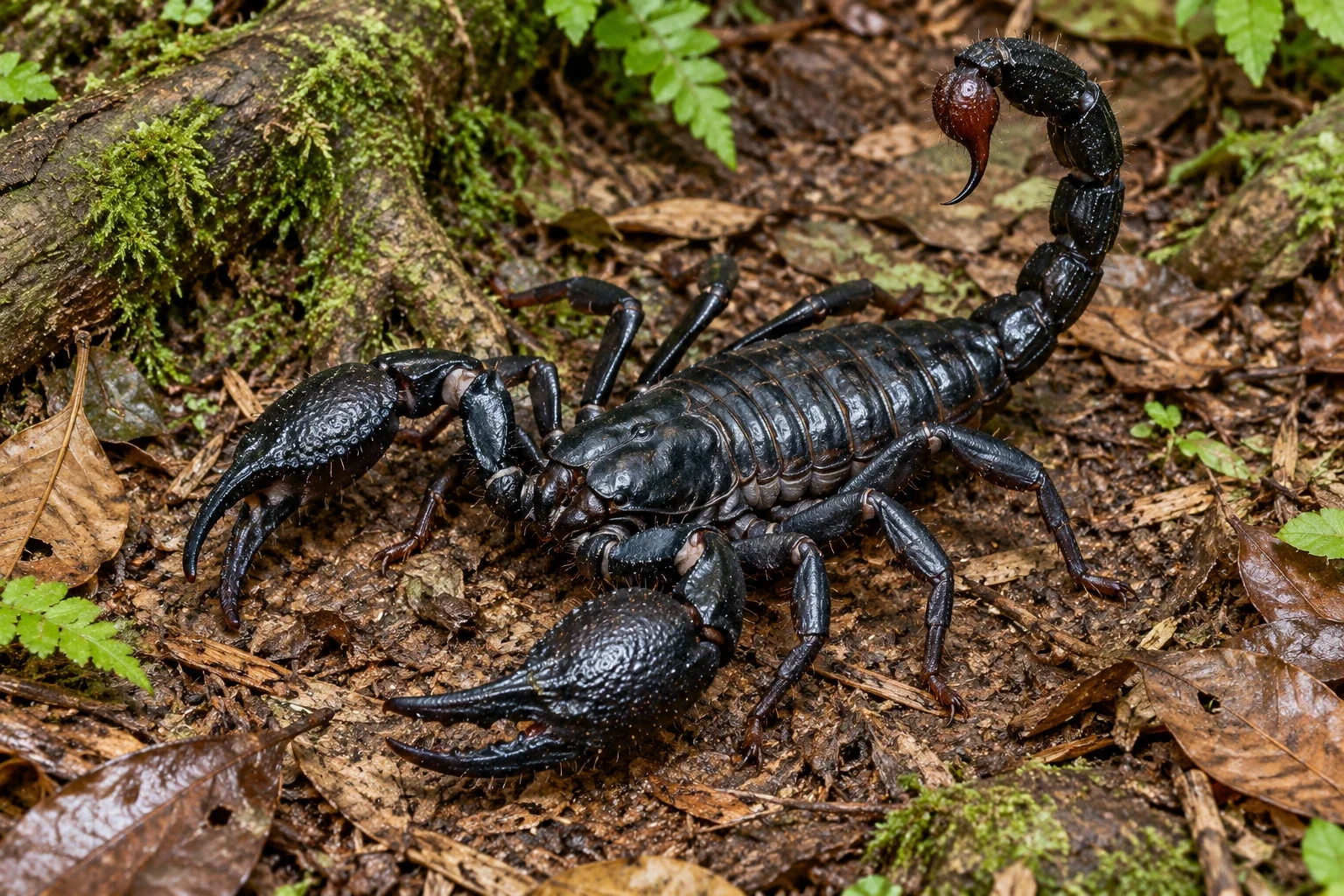
AI-generated natural-history study.
Interpretive portrait; no authenticated specimen claim.
Overview
The emperor scorpion has a glossy dark body, broad grasping pincers and a segmented tail ending in a sting. Zoo Zagreb describes four pairs of walking legs. Its large pincers are separate appendages, rather than another pair of legs, a distinction that matters when interpreting the animal’s outline.
Oregon Zoo describes a nocturnal rainforest predator from West Africa. Adults take ground-dwelling insects and other small animals, while young are fed fruit flies and small crickets in care. Sensory hairs compensate for limited vision. Large claws serve defence as well as handling prey; these features belong to a ground-dwelling hunter rather than a winged insect.
Zoo Zagreb reports live birth after an average gestation of around nine months, giving ten to twelve young in its account. Newborns depend strongly on their mother and ride on her back before becoming independent. Those reproductive values are attributed to the zoo’s account, rather than treated as a universal litter size or a measurement of wild population growth.
Origins & earliest records
Humid forest shelters
Evidence & interpretation
Institutional accounts and observed photographs.
Selected bibliography
Documented works and useful reading. This is not a list of every appearance.
- 01
- 02
Family & connections
A source-supported family tree or inspiration record has not yet been compiled for this profile. Related reading below indicates a connection in subject matter, not a proven lineage or creative influence.
Look for a taxonomic record and classified relativesReferences
Sources supporting this profile. Linked pages have their own scope and editorial standards.
- Institutional species account, CroatianKraljevski škorpion (Pandinus imperator)Research access: 2026-10-23
- Institutional species accountCommon emperor scorpionResearch access: 2026-10-23
Image credits
AI-generated interpretive illustrationAI-generated natural-history study.
Interpretive portrait; no authenticated specimen claim.