
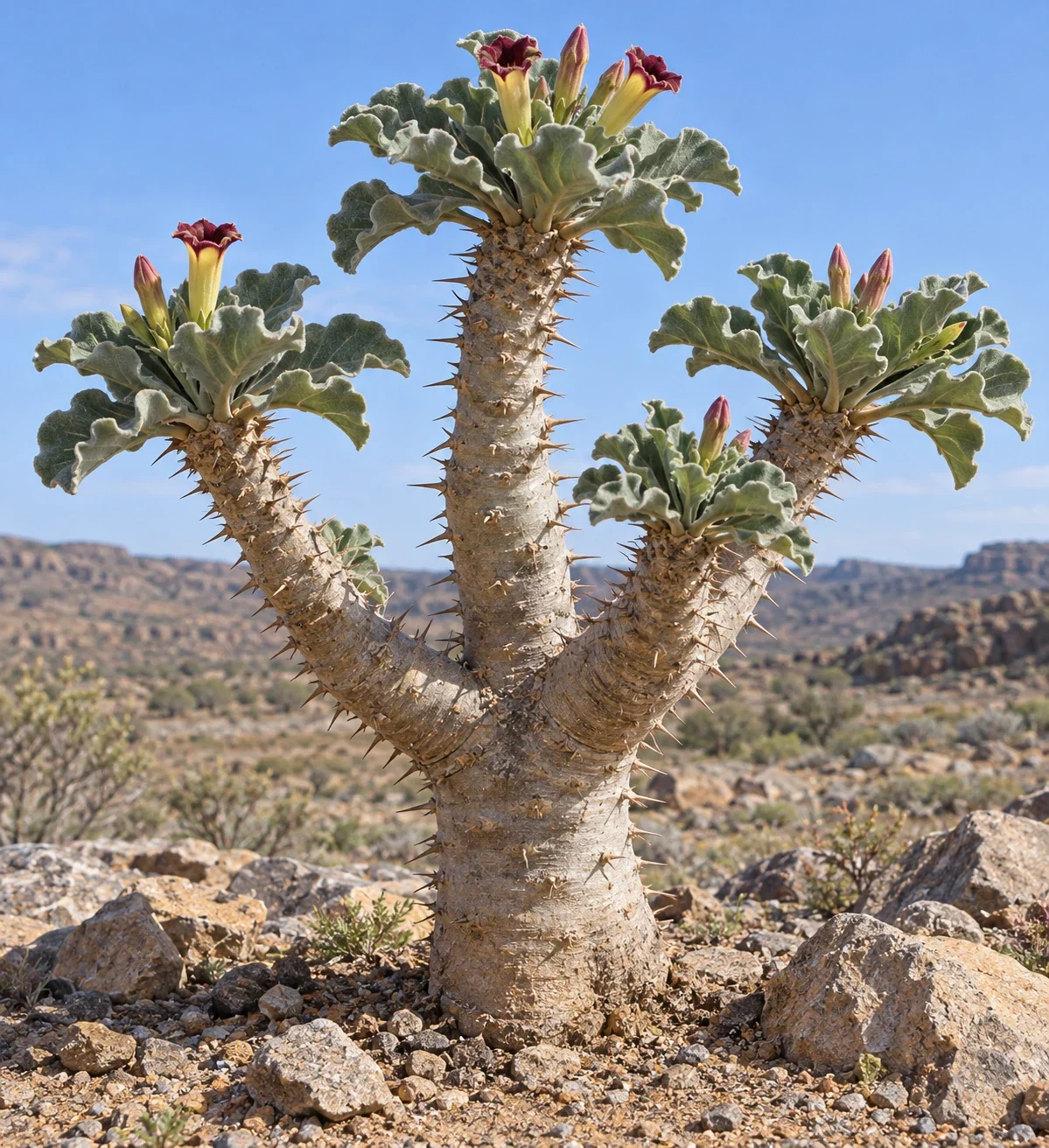
Modern AI botanical interpretation of a whole branching halfmens.
Modern AI halfmens botanical interpretation; fine spines and flowers schematic, no human anatomy.
Overview
SANBI’s genus account identifies the halfmens as a succulent with a cylindrical spiny stem and branch tips crowned by grey-green velvety leaf rosettes. Leaf margins are crisped. Long tubular flowers sit within the leafy heads, yellowish outside and wine-red inside; the leaves later dry and fall during hot summer conditions. The plant inhabits extremely dry rocky slopes, with roots wedged among boulders and crevices. Its distinctive silhouette is botanical structure, without requiring human features suggested by its common name.
The species account describes bees and ants entering its tubular flowers. Sugarbirds were observed pollinating cultivated plants at the Karoo Desert National Botanical Garden, but the author explicitly leaves their role in wild populations uncertain. After fertilisation, fruits take months to mature; seeds carry silky hairs that assist wind dispersal. Mining, grazing, invasive plants and collection are identified as threats. These observations distinguish documented garden activity from an untested claim about every wild population.
Kew accepts Pachypodium namaquanum in Apocynaceae and Gentianales, with Adenium namaquanum as a synonym. Its native range extends from southern Namibia to the northwestern Cape, in desert or dry shrubland.
Origins & earliest records
Accepted Kew identity with retained SANBI botanical and ecological accounts.
Evidence & interpretation
Retained scientific and institutional passages.
Selected bibliography
Documented works and useful reading. This is not a list of every appearance.
- 01
Pachypodium: halfmens species section
Pre403 indexed species section; whole genus-account cap.
- 02
Pachypodium namaquanum
Pre-access indexed ecology; wild sugarbird role uncertain.
- 03
Pachypodium namaquanum
Accepted family, order, range and synonym.
Family & connections
A source-supported family tree or inspiration record has not yet been compiled for this profile. Related reading below indicates a connection in subject matter, not a proven lineage or creative influence.
Look for a taxonomic record and classified relativesReferences
Sources supporting this profile. Linked pages have their own scope and editorial standards.
- Scientific or institutional accountPachypodium: halfmens species sectionResearch access: 2026-10-12
- Scientific or institutional accountPachypodium namaquanumResearch access: 2026-10-12
- Scientific or institutional accountPachypodium namaquanumResearch access: 2026-10-12
Image credits
Modern scientific interpretationModern AI botanical interpretation of a whole branching halfmens.
Modern AI halfmens botanical interpretation; fine spines and flowers schematic, no human anatomy.