
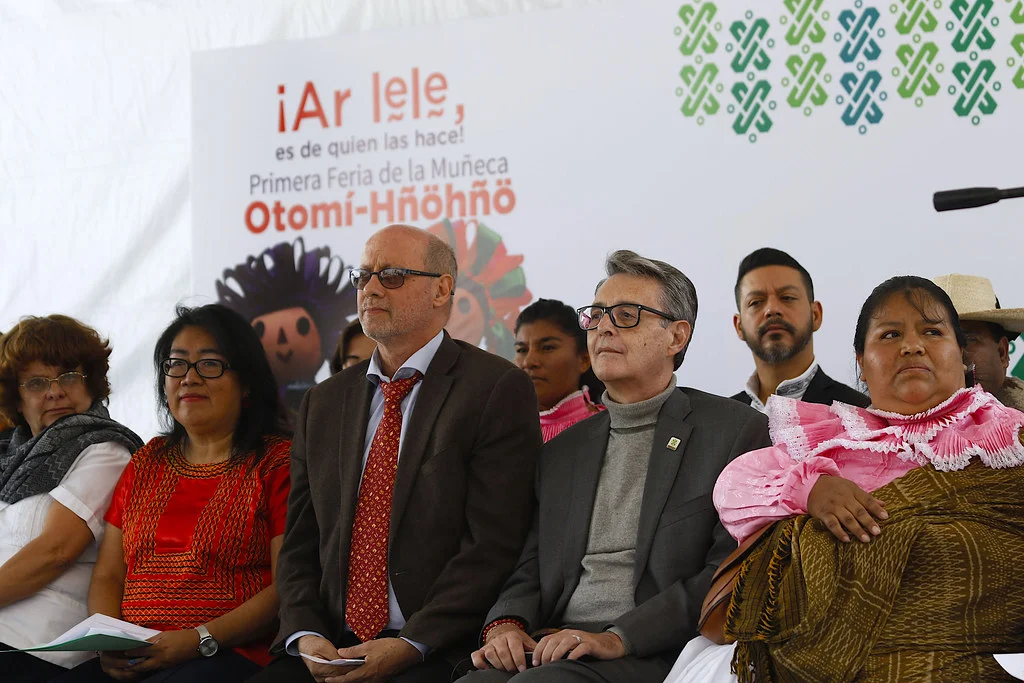
Seated attendees at the opening of the first Ar lele Otomí-Hñöhñö Doll Fair, in front of a banner naming the fair and showing a doll illustration.
Opening of the first Ar lele Otomí-Hñöhñö Doll Fair at Mexico City’s Monumento a la Revolución on 17 December 2019. This records a public cultural event; the photograph alone does not establish the identity or community membership of every attendee.
Overview
Otomí refers to communities with substantial regional and linguistic diversity. INPI's language introduction places the grouping within the Otomanguean family and identifies nine language variants across central Mexican states, including Hidalgo, Querétaro, the State of Mexico, Puebla and Veracruz. It records different self-designations, including hñähñú in the Mezquital Valley and yühmu in Ixtenco. These are linguistic descriptions with local contexts, not nine biological divisions or a map of nine interchangeable political governments. The page's undated speaker total is not used as a present population count.
Community teaching materials make that local specificity tangible. INPI's presentation of Margarita de la Vega Lázaro introduces her as an Otomí woman from La Magdalena Tenexpan in Temoaya, State of Mexico. Her language-learning book draws on everyday community life and on the language transmitted by her grandparents. The accompanying account describes workshops involving children, young people and adults, connecting older people's experience with daily activities. A resource made for this community should retain its place and author rather than being presented as a universal textbook for all Otomí varieties.
Contemporary literary work is equally specific in authorship. A Culture Ministry announcement of 29 August 2025 identifies María Isabel Pérez León, known as Margarita León, as the winner of that year's Nezahualcóyotl prize for Pothe/Manantial. The announcement describes an Otomí/hñähñu poetry manuscript, submitted under the pen name Bartola López, and discusses themes including nature, loss and collective memory. It also describes León's practice of writing in hñähñu and translating into Spanish. This is an account of a named writer's work and a dated award; it does not establish a publication date for the winning manuscript or turn her poetry into anonymous ancient testimony.
Another INPI notice, dated 26 October 2021, presents Relatos y leyendas del pueblo otomí de Michoacán as narratives contributed by older residents of Epitacio Huerta for the season of remembrance of the dead. The notice connects oral sharing with an editorial format intended for wider circulation. Its scope is one municipality's contributors, not every Otomí community's ceremonial practice. These book presentations provide routes into locally situated voices, but the complete books and their individual narratives have not been read for this profile. No poem, invocation or ceremonial instruction is reproduced.
History & identity
Regional community identities and language self-designations are documented separately from modern educational and literary publication dates.
Sources & representation
INPI language introduction and variant list; indexed complete substantive author/book presentation and two dated publication/award notices. Direct notice opens returned 403; no access bypass or full-book claim.
Selected bibliography
Documented works and useful reading. This is not a list of every appearance.
- 01
Aprendiendo otomí (hñähñu) de La Magdalena Tenexpan, Temoaya, Estado de México
INPI presentation only; complete book not read.
- 02
Pothe/Manantial
Winning manuscript announced in 2025; publication date not established.
Language & cultural connections
Source-supported language and cultural connections have not yet been compiled for this profile.
References
Sources supporting this profile. Linked pages have their own scope and editorial standards.
- InstitutionalINPI language introductionResearch access: 2026-10-05
- InstitutionalMargarita de la Vega Lázaro teaching resourceResearch access: 2026-10-05
- InstitutionalMargarita León award announcement, 2025Research access: 2026-10-05
- InstitutionalEpitacio Huerta narratives notice, 2021Research access: 2026-10-05
Image credits
Documentary photograph of a specifically identified public Otomí-Hñöhñö doll-fair openingSeated attendees at the opening of the first Ar lele Otomí-Hñöhñö Doll Fair, in front of a banner naming the fair and showing a doll illustration.
Opening of the first Ar lele Otomí-Hñöhñö Doll Fair at Mexico City’s Monumento a la Revolución on 17 December 2019. This records a public cultural event; the photograph alone does not establish the identity or community membership of every attendee.