
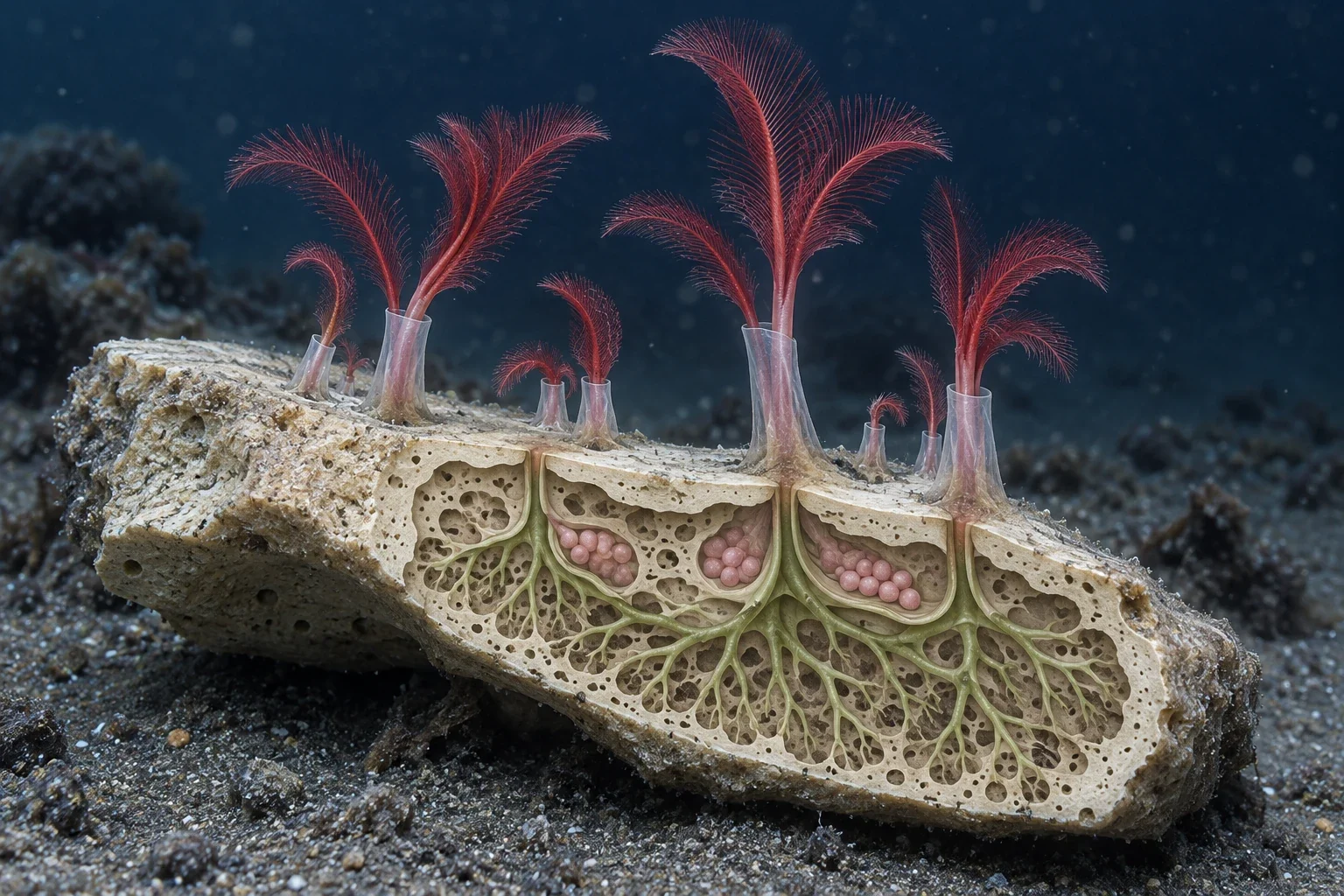
Modern AI interpretation of bone-dwelling worms.
Modern AI interpretation; tissue arrangement schematic, not a specimen or copied source illustration.
Overview
Osedax rubiplumus was among the two bone-eating worms announced from a whale fall in Monterey Canyon. MBARI describes reddish feathery plumes functioning as gills, a retractile muscular trunk and a tube. Below the trunk, an egg-bearing region and branching roots occupy the bone. The diagrammatic distinction between exposed and embedded tissues is central to interpreting its unusual appearance.
The original research abstract places Osedax in Siboglinidae using molecular and morphological evidence. Females consume whale bones through ramifying roots; numerous tiny, larva-like males occupy their tubes. The paper’s divergence estimate concerns the two discovered species, not a directly observed fossil origin. This account retains the association and reproductive contrast without turning a model estimate into a dated certainty.
The discovery team’s account reports bacteria in the roots and explains their nutritional role. Its female dimensions and observations cover the two species together; they should not become measurements for every O. rubiplumus individual. The present profile therefore avoids a universal body length, a prescribed plume count, or a complete range inferred from one whale fall.
Origins & earliest records
Described in 2004; that naming event is distinct from evolutionary divergence.
Evidence & interpretation
Retained scientific and institutional passages.
Selected bibliography
Documented works and useful reading. This is not a list of every appearance.
- 01
- 02
Family & connections
A source-supported family tree or inspiration record has not yet been compiled for this profile. Related reading below indicates a connection in subject matter, not a proven lineage or creative influence.
Look for a taxonomic record and classified relativesReferences
Sources supporting this profile. Linked pages have their own scope and editorial standards.
- Primary research abstractBone-eating wormsResearch access: 2026-10-11
- Research institution discovery accountWhale-fall discoveryResearch access: 2026-10-11
Image credits
Modern scientific interpretationModern AI interpretation of bone-dwelling worms.
Modern AI interpretation; tissue arrangement schematic, not a specimen or copied source illustration.