
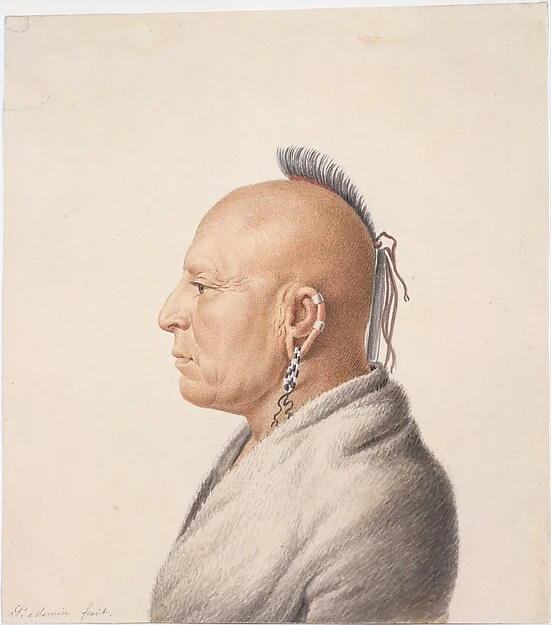
Saint-Mémin’s 1805–7 watercolor and graphite profile portrait catalogued as Osage Warrior, Met accession 54.82
Saint-Mémin made this watercolor and graphite portrait in 1805–7, drawing on his encounters with Indigenous delegations in Washington. The museum identifies the sitter as Osage, but does not provide his name. This is a French artist’s historical representation of one person, rather than a portrait of the contemporary Osage Nation or a definition of Osage appearance.
Overview
The Osage Nation, also identified as Wahzhazhe in its public cultural materials, is a living Indigenous nation with its present reservation in northeastern Oklahoma. Its visitor history describes earlier lands in Missouri, Arkansas, Kansas and Oklahoma, followed by displacement and removal. Proceeds from the forced sale of Kansas lands helped purchase the Oklahoma homeland from the Cherokee Nation. The history also records the violence directed against Osage people during the oil-rich 1920s. These experiences belong within a continuing national history that includes contemporary schools, cultural work and self-government, rather than ending with dispossession or the Reign of Terror.
The Nation’s government page dates the transfer of authority to a new constitutional government to 5 June 2006, with executive, legislative and judicial branches. That institutional date does not mark the beginning of Osage identity. Cultural planning likewise looks toward the future: a published twenty-five-year vision prioritizes language learning, historical education and stronger cultural institutions. It proposes preserving family materials and bringing resources together under Osage control, including concern about sensitive information on external websites. These priorities express goals and responsibilities; they are not measurements proving that a particular level of language fluency has already been achieved.
Language publishing gives those aspirations a concrete form. A January 2025 announcement introduced Corn and Squash, illustrated by Eric Pretty Eagle, and Devouring Mountain, illustrated by Cameron Free. Language Department director Braxton Redeagle explained that the books adapt older recorded versions while acknowledging that multiple versions circulated among Osage and related peoples. The announcement proposed distribution to schools, early-learning centres and libraries and described an accompanying app. The books are contemporary, credited language resources, rather than an assertion of a single unchanging version of every story. Their complete contents and app features have not been independently reviewed here.
Contemporary literature also includes Osage poet Elise Paschen’s Blood Wolf Moon. A March 2025 Nation announcement connected a planned museum reading with Paschen’s exploration of family, land and ancestral history, including the Reign of Terror. This is an individual author’s literary work, not a substitute for every Osage perspective. The same announcement describes the Osage Nation Museum in Pawhuska, founded in 1938, as a place for photographs, historical objects and both traditional and contemporary art. Literature and museum collections thus appear within living cultural institutions; the announcement alone does not prove that the scheduled reading occurred.
History & identity
The Nation’s public history distinguishes earlier homelands and forced removal from modern Oklahoma residence and the 2006 governmental transition.
Sources & representation
Complete reservation-history body, government introduction, cultural-vision body and two2025 publication announcements read. Full constitution, storybooks, poems and app not inspected.
Selected bibliography
Documented works and useful reading. This is not a list of every appearance.
- 01
Corn and Squash; Devouring Mountain
Bibliographic attestation from January2025 launch announcement; older versions and modern adaptations explicitly distinguished.
- 02
Blood Wolf Moon
Nation’s March2025 announcement identifies Red Hen Press publication and a planned reading; no complete-poetry reading claim.
- 03
Interview with Elise Paschen, author of Blood Wolf Moon
Chapter House Journal,25April2025 actual publication metadata.
Language & cultural connections
Source-supported language and cultural connections have not yet been compiled for this profile.
Located primary passages
Specific passages supporting details in this entry, grouped by their published witness.
Interview with Elise Paschen, author of Blood Wolf Moon
2025 interview.
- Paschen describes combining family research, linked poetic sections and Osage-language learning in Blood Wolf Moon. She credits Christopher Côté for orthographic assistance and Addie Roanhorse for the cover. Her account shows contemporary collaborative literary practice; remembered family history and interview interpretations remain attributed, rather than representing every Osage experience.
Full collection, dictionaries, family documents and film uninspected. No independent language verification, cover reproduction or universal cultural claim.
References
Sources supporting this profile. Linked pages have their own scope and editorial standards.
- Osage Nation official publicationOsage Culture: reservation historyResearch access: 2026-10-05
- Osage Nation official publicationOsage Nation: governmentResearch access: 2026-10-05
- Osage Nation official publicationOsage Nation: cultural visionResearch access: 2026-10-05
- Osage Nation official publicationOsage Nation: two language booksResearch access: 2026-10-05
- Osage Nation official publicationOsage Nation: Paschen literary event and museumResearch access: 2026-10-05
Image credits
Historical individual portrait illustrationSaint-Mémin’s 1805–7 watercolor and graphite profile portrait catalogued as Osage Warrior, Met accession 54.82
Saint-Mémin made this watercolor and graphite portrait in 1805–7, drawing on his encounters with Indigenous delegations in Washington. The museum identifies the sitter as Osage, but does not provide his name. This is a French artist’s historical representation of one person, rather than a portrait of the contemporary Osage Nation or a definition of Osage appearance.