
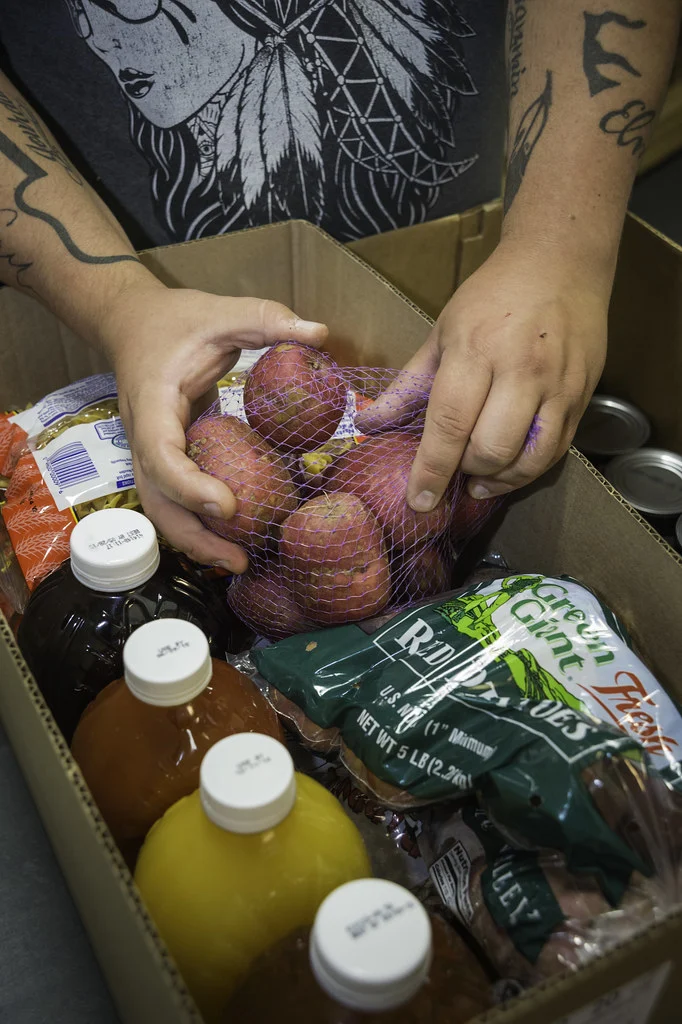
Joseph Jordan packing requested foods at the Oneida Nation Food Distribution Center in Oneida, Wisconsin, photographed by USDA’s Bob Nichols on 10 September 2014
Joseph Jordan packs requested foods at the Oneida Nation Food Distribution Center in Oneida, Wisconsin, on 10 September 2014. This photograph documents a particular community service and its work. It does not portray every Oneida household or establish an individual’s identity from clothing; the Wisconsin location is supplied by the original USDA caption.
Overview
The Oneida Nation of Wisconsin documents both connections to an earlier homeland in New York and a continuing history in Wisconsin. Its historical timeline places movement westward within a nineteenth-century removal period and describes continuing government by Oneida chiefs. Later sections identify language revitalization and the development of educational and heritage institutions. This entry follows the Wisconsin nation's own institutional record; it does not combine every Oneida community into one political jurisdiction or make migration the beginning of Oneida identity.
The Oneida Nation Museum opened in 1979 with a collection contributed by community members. Its institutional history records a substantial acquisition from the closing Turtle Museum in Niagara Falls during 1994–1995. The museum's stated purpose includes explaining culture, history and nationhood, supporting contemporary artwork and developing educational programming for different ages. These origins show that a collection has its own history of contributions and acquisition. Objects held together in a museum should not automatically be interpreted as originating in a single locality or period.
Language work is presented as an activity in which community members can participate. The nation's language program describes regular classes and a Language House, and it connects learning and everyday speaking with continued use of Oneida. This is an educational mission and an invitation to participate, rather than evidence that all citizens have equal language proficiency. The public program description also does not establish the results achieved by any particular class or learner.
The Cultural Heritage resources catalogue makes named contributors visible. It lists family-term recordings by Leanne Thompson and Hudson Doxtator, lessons credited to Doxtator and sound practice recorded by Randy Cornelius. Learning materials include printable activities, visual aids and companion documents for recordings, alongside historical publications and a WPA Writers' Project link. The catalogue was examined as a guide to community-produced resources; the linked stories, recordings and teaching packets were not themselves reviewed, and their access conditions are not replaced by this summary.
The broader Cultural Heritage mission brings knowledge about social, political and economic life into conversation with historical and contemporary worldviews. It emphasizes strengthening the community's ways through resources and teaching. Read together, these institutional descriptions present culture as sustained work by educators, collectors and community participants, while leaving room for differences in individual knowledge, practice and experience.
History & identity
Historical movement, political community and the later founding of cultural institutions are distinguished.
Sources & representation
Complete museum About and Cultural Heritage mission bodies; selected timeline migration/revitalization sections; complete language program introduction and selected teaching-resource catalogue. Linked books, audio and legal texts unread.
Selected bibliography
Documented works and useful reading. This is not a list of every appearance.
- 01
Oneida Cultural Heritage Resources: Listen and Learn catalogue
Catalogue only; individual recordings and accompanying texts not reviewed.
- 02
These Rivers Remember: poem commentary
LOC AFC2020/004:42; recorded28June2020, Mt.Horeb, Wisconsin.
Language & cultural connections
These connections link languages or specific cultural works and institutions; they do not establish biological ancestry or ethnic identity.
Oneida Nation Museum
The Nation’s museum account records community collections at its 1979 opening and a mission connecting preservation, exhibitions and education. This is an institutional relationship, not biological descent.
Located primary passages
Specific passages supporting details in this entry, grouped by their published witness.
These Rivers Remember: poem commentary
LOC2020 transcript.
- Hill identifies herself as Oneida while discussing her poem about Dakota displacement and remembrance. She credits Chris Mato Nunpa for language assistance and connects the writing to her Twin Cities experience. This is an individual author’s reflection across communities, not a universal Oneida account or independently verified historical chronology.
Poem text, audio and Cicadas collection not inspected. Historical details, translations and broad cultural statements remain attributed.
References
Sources supporting this profile. Linked pages have their own scope and editorial standards.
- Community-authoredOneida historical timelineResearch access: 2026-10-05
- Community-authoredMuseum founding and missionResearch access: 2026-10-05
- Community-authoredOneida language programResearch access: 2026-10-05
- Community-authoredCultural Heritage resources catalogueResearch access: 2026-10-05
- Community-authoredCultural Heritage missionResearch access: 2026-10-05
Image credits
Contextual community food-distribution photographJoseph Jordan packing requested foods at the Oneida Nation Food Distribution Center in Oneida, Wisconsin, photographed by USDA’s Bob Nichols on 10 September 2014
Joseph Jordan packs requested foods at the Oneida Nation Food Distribution Center in Oneida, Wisconsin, on 10 September 2014. This photograph documents a particular community service and its work. It does not portray every Oneida household or establish an individual’s identity from clothing; the Wisconsin location is supplied by the original USDA caption.