
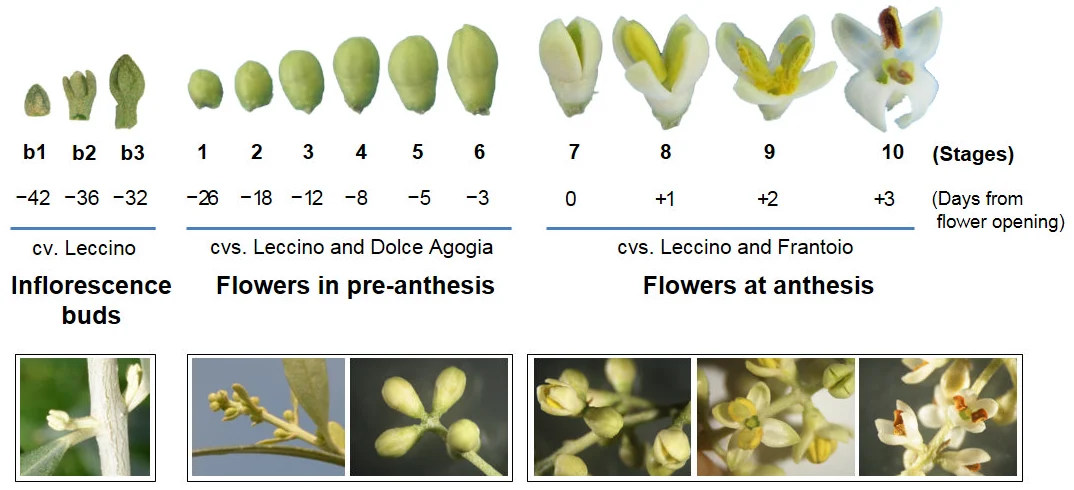
Whole olive-flower development montage with cultivar labels, flower buds, open flowers and sampling-stage markers.
Flower stages in Leccino, Dolce Agogia and Frantoio cultivars sampled at the Spoleto olive collection. Dates describe this sampling schedule.
Overview
Kew accepts Olea europaea in Oleaceae, with a native range across Africa and from the Mediterranean toward southern central China, including Greece and Kriti. Its 1753 publication marks naming history only.
It is an evergreen with paired, elliptic, silvery leaves. Flowers form clusters in the leaf axils, with four-lobed calyx and corolla and two stamens. The fruit has a fleshy outer layer around a hard stone enclosing the seed.
A 2020 study sequenced Picual and resequenced forty cultivated and ten wild accessions. It found high cultivated diversity and expanded transposable-element families, with some insertions near genes potentially linked to domestication traits. Clonal propagation and occasional sexual crosses shape cultivars; no single domestication route was established.
Origins & earliest records
Formally published in Species Plantarum (1753), p. 8, per Kew. Domestication history is not resolved by the sources used.
Evidence & interpretation
Kew accepted name, distribution and species profile; Jiménez-Ruiz et al. 2020 genomic study (abstract, pp. 1–2).
Selected bibliography
Documented works and useful reading. This is not a list of every appearance.
- 01
Species Plantarum
Selected bibliography; original place of publication (p. 8) as recorded by Kew.
- 02
Transposon activation is a major driver in the genome evolution of cultivated olive trees (Olea europaea L.)
Selected bibliography; The Plant Genome, DOI 10.1002/tpg2.20010.
Family, evolution & connections
Taxonomic classification
A hierarchy of classified groups, not a chain of direct ancestors.
Source note: Family placement follows Kew, which currently accepts seven infraspecific taxa; these are not itemised here.
- FamilyOleaceae
- SpeciesOlea europaea
References
Sources supporting this profile. Linked pages have their own scope and editorial standards.
- Taxonomic databaseOlea europaea L. | Plants of the World OnlineResearch access: 2026-10-07
- Institutional species profileOlea europaea L. — general informationResearch access: 2026-10-07
- Journal articleTransposon activation is a major driver in the genome evolution of cultivated olive trees (Olea europaea L.)Research access: 2026-10-07
Image credits
Original scientific figureWhole olive-flower development montage with cultivar labels, flower buds, open flowers and sampling-stage markers.
Flower stages in Leccino, Dolce Agogia and Frantoio cultivars sampled at the Spoleto olive collection. Dates describe this sampling schedule.