
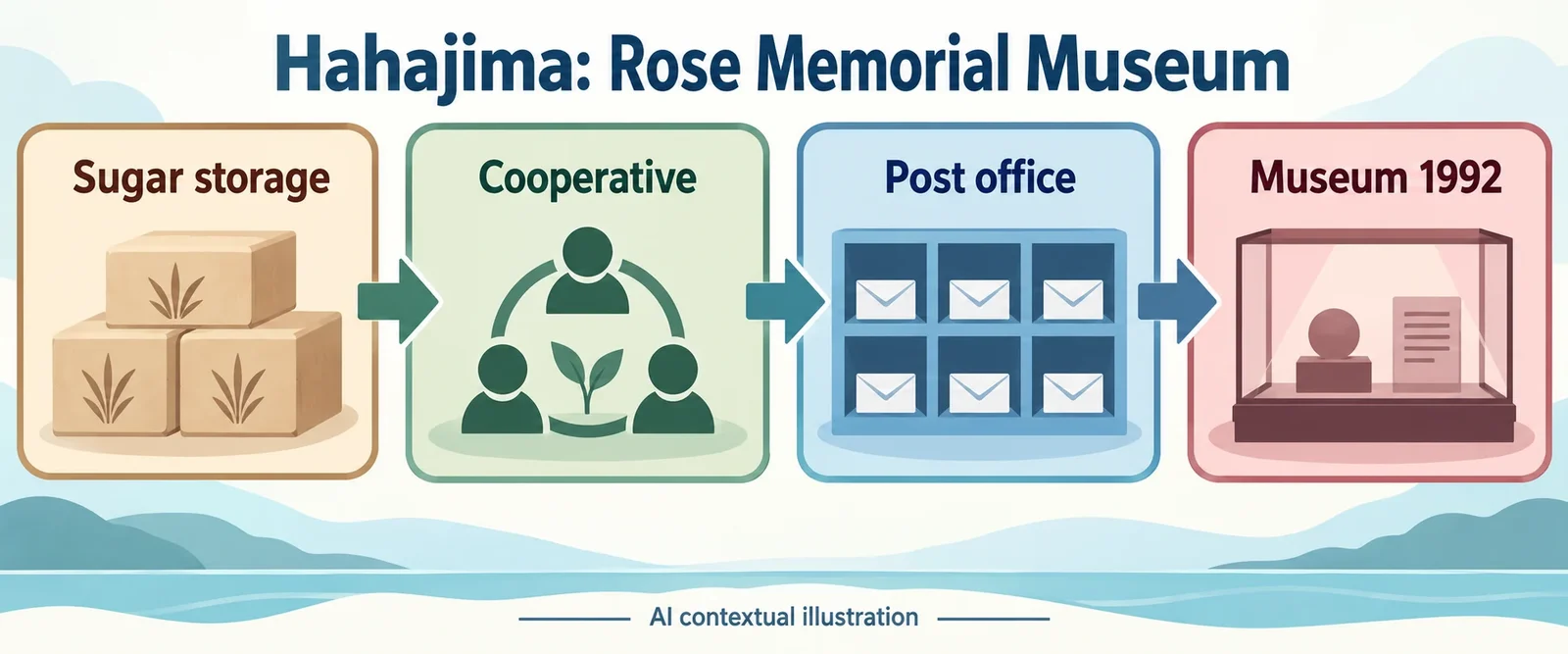
AI diagram of Hahajima building uses ending at Rose Memorial Museum
AI contextual illustration. Setting, tools and layout imagined; not ethnographic evidence.
Overview
The village tourism association describes European and Pacific Islander settlement in 1830, wartime evacuation in 1944 and general permission to return in 1968. It also traces the shift from whaling to whale watching. These selected island histories do not define a single ethnicity or establish identical experiences for all residents.
Tokyo’s 2026 visitor brochure follows Hahajima’s Rose Memorial Museum building from sugar storage through cooperative and postal uses to a local-history museum in 1992. It describes displays of residents’ whaling tools and older daily-life photographs. This is institutional interpretation.
History & identity
Selected settlement and local-institution histories.
Sources & representation
Selected public institutional passages retained.
Selected bibliography
Documented works and useful reading. This is not a list of every appearance.
- 01
- 02
Language & cultural connections
Source-supported language and cultural connections have not yet been compiled for this profile.
References
Sources supporting this profile. Linked pages have their own scope and editorial standards.
- Village-association historical accountHistory and Lives: OgasawaraResearch access: 2026-10-12
- Official indexed museum visitor accountRose Memorial Museum: Tokyo visitor brochure (2026)Research access: 2026-10-12
Image credits
AI contextual interpretationAI diagram of Hahajima building uses ending at Rose Memorial Museum
AI contextual illustration. Setting, tools and layout imagined; not ethnographic evidence.