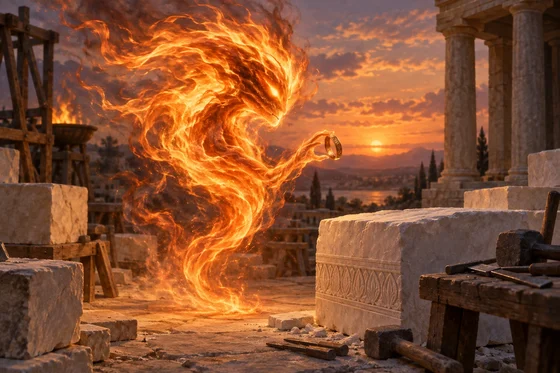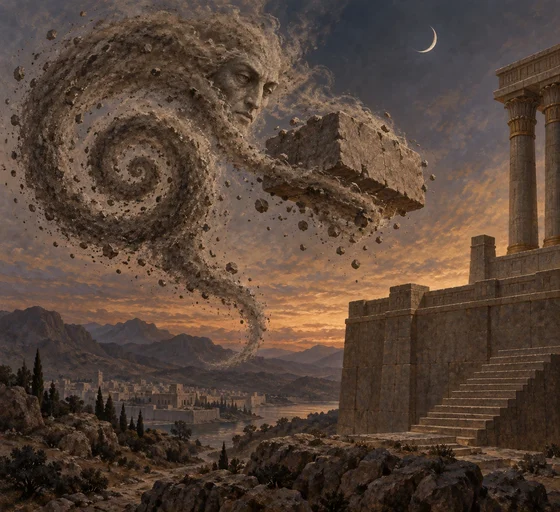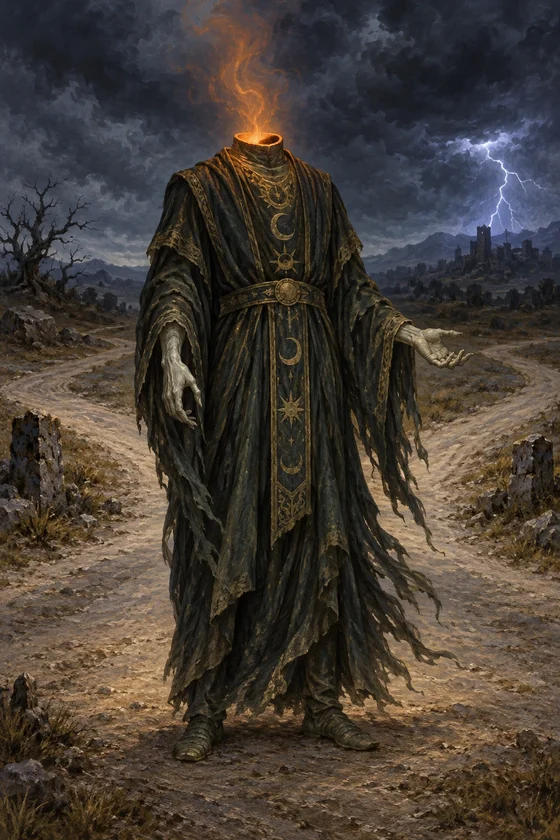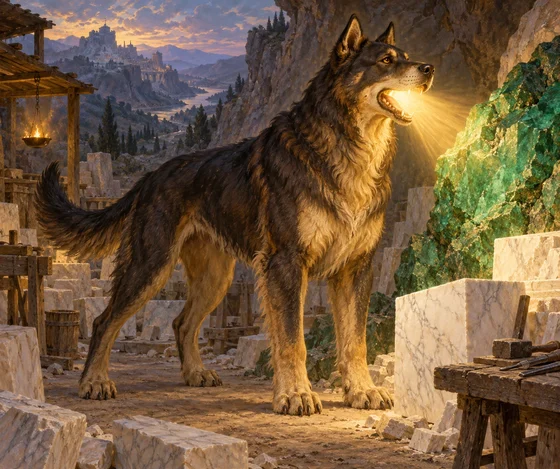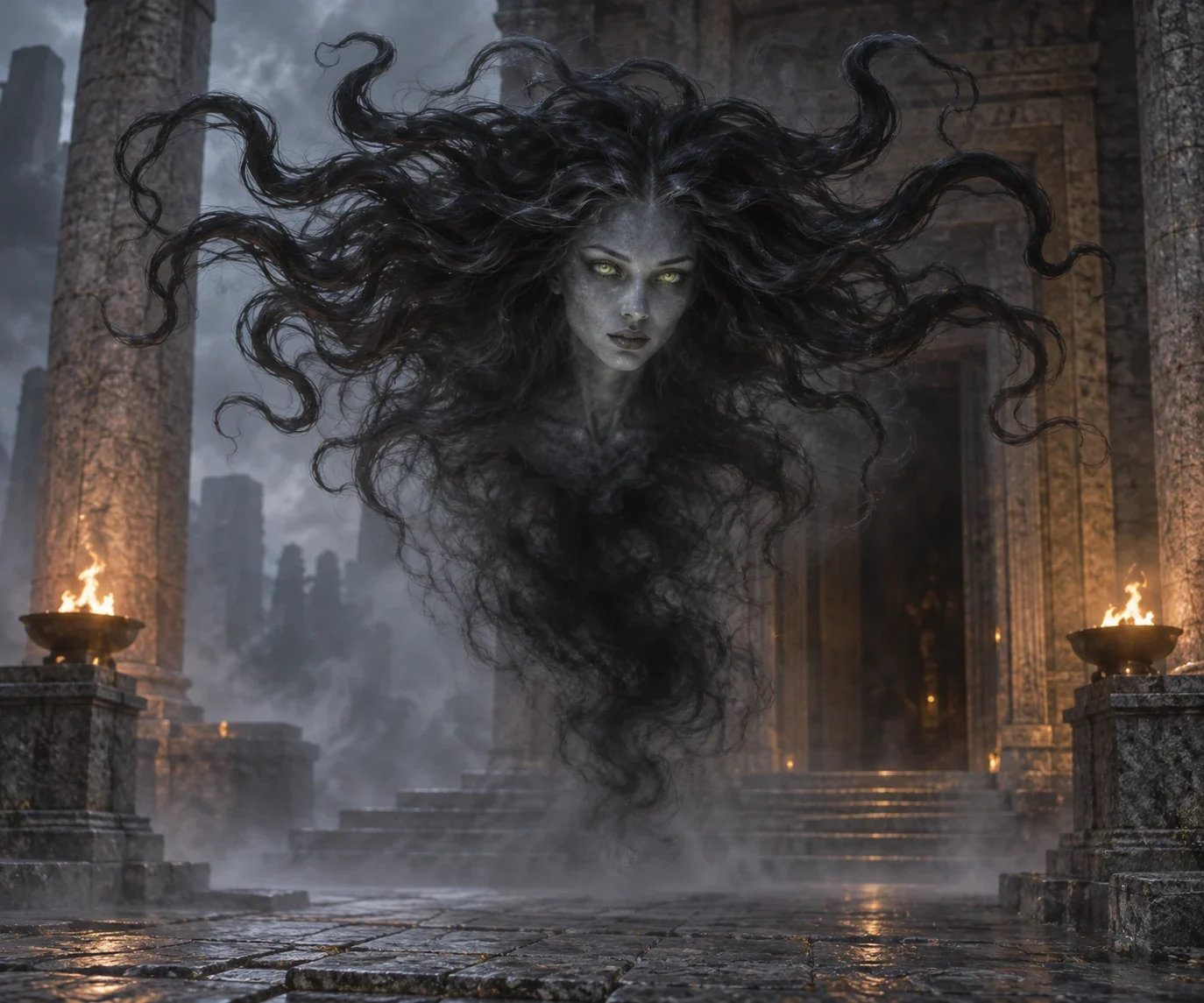
Obizuth - AI-generated imagined folklore illustration.
AI-generated imagined Obizuth with greenish eyes, dishevelled hair and a body concealed in darkness. Face details, mist and temple entrance are invented; this is no ethnic or historical portrait.
Overview
Obizuth appears as a female-shaped spirit with a head but no visible limbs. She initially orders Solomon to wash his hands before questioning her. Later his inspection describes her body as dark, her eyes as bright and greenish, and her tossed hair as dragon-like. The clear speaking voice contrasts with the concealment of her body.
She identifies herself as a sleepless traveler of many names and shapes, visiting women in childbirth and seeking to destroy children. The account also attributes sensory and bodily afflictions to her. These are the text’s explanations of feared childhood harm, not medical claims. This selected episode supplies no complete catalogue of her many names and is not used to collapse every childbirth demon into one identity.
Obizuth names Afarôf, interpreted by the passage as Raphael, as the power that defeats her. Writing that name on a woman in childbirth is given as an exclusion rite, with the number640 explained in an editorial note. Solomon orders the spirit suspended by her bound hair before the temple. Conybeare compares the appearance to Medusa in a note; that comparison does not prove a direct origin from the Greek figure.
Origins & earliest records
The selected documented witness is F. C. Conybeare’s1898 English translation of the Greek Testament of Solomon, following Fleck’s edition of a Paris manuscript. Its narrated temple-era setting is not a verified date of composition or folklore invention. Jewish and Christian elements and difficult readings are retained with source attribution.
Records & interpretation
§§57–59 and notes89–93; depiction deliberately excludes children and harm.
Selected bibliography
Documented works and useful reading. This is not a list of every appearance.
- 01
The Testament of Solomon, selected episode and editorial notes
§§57–59 and notes89–93; depiction deliberately excludes children and harm.
Family & connections
A source-supported family tree or inspiration record has not yet been compiled for this profile. Related reading below indicates a connection in subject matter, not a proven lineage or creative influence.
References
Sources supporting this profile. Linked pages have their own scope and editorial standards.
- Primary text in a historical scholarly editionThe Testament of Solomon: Conybeare translation and notesResearch access: 2026-10-10
Image credits
AI-generated imagined folklore illustrationObizuth - AI-generated imagined folklore illustration.
AI-generated imagined Obizuth with greenish eyes, dishevelled hair and a body concealed in darkness. Face details, mist and temple entrance are invented; this is no ethnic or historical portrait.