
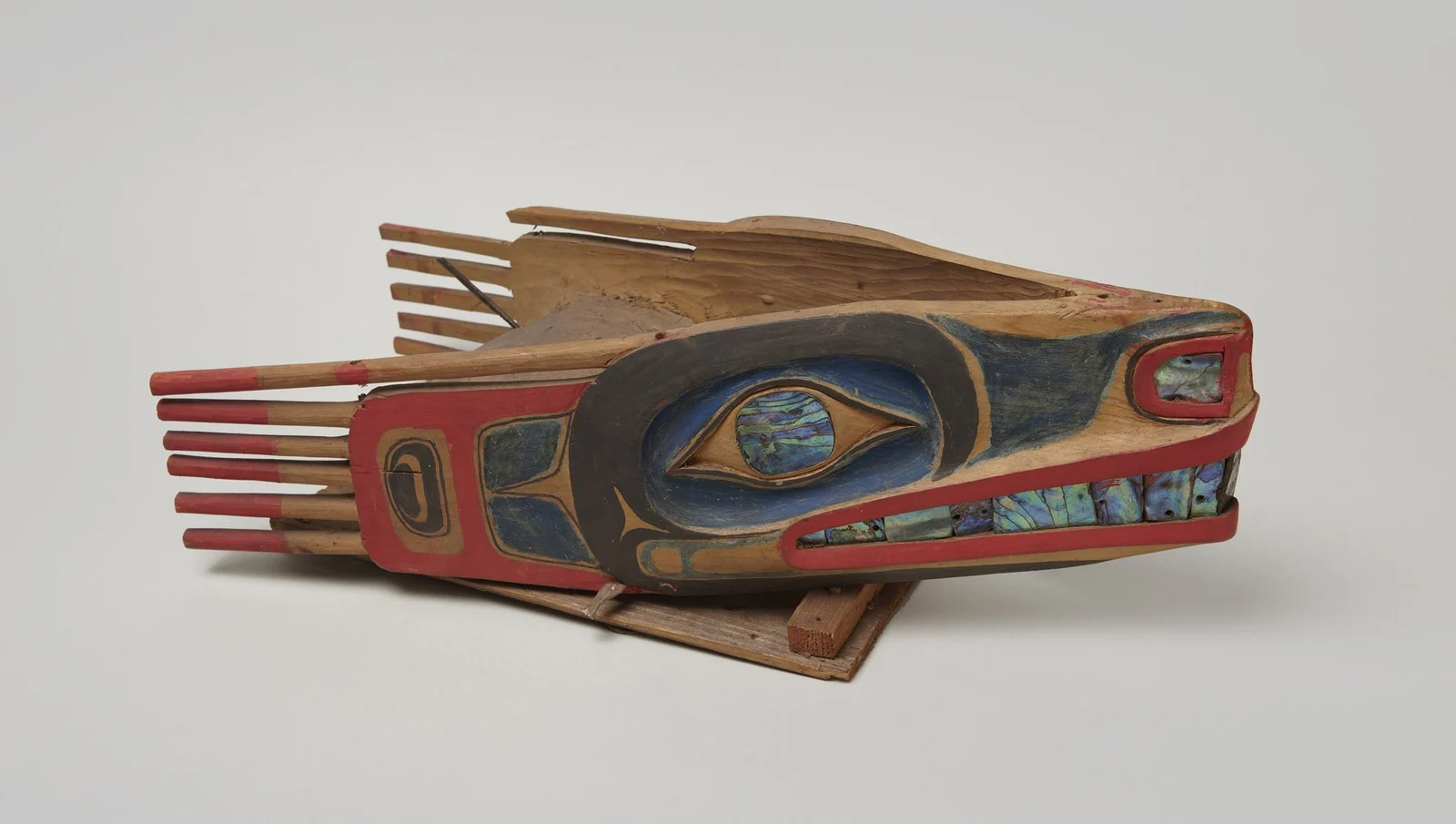
A carved wooden wolf-salmon trap headdress with a long muzzle, red and dark painted forms, abalone eye and teeth, and projecting wooden rods at the back.
Wolf-salmon trap headdress, before1885, catalogued by Princeton as probably Nuu-chah-nulth. Its attribution remains qualified; the object does not establish a universal design or practice among Nuu-chah-nulth peoples.
Overview
Nuu-chah-nulth encompasses distinct First Nations, rather than one interchangeable local government. The Nuu-chah-nulth Tribal Council describes itself as a nonprofit society supporting fourteen nations grouped in southern, central and northern regions. Its members include communities such as Ahousaht, Tseshaht, Huu-ay-aht, Ehattesaht and Nuchatlaht. Its remit joins political advocacy with education, health, family support and aquatic-resource management. The council also identifies protection of hereditary chiefs’ territories among its goals. Shared administration serves participating nations; it does not erase their own identities, authority or different arrangements for particular services.
The council’s historical timeline distinguishes several stages of organization: the West Coast Allied Tribes alliance in 1958, incorporation under another name in 1973, and adoption of the Nuu-chah-nulth Tribal Council name in 1979. Ha-Shilth-Sa, its newspaper, began in 1974. These dates concern modern institutions rather than the beginning of Nuu-chah-nulth histories. The same timeline places the launch of Uu-a-thluk aquatic-resource work in 2005 and the coming into effect of the Maa-nulth Treaty for five named nations in 2011. The latter is not presented as a treaty applying uniformly to every council member.
The council’s school-support account describes education workers as links among students, parents and schools in districts 70 and 84. Its Pathways approach seeks to incorporate culturally relevant teaching while providing everyday support from kindergarten through secondary school. Agreements with three school districts are described as developed in partnership with communities, and the council also organizes graduation recognition and scholarships. This is an account of service design and institutional relationships, not a comparative measure of students’ achievement. The agreements themselves have not been examined, and the description does not imply that schooling is the only place cultural knowledge is learned.
Denise Titian’s March 2023 report for Ha-Shilth-Sa gives a more personal example. Ehattesaht learner and teacher ḥakaƛ, also identified as Chrissy John, was undertaking a teaching practicum while continuing daily language work with elder Fidelia Haiyupis. The report describes remote mentoring, learning expressions connected with everyday situations, and sharing language with family at home. It also names the late Katie Fraser as an earlier mentor. These details show learning and teaching occurring together through particular relationships. They remain a dated account of one person’s work, not a present employment claim or a single model imposed on all Nuu-chah-nulth communities.
History & identity
Tribal Council institutional history and services, plus a named community newspaper report.
Sources & representation
Complete About, history and school-support bodies and full Titian article read; treaties, agreements and recordings not examined.
Selected bibliography
Documented works and useful reading. This is not a list of every appearance.
- 01
Nuu-chah-nulth-aht integrate ancestral language into daily life as First People’s Cultural Council releases report
Denise Titian; community newspaper, 10 March 2023
Language & cultural connections
Source-supported language and cultural connections have not yet been compiled for this profile.
References
Sources supporting this profile. Linked pages have their own scope and editorial standards.
- Community institutionAbout NTCResearch access: 2026-10-06
- Community institutional historyNuu-chah-nulth Tribal Council: HistoryResearch access: 2026-10-06
- Community education servicesKindergarten to Grade 12 Education Support ServicesResearch access: 2026-10-06
Image credits
Museum photograph of a historical carved headdress with qualified cultural attributionA carved wooden wolf-salmon trap headdress with a long muzzle, red and dark painted forms, abalone eye and teeth, and projecting wooden rods at the back.
Wolf-salmon trap headdress, before1885, catalogued by Princeton as probably Nuu-chah-nulth. Its attribution remains qualified; the object does not establish a universal design or practice among Nuu-chah-nulth peoples.