
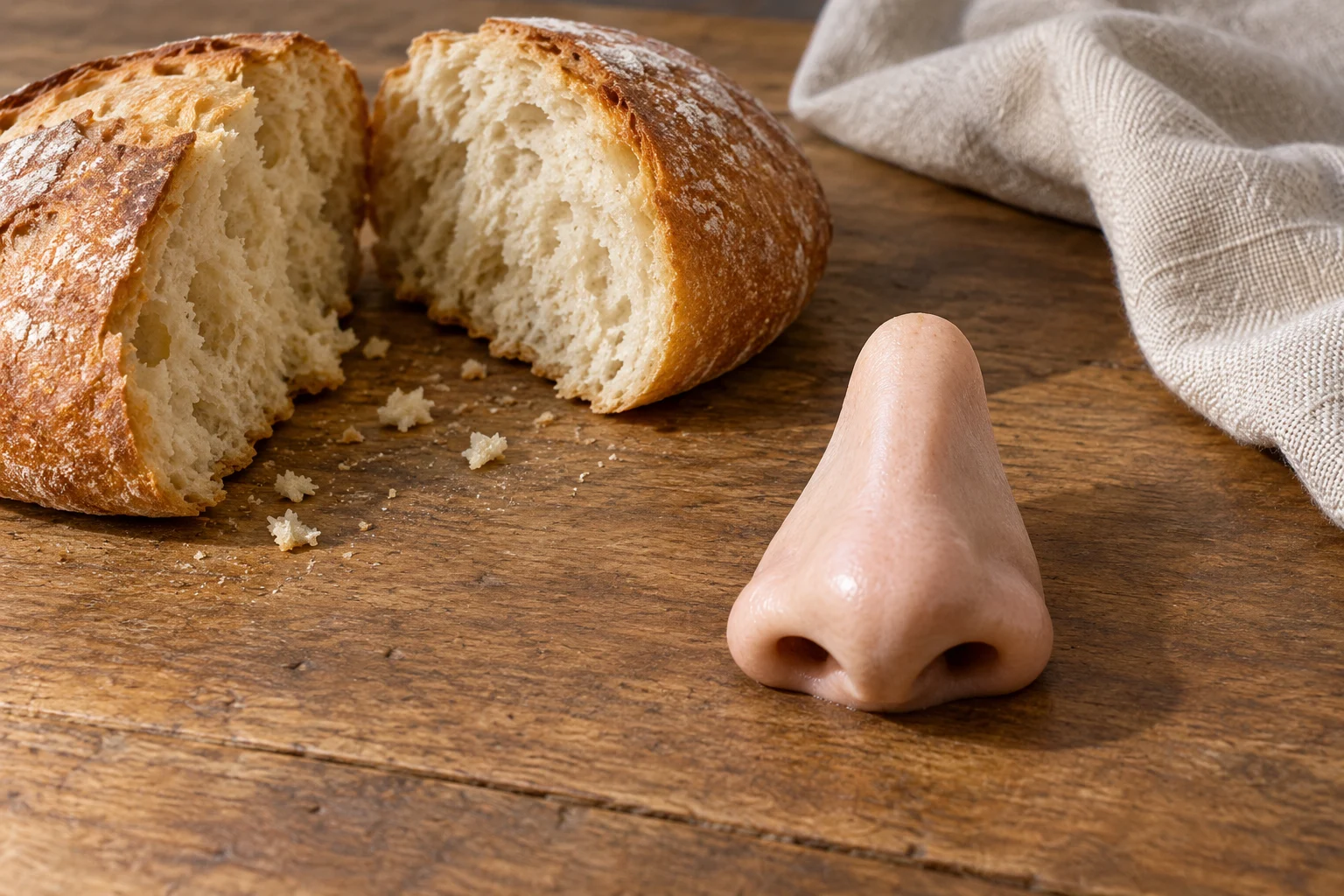
AI-generated interpretation of Gogol’s Nose in its intact ordinary-scale form; exact contours and still-life staging are reconstructed.
The illustration selects the Nose’s ordinary-scale form, rather than adding a body to its separate official persona.
Overview
In Claud Field’s translation of Gogol’s tale, the Nose is both an ordinary-looking part of Major Kovaloff’s face and an inexplicably independent gentleman. The barber Ivan Jakovlevitch discovers something whitish in a fresh loaf, draws out a nose and recognises his customer’s missing feature. Meanwhile Kovaloff wakes with a smooth vacancy where it should be. Later he encounters his own nose dressed in a gold-embroidered uniform, a stiff high collar, chamois-leather trousers, a sword and a plumed hat marking the rank of state-councillor. This is the same missing nose operating in society, not a separately introduced man named Nose.
The official-looking Nose speaks for itself and rejects Kovaloff’s claim to ownership, insisting on its independent identity and on the difference between their departments. Its apparent superiority of rank leaves Kovaloff unable to command it. The Major tries the police and an advertisement office, but his loss becomes an occasion for bureaucratic obstruction, embarrassment and suspicion. A police official eventually returns the Nose wrapped in paper, saying it was intercepted while preparing to travel to Riga. Restored to the scale of an ordinary bodily feature, it still will not attach when Kovaloff tries to replace it; even a doctor provides no useful solution.
The city adds rumours and imagined sightings to the affair. On 7 April the Nose is suddenly back between Kovaloff’s cheeks, without a demonstrated cause, and his ordinary social rounds resume. The narrator calls attention to the implausibility of both the disappearance and the discovery in bread, then refuses a tidy explanation. The tale therefore supplies no reliable origin spell or repeatable transformation rule. Its shifts between intact bodily feature and uniformed official are part of the literary absurdity, not evidence for a general species of wandering noses.
First appearances & development
Russian-language authored narrative, consulted in Claud Field’s historical English translation.
Canon & continuity
Complete selected story, title, preface and relevant notes retained.
Selected bibliography
Documented works and useful reading. This is not a list of every appearance.
- 01
The Mantle and Other Stories — The Nose
Retained Stokes/Laurie print title is undated; no exact publication year is asserted.
Family & connections
A source-supported family tree or inspiration record has not yet been compiled for this profile. Related reading below indicates a connection in subject matter, not a proven lineage or creative influence.
References
Sources supporting this profile. Linked pages have their own scope and editorial standards.
- Primary historical English translationThe Mantle and Other Stories — The NoseResearch access: 2026-10-18
- Institutional bibliographyBnF record FRBNF33027012Research access: 2026-10-18
Image credits
AI-generatedAI-generated interpretation of Gogol’s Nose in its intact ordinary-scale form; exact contours and still-life staging are reconstructed.
The illustration selects the Nose’s ordinary-scale form, rather than adding a body to its separate official persona.