
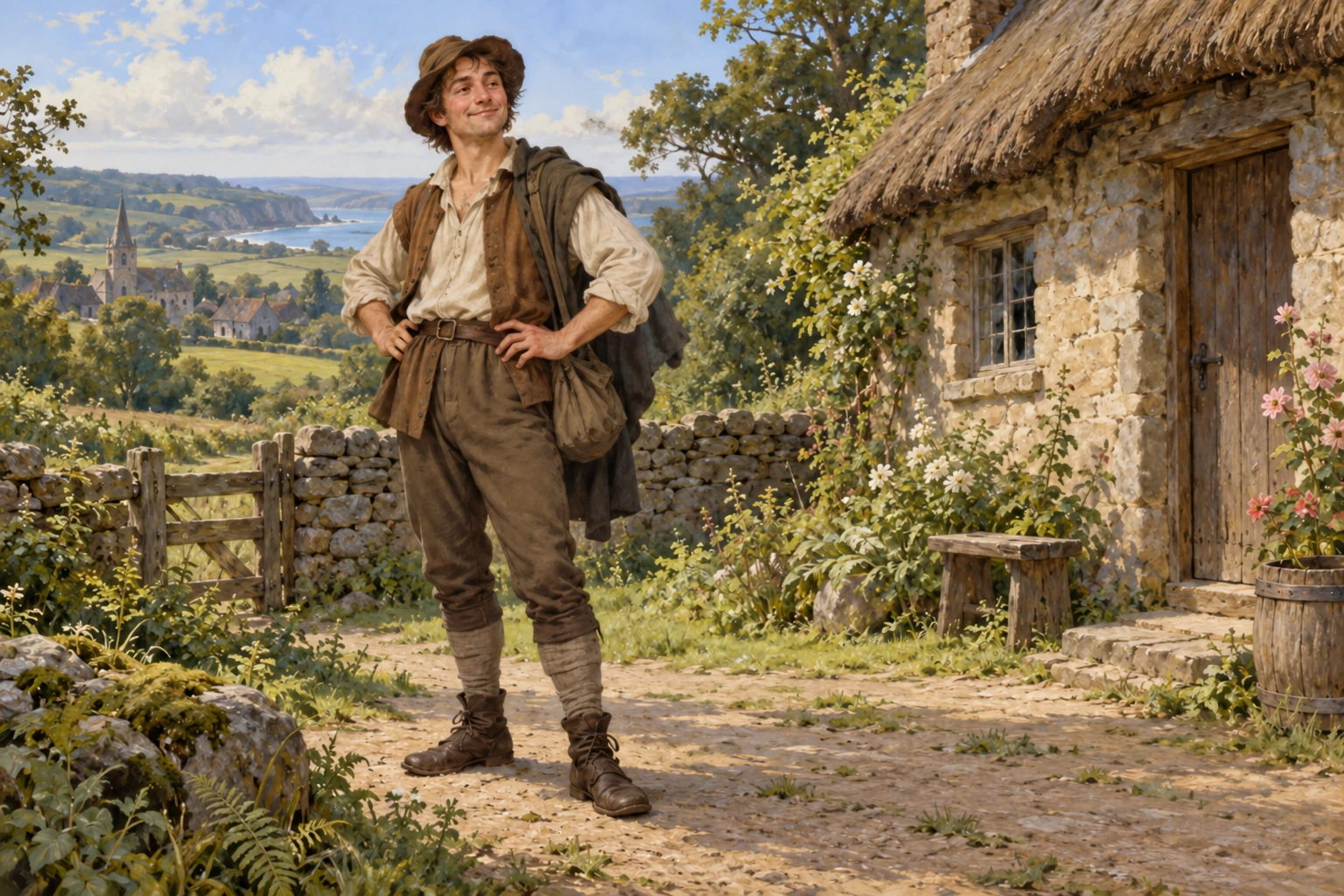
AI-generated interpretation of the Lutin’s young-villager presentation in Keightley’s Norman account. Face, clothes, bag, pose, buildings and landscape are imagined. This depicts one reported presentation rather than a universal goblin body or documented Norman costume.
The original generated image was edited once to remove an invented signature; the full frame is retained. No modern franchise design or ethnographic portrait is claimed.
Overview
Keightley’s Norman account groups several domestic and roadside encounters under the names Lutin and Gobelin. The being tends children and horses, but affectionate attention can become punishment or a troublesome joke. Children receive food and caresses, while disobedience brings pinching or whipping. Horses receive care, yet their manes are tangled into complicated plaits. In one brief incident two girls sleep in a stable and wake with their own hair so entangled that it must be cut away. These reports locate the spirit among household routines rather than describing a uniform population with fixed ears, skin colour or equipment.
The same discussion gives the Lutin a changing outward presentation. Sometimes he appears as a young villager, whom a peasant should address politely as Bon Garçon. Sometimes he is a bridled and saddled horse, apparently offering a tired worker an easy journey home. A rider instead receives a violent sequence of bucking and rearing, ending in a marsh or water-filled ditch. Keightley records the name Cheval Bayard for that presentation and suggests a connection with the romance horse. His proposed explanation is kept separate from the narrated trick; it does not make the Norman household spirit and every literary Bayard one creature.
A fuller tale from the neighbourhood of Argentan follows a Fé who visits a woman at her spinning each evening. He sits opposite her and watches. After she tells her husband, the husband puts a red-hot griddle on the visitor’s stool, dresses in her clothes and attempts her work. The visitor notices that the spinner’s movement has changed, but nevertheless takes his usual seat and is burned. His nearby companions ask who has injured him. He answers with the name the woman has supplied for her husband: Myself. The companions mock the apparent self-inflicted injury and leave. The episode depends on recognition, deception and an unhelpful answer rather than on defeating the spirit through strength.
Other means of avoiding trouble are more orderly. Scattered flax seed is said to drive a Lutin from a house: he cannot tolerate the disorder, but grows tired of gathering it. The coastal Nain Rouge provides a different set of encounters. Two fishermen travelling towards Pollet meet a boy who joins them and entertains them with tricks. Near a pond he flings one fisherman across the water; the man lands safely, and the spirit credits the holy water taken that morning for preventing the intended soaking. In another account, children who mock the little red man shelter in a boat under an apparent hour-long shower of stones. When the attack stops, no stones can be found.
Keightley closes this stretch with wolf-shaped Lubins, frightened churchyard visitors led by a black chief, while treating the connection between their name, Lutin and the French word for wolf as a possibility. That neighbouring account is not imported as the Lutin’s universal anatomy. His notes also assemble older uses of Gobelin and Lutin and a related disguise story with a different outcome. This profile therefore records the Norman cluster as Keightley presents it in his 1892 edition, with separate episodes and explanatory conjectures visible. It does not establish a single ancient origin, eyewitness proof, or a source consulted by a modern fantasy creator.
Origins & earliest records
The selected witness is Thomas Keightley’s The Fairy Mythology, 1892 revised and enlarged edition, pp. 476–478 and notes 551–555. It is a historical compilation, not a claim that Keightley witnessed the encounters. His medieval-name citations and etymological suggestions are attributed to him rather than used to date every Norman story.
Records & interpretation
The complete Lutin/Gobelin subsection, including the Argentan spinning-visitor episode, both coastal little-red-man encounters, the adjacent Lubin distinction and all five attached notes, was read from the retained historical text. The underlying French sources and medieval works cited by Keightley were not independently collated.
Selected bibliography
Documented works and useful reading. This is not a list of every appearance.
- 01
The Fairy Mythology, revised and enlarged edition: Norman Lutin/Gobelin account, pp. 476–478, notes 551–555
Complete selected historical cluster, including variants and conjectural explanations kept distinct.
Family, evolution & connections
Goblin (Warcraft)
Keightley’s 1892 Norman account uses Lutin and Gobelin for a spirit encountered in households, stables and roadside tricks; his note 551 also gives the English form Goblin. This is a comparison of historical and later fictional naming. It does not transfer the Norman episodes or changing forms to the fictional people, or establish that their creators consulted Keightley.
Goblin (Harry Potter)
Keightley calls the Norman spirit Lutin or Gobelin, and his note 551 includes the English form Goblin. His account describes household and roadside encounters with changing forms. This is a historical naming comparison; it does not transfer those episodes or anatomy to the fictional people, identify one shared being, or establish that their creators consulted Keightley.
References
Sources supporting this profile. Linked pages have their own scope and editorial standards.
- Primary historical accountKeightley 1892, Norman Lutin/Gobelin subsection and notes 551–555Research access: 2026-10-25
Image credits
Modern interpretation of a historical folklore accountAI-generated interpretation of the Lutin’s young-villager presentation in Keightley’s Norman account. Face, clothes, bag, pose, buildings and landscape are imagined. This depicts one reported presentation rather than a universal goblin body or documented Norman costume.
The original generated image was edited once to remove an invented signature; the full frame is retained. No modern franchise design or ethnographic portrait is claimed.