
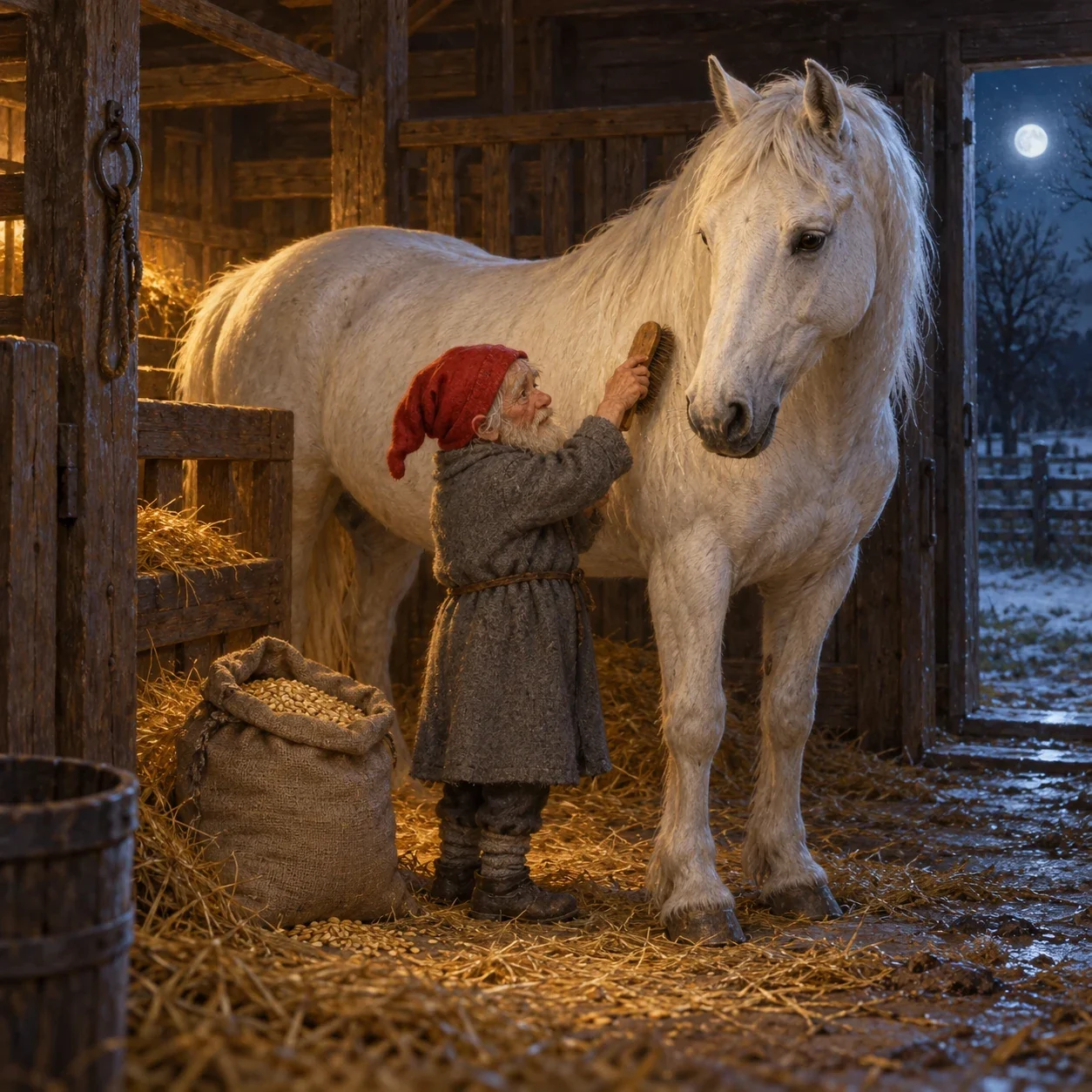
AI-generated interpretation of the Nis’s last grooming of the white mare in Keightley’s Jutland account. Small old-faced form, grey clothing, red cap, grain and the mare follow the selected text. Beard, brush, stable, season, light and precise proportions are imagined; this is not ethnographic evidence or a historical portrait.
AI-generated interpretation of the Nis’s last grooming of the white mare in Keightley’s Jutland account. Small old-faced form, grey clothing, red cap, grain and the mare follow the selected text. Beard, brush, stable, season, light and precise proportions are imagined; this is not ethnographic evidence or a historical portrait.
Overview
Keightley introduces the Nis as a small old-faced being, the size of a year-old child, usually dressed in grey with a pointed red cap. He says that Denmark and Norway use the name Nisse god-dreng and compares Sweden’s Tomte or Tomtgubbe. He also equates the being with several other European household spirits. These are his comparative classifications, not grounds for merging every named tradition into one biography. The named tales that follow are placed in Jutland, while the chapter’s final Swedish anecdote remains separately attributed.
Farm prosperity depends on a relationship involving food, work and respect. A well-disposed Nis sweeps, brings water and tends horses, but sometimes enriches his household by taking fodder from neighbours. An attempt to escape a troublesome Nis by moving fails when the farmer discovers him already sitting in a tub on the last cart. His cheerful announcement turns the supposed departure from the spirit into a shared removal. Changing houses therefore does not automatically end this particular association.
Two butter episodes show different kinds of conflict. In The Penitent Nis, the spirit thinks that his evening porridge lacks butter and kills the best cow in anger. After finding that the butter had sunk to the bottom, he leaves money beside the dead animal to compensate the family. In The Nis and the Boy, a servant deliberately hides the butter underneath. The Nis repeatedly drags the sleeping boy up and down beside a taller bedmate, trying to make their lengths match. Later the boy turns the tables by pushing the teasing spirit from a window towards the house-dog. The second tale ends there, without supplying a final injury or reconciliation.
The Nis Stealing Corn begins with successful cooperation at Thyrsting. On a trip to Fugleriis, a boy teaches the heavily laden spirit the pleasure of resting, whereupon the Nis regrets not taking even more corn. Their friendship later breaks down: the boy knocks him into the granary, and the spirit tries to arrange his death by placing him asleep over a well. The boy nevertheless survives unharmed. Resourcefulness and comedy do not erase the attempted killing or turn the stolen grain into an innocent gift.
A different Nis attaches his care to a particular white mare at Tirup. When she is sold, the steady supply of stolen fodder and the household’s luck move with her. The purchaser’s curiosity then ends the arrangement: caught being watched, the Nis feeds and grooms the mare for the last time and departs. Both farms return to depending upon their own resources. In The Nis Riding, the spirit’s tormenting ride on an ox backfires, and laughing maids later receive his revenge when he secretly blackens their faces before a dance.
The Vosborg accounts again place useful care beside retaliation. Nisses keep six calves healthy inside a snowbound building for fourteen days. Another spirit, struck with a fork, later throws the sleeping offender repeatedly over the house, catching him before he falls until the final plunge into water. The Swedish coda concerns a Tomte carrying a single straw or ear of corn: a farmer’s ridicule drives him to a neighbour, taking prosperity with him. Keightley’s notes question whether a Norwegian music-teaching report confuses Nis with Nöck and give a separate Christmas-payment custom. Neither detail should become an unquestioned universal trait of the Jutland characters.
Origins & earliest records
Thomas Keightley, The Fairy Mythology, London: George Bell & Sons, 1892, Nisses, pp139–147, complete introduction, seven named tales, Swedish coda and notes200–204.
Records & interpretation
All tales and endings read. Nis-music identification doubt in note201 preserved. Chapter comparisons and etymological suggestions attributed rather than treated as settled taxonomy.
Selected bibliography
Documented works and useful reading. This is not a list of every appearance.
- 01
The Fairy Mythology — Nisses, pp139–147, complete introduction, seven named tales, Swedish coda and notes200–204
All tales and endings read. Nis-music identification doubt in note201 preserved. Chapter comparisons and etymological suggestions attributed rather than treated as settled taxonomy.
Family & connections
A source-supported family tree or inspiration record has not yet been compiled for this profile. Related reading below indicates a connection in subject matter, not a proven lineage or creative influence.
References
Sources supporting this profile. Linked pages have their own scope and editorial standards.
- Historical English compilationKeightley1892 — Nisses, pp139–147, complete introduction, seven named tales, Swedish coda and notes200–204Research access: 2026-10-27
Image credits
AI-generated illustrationAI-generated interpretation of the Nis’s last grooming of the white mare in Keightley’s Jutland account. Small old-faced form, grey clothing, red cap, grain and the mare follow the selected text. Beard, brush, stable, season, light and precise proportions are imagined; this is not ethnographic evidence or a historical portrait.
AI-generated interpretation of the Nis’s last grooming of the white mare in Keightley’s Jutland account. Small old-faced form, grey clothing, red cap, grain and the mare follow the selected text. Beard, brush, stable, season, light and precise proportions are imagined; this is not ethnographic evidence or a historical portrait.