
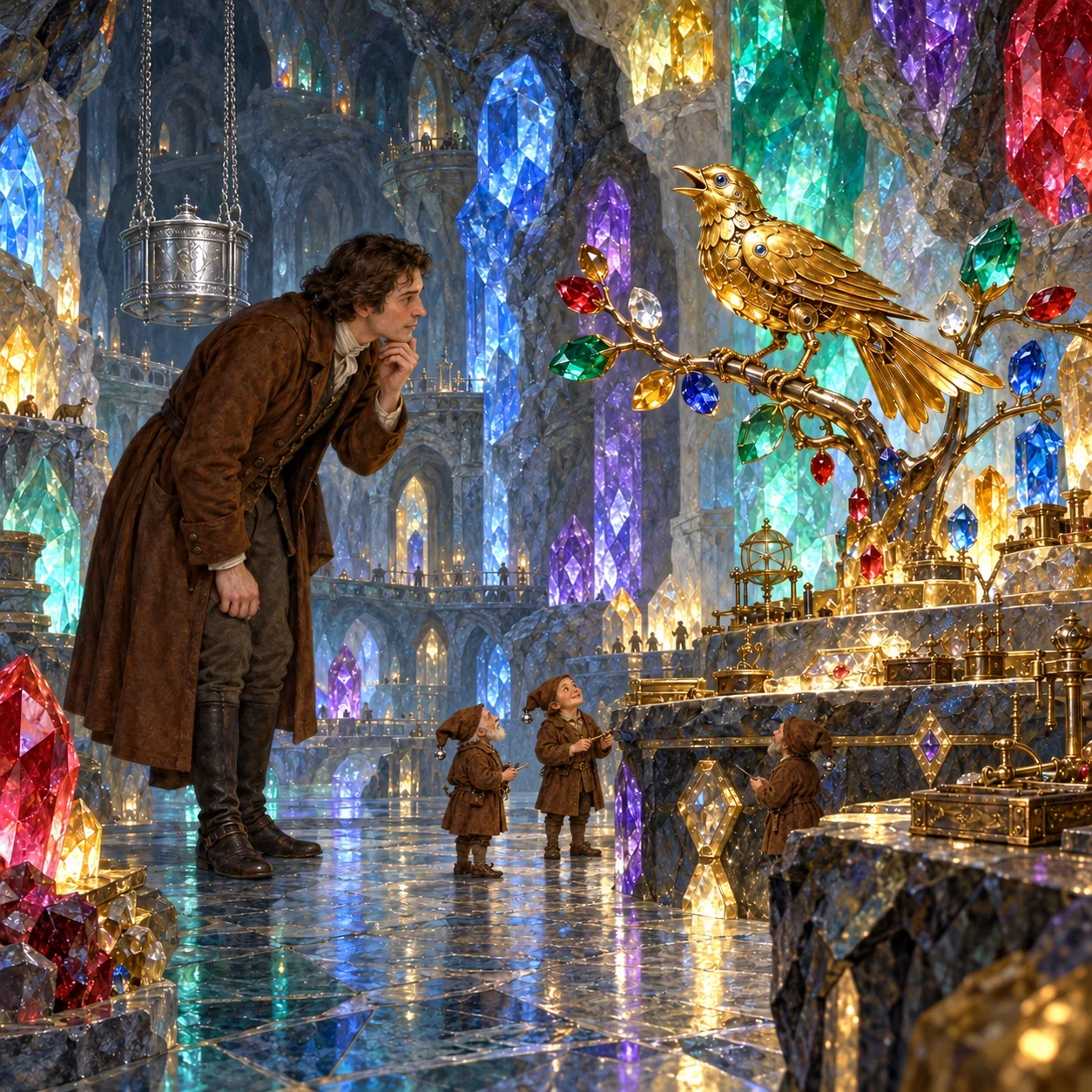
AI-generated interpretation of John Dietrich among the underground people: brown caps with silver bells, gemstone light, an artificial bird and the silver entrance tub follow the tale. Faces, architecture, exact relative scales, bird design and the adult-stage encounter are artistic choices.
AI-generated interpretation of John Dietrich among the underground people: brown caps with silver bells, gemstone light, an artificial bird and the silver entrance tub follow the tale. Faces, architecture, exact relative scales, bird design and the adult-stage encounter are artistic choices.
Overview
Keightley’s Rügen chapter distinguishes several kinds of underground people before relating John Dietrich’s adventures. The Nine-Hills near Rambin house the white- and brown-clad groups, while the black-clad smiths belong to a different part of the island. These colour terms refer to the account’s clothing classifications. Keightley’s source is Arndt’s 1818 collection, and his framing credits the local bailiff Hinrich Vieck with stories Arndt heard in childhood. The selected English narrative is a mediated literary witness, not proof that the chapter’s ethnic history or supernatural inhabitants were independently established.
John is eight when he spends a summer herding cattle near the hills. The cowherd Klas Starkwolt teaches him that possessing one inhabitant’s cap can reverse the usual relationship between mortal visitor and underground captor. After midsummer celebrations, John waits at the dancing place. He hears unseen merriment until a brown cap thrown during play lands on his head. He seizes it, discovering that wearing it lets him see the little people. Its owner, smaller than the boy’s knee, pleads unsuccessfully for its return. John makes him a servant and insists on accompanying him below.
At dawn a glass point opens in the hillside. Silver tubs lowered on chains carry the returning company into an interior lit by precious stones. John receives rich clothes and rooms, while his obedient attendant explains the immense underground landscape. The inhabitants have no sun, moon or stars; brilliant gems illuminate their dwellings and passages. Tables rise through the floor for banquets, and mechanically made birds fly and sing like living ones. Crystal passages connect fields, waterways and self-moving boats. The tale presents elaborate manufactured wonder, rather than reducing the people’s skill to ordinary mining.
The glittering society depends partly on human servants who entered without retaining a protective pledge. Their white clothes, blue caps and silent glass shoes distinguish them from their employers. John initially excuses their fifty-year servitude because they appear well fed and cheerful, but the narrative later exposes the cost of separation. Schools taught by ancient wise inhabitants provide reading, calculation, stories, craft, poetry and other learning. John becomes accomplished in drawing and working precious materials. These attractions coexist with the rulers’ determination to control those within their power.
Elizabeth Krabbin, daughter of Rambin’s minister, fell asleep near the hills as a small child and awoke underground. The story explicitly distinguishes that circumstance from being stolen. When John is eighteen and she sixteen, their affection becomes love. Hearing cocks crow above the hill awakens Elizabeth’s longing for home, church and parents. Her fear is that she will emerge still young after fifty years to find her family dead and her beloved aged. The two characters interpret their desire to leave through Christian worship and marriage; that judgement belongs to their narrated outlook.
The underground leaders refuse to release Elizabeth, claiming that breaking the fixed term would destroy their empire. John first forces hundreds of inhabitants, including families, to perform exhausting stonework, then orders mutual whipping and tries further punishments. This coercion is an essential part of the escape narrative, not evidence of an uncomplicated humane hero. His decisive weapon is a toad found inside a broken stone: its presence or smell causes the inhabitants extraordinary distress. Faced with that torment, the leaders agree to release Elizabeth and all human servants whose earthly age is at least twenty, and to forbid detention beyond that age.
John demands treasure, household furnishings, a carriage and wealth for the released servants. At the midsummer departure, identified in the tale as twelve years after his arrival, he throws back the seized cap and can no longer see the underground company. The return leads to family recognition, marriage and great wealth, followed by church-building and charity. The closing claim says their donated glass shoes and vessels were later lost during wartime plunder. Those relic claims have not been independently checked. The age markers and stated durations are preserved as the narrative gives them, without manufacturing a perfectly reconciled chronology or a universal rule about time in fairyland.
Origins & earliest records
Thomas Keightley, The Fairy Mythology, London: George Bell & Sons, 1892, Adventures of John Dietrich, pp178–194; Rügen framing pp174–178; notes237–243.
Records & interpretation
All framing and tale through recognition, wedding, church endowment and relic-loss coda read. Chapter’s historical and ethnic assertions remain attributed; not independently authenticated.
Selected bibliography
Documented works and useful reading. This is not a list of every appearance.
- 01
The Fairy Mythology — Adventures of John Dietrich, pp178–194; Rügen framing pp174–178; notes237–243
All framing and tale through recognition, wedding, church endowment and relic-loss coda read. Chapter’s historical and ethnic assertions remain attributed; not independently authenticated.
Family & connections
A source-supported family tree or inspiration record has not yet been compiled for this profile. Related reading below indicates a connection in subject matter, not a proven lineage or creative influence.
References
Sources supporting this profile. Linked pages have their own scope and editorial standards.
- Historical English compilationKeightley1892 — Adventures of John Dietrich, pp178–194; Rügen framing pp174–178; notes237–243Research access: 2026-10-27
Image credits
AI-generated illustrationAI-generated interpretation of John Dietrich among the underground people: brown caps with silver bells, gemstone light, an artificial bird and the silver entrance tub follow the tale. Faces, architecture, exact relative scales, bird design and the adult-stage encounter are artistic choices.
AI-generated interpretation of John Dietrich among the underground people: brown caps with silver bells, gemstone light, an artificial bird and the silver entrance tub follow the tale. Faces, architecture, exact relative scales, bird design and the adult-stage encounter are artistic choices.