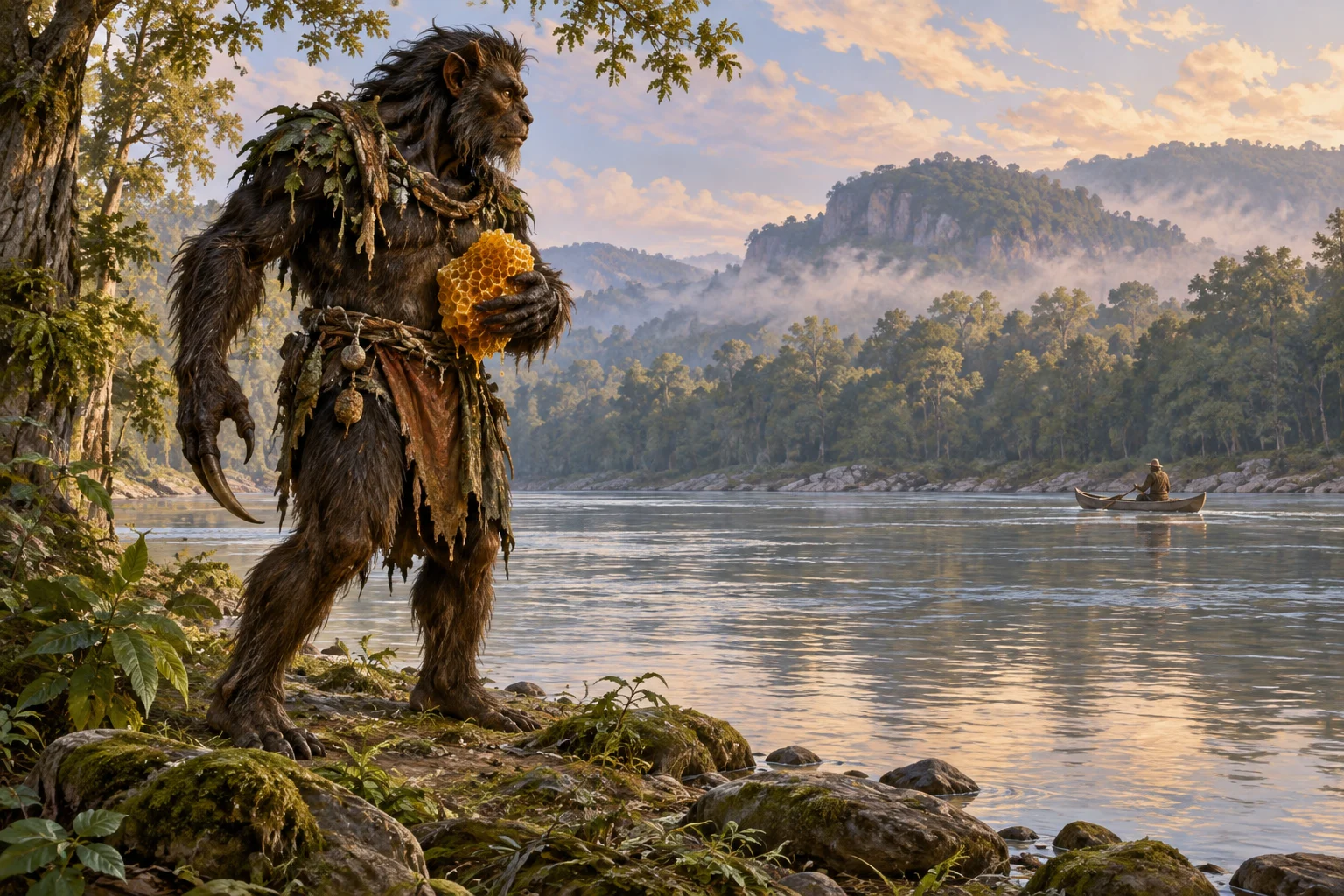
AI interpretation of Ngojama. One imaginary manlike forest predator holding honeycomb, a single long hand-claw visible, standing on riverbank while a small canoe is far across the river. Complete predator. Exact form and costume imagined, not a real community portrait or ape species.
AI-generated unofficial original narrative interpretation. Selected scene: One imaginary manlike forest predator holding honeycomb, a single long hand-claw visible, standing on riverbank while a small canoe is far across the river. Complete predator. Exact form and costume imagined, not a real community portrait or ape species. Fine anatomy, garments, objects and setting are modern AI imagined visual details, not an historical reconstruction, community portrait, authentic artifact or evidence of living practice.
Overview
Bombe encounters Ngojama while gathering honey in a tree. He gives the waiting predator honeycomb, then escapes into a canoe before it follows. The creature remains on the bank, lamenting its delay. The source describes a long claw in a hand, while a neighboring interpretation identifies the name with an old man-eating lion. These accounts are reported separately; neither a new ape species nor a universal humanoid anatomy is inferred from the story.
The honey-gatherer’s escape exploits two specific delays: the predator stays to eat the best honeycomb and cannot follow the canoe across the river. The account gives the encounter a forest-to-water sequence. Its warning of a later meeting leaves the relationship unsettled, rather than ending with the monster’s death or permanent banishment.
Origins & earliest records
The selected witness is Alice Werner’s 1933 comparative collection, section Gnomes and Spirits: Bombe encounter. Its stated source context is Werner’s account told by Pokomo narrators. Publication and collection dates do not establish the beginning of the oral tradition.
Records & interpretation
Gnomes and Spirits: Bombe encounter explicitly supplies the features and narrative actions summarized here. The account is mediated through named collectors or reported narrators, not a current community statement or independently verified encounter. Broad colonial interpretations are not adopted as facts.
Selected bibliography
Documented works and useful reading. This is not a list of every appearance.
- 01
Myths and Legends of the Bantu
Gnomes and Spirits: Bombe encounter; cited source context: Werner’s account told by Pokomo narrators. Selected historical witness, not exhaustive.
Family & connections
A source-supported family tree or inspiration record has not yet been compiled for this profile. Related reading below indicates a connection in subject matter, not a proven lineage or creative influence.
References
Sources supporting this profile. Linked pages have their own scope and editorial standards.
- Historical collection and comparative commentaryMyths and Legends of the Bantu — Gnomes and Spirits: Bombe encounterResearch access: 2026-10-05
Image credits
AI-generated interpretationAI interpretation of Ngojama. One imaginary manlike forest predator holding honeycomb, a single long hand-claw visible, standing on riverbank while a small canoe is far across the river. Complete predator. Exact form and costume imagined, not a real community portrait or ape species.
AI-generated unofficial original narrative interpretation. Selected scene: One imaginary manlike forest predator holding honeycomb, a single long hand-claw visible, standing on riverbank while a small canoe is far across the river. Complete predator. Exact form and costume imagined, not a real community portrait or ape species. Fine anatomy, garments, objects and setting are modern AI imagined visual details, not an historical reconstruction, community portrait, authentic artifact or evidence of living practice.