
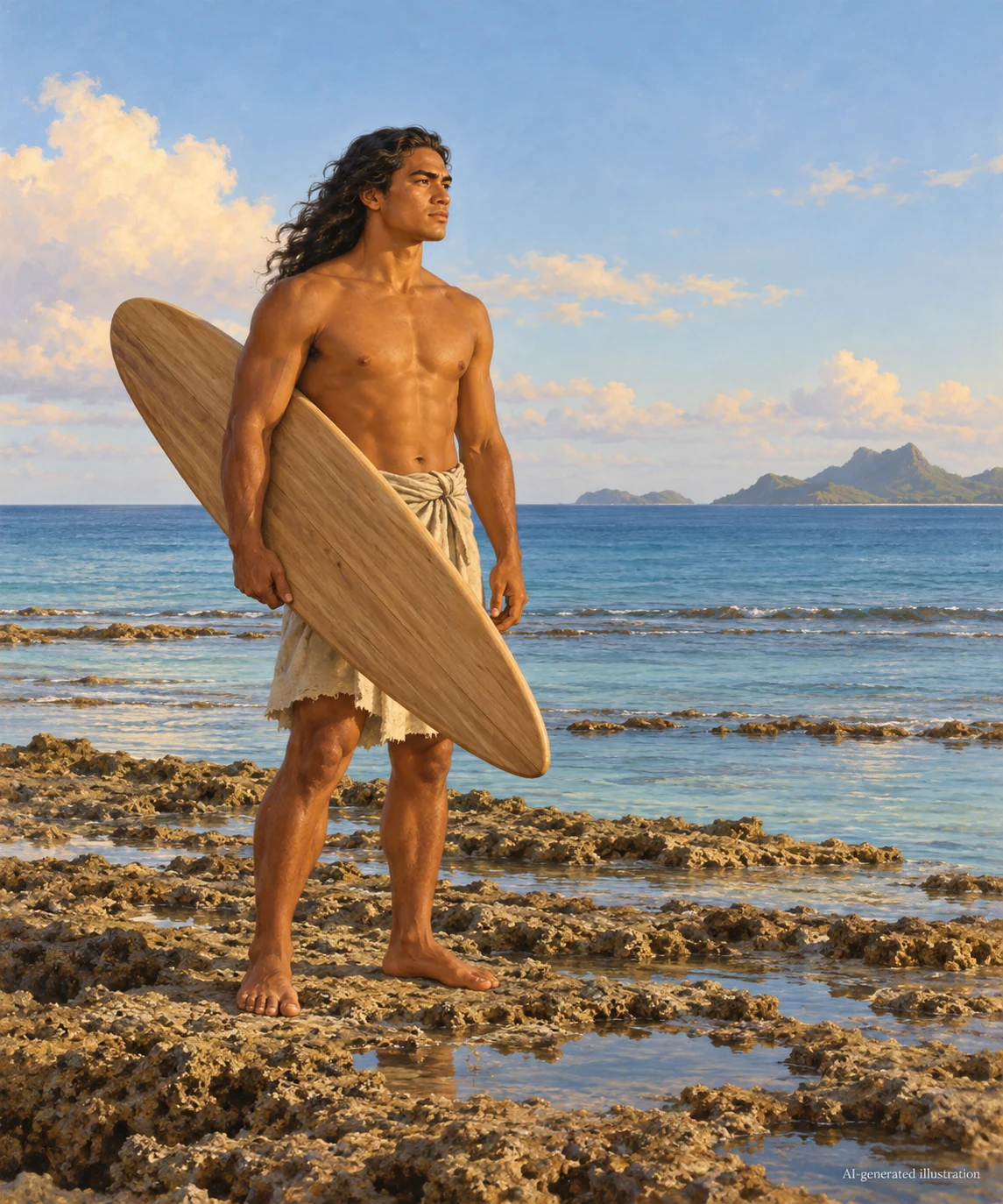
An imagined Ngaru stands on a dry reef carrying the light surfboard Orua.
Ngaru in Gill’s Mangaian Narrative — an imagined scene from Gill’s historical collected narrative. Human appearance, garments and setting are explicitly imagined narrative choices, not authenticated anatomy, costume or ethnographic reconstruction.
Overview
Gill introduces Ngaru as the son of Vaiare and grandson of Moko, the Great Lizard, living in Mania or Shady-Land with his wife Tongatea. Seeking distinction, he makes the light surfboard Orua and challenges Tikokura the storm-wave and Tumuitearetoka the great shark. He rides the returning surf while Moko watches from a rock and warns of the shark’s approach. Leaping and diving keep him out of its jaws for eight days and nights, until he throws away the board and the opponents withdraw. The encounter establishes both his daring and his dependence on his grandfather’s vigilance.
The battered hero’s altered appearance leads Tongatea to reject him. Moko buries him beneath fragrant leaves in a transformation compared with ripening bananas. He emerges shining but bald; Vaiare obtains successive kinds of hair from Tangaroa until Moko accepts smooth, wavy black locks. Tongatea’s later attempt to reclaim him fails, and the episode ends with her death. Gill’s presentation attaches strong value judgments to skin and hair. These are features of this historical telling, not a medical account of exposure or a hierarchy of human appearances endorsed here.
Miru sends Kumutonga-i-te-po and Karaia-i-te-ata to entice Ngaru into the shades. Moko’s lizards first investigate her narcotic drink and cooking oven. The two women carry Ngaru wrapped in tapa and tied to a pole, then offer kava; he remains alert. At the oven he confronts Miru’s treatment of visitors. A deluge extinguishes the fire and sweeps away her company. Ngaru holds a nono stem while the two women cling to his legs, surviving with him. They teach him ball-throwing. He later reaches Taumareva, but Moko’s two little birds lower cords and lift him back to his grieving grandfather.
The final adversary lowers a basket from the sky to collect human victims. Warned by another lizard reconnaissance, Ngaru nevertheless enters it and repeatedly jerks the basket back to earth, tiring Amai-te-rangi. Each descent lets Moko add small lizard protectors. At the confrontation they swarm over the giant and tickle him until he drops his chisel and mallet; Ngaru uses the weapons to kill him. Before returning he competes successfully at ball-throwing with the sky women Ina and Matonga. Gill calls him a Polynesian Hercules, but that comparison is the collector’s, not evidence identifying him with a Greek figure.
Origins & earliest records
The complete prose account and interpretive notes occupy pages 225–237 of Gill’s 1876 volume. Gill localizes the telling on Mangaia while proposing older connections with Samoa and Tonga from names and remembered origins; those proposed connections are not established migration history.
Records & interpretation
Complete prose and every accompanying note read continuously, with the full preface and introductory remarks. Gill’s missionary interpretation of victory over death and his comparisons with Christianity remain attributed. No claim that all Miru traditions end with her destruction is made: Gill explicitly notes a different wider belief in her continuing existence. The main narrative saves the two named women; a closing generalizing note nevertheless says two peerless daughters perish. This textual inconsistency is recorded rather than silently reconciled.
Selected bibliography
Documented works and useful reading. This is not a list of every appearance.
- 01
Myths and Songs from the South Pacific
The Adventures of Ngaru, complete prose and notes pp. 225–237; preface and introductory remarks.
Family & connections
A source-supported family tree or inspiration record has not yet been compiled for this profile. Related reading below indicates a connection in subject matter, not a proven lineage or creative influence.
References
Sources supporting this profile. Linked pages have their own scope and editorial standards.
- Primary historical collected witnessGill 1876: complete Ngaru prose narrative and notesResearch access: 2026-10-18
Image credits
Original literary interpretation. Human appearance, garments, artifact forms and staging are illustrative choices, not authenticated anatomy, traditional costume or archaeological reconstruction.An imagined Ngaru stands on a dry reef carrying the light surfboard Orua.
Ngaru in Gill’s Mangaian Narrative — an imagined scene from Gill’s historical collected narrative. Human appearance, garments and setting are explicitly imagined narrative choices, not authenticated anatomy, costume or ethnographic reconstruction.