
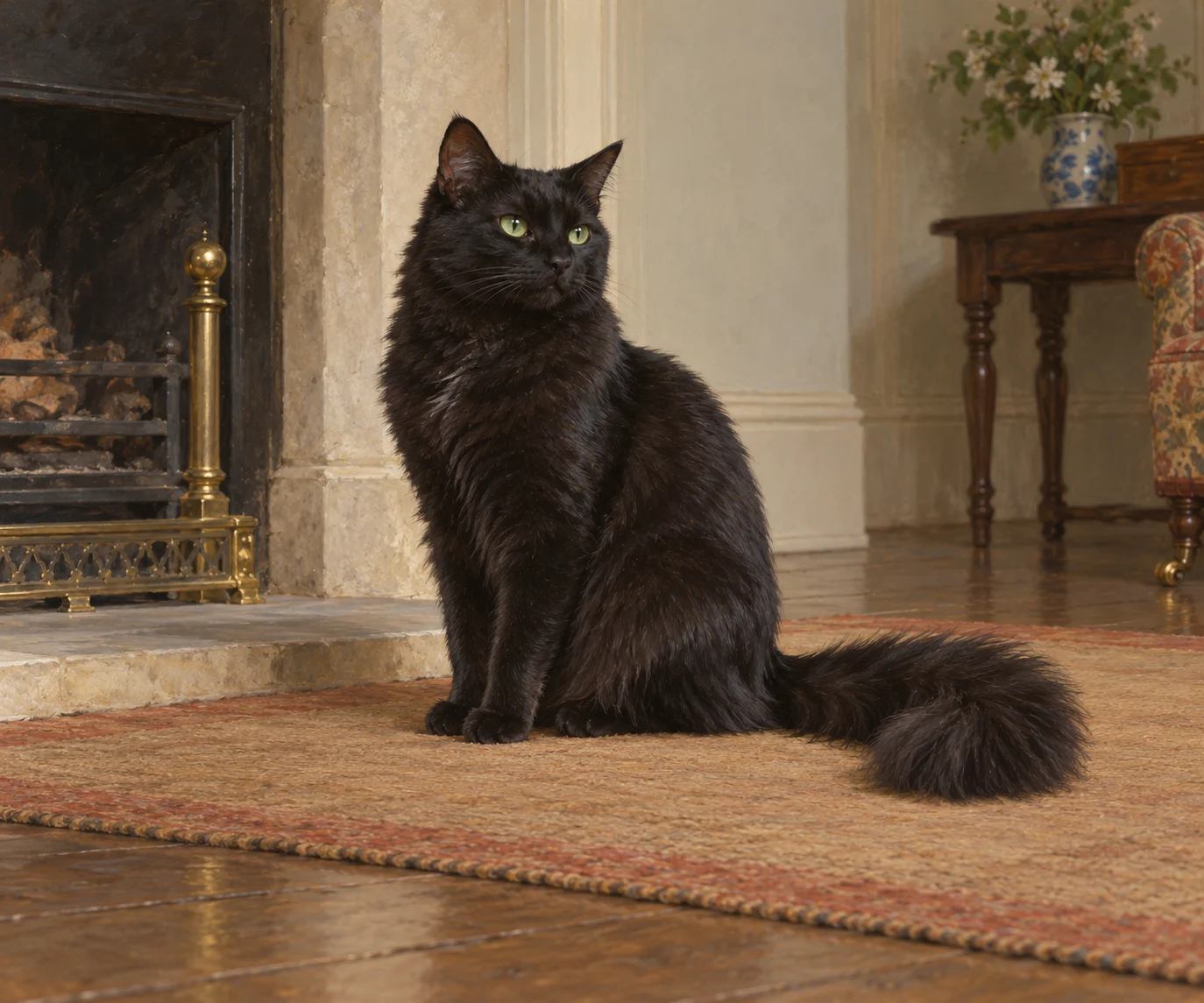
AI interpretation; independently composed.
Text-led interpretation; unspecified details imagined.
Overview
Lord Hugh Cecil is the favourite household cat whom Maurice Basingstoke repeatedly mistreats without thinking through the pain and fear he causes. The story identifies the cat as black, with green eyes and a handsome half-Persian tail. His whiskers have been shortened by Maurice. At first the family hear his cries rather than an explanation: the sardine-tin incident brings rescue, but he scratches and bites the rescuers in his terror. The narrator’s account centres the animal’s experience rather than treating the boy’s experiments as harmless entertainment.
When Maurice is about to be sent away to Dr. Strongitharm’s school, Lord Hugh unexpectedly speaks. He challenges the boy’s belief that cats have easy lives and supplies a transforming word which the narrator deliberately withholds. Maurice takes the cat’s appearance, while Lord Hugh appears as Maurice and leaves for school in his place. Lord Hugh says that another person can reverse the change by asking Maurice to stop being a cat. This is a trap in practice: Maurice’s appeals reach the household only as mewing. His attempts to write with milk, ink and cardboard letters also fail to secure release.
The cat in the boy’s appearance repeats the sardine-tin torment before departing, forcing Maurice to experience the fear he had dismissed. Over the following week, Maurice learns how easily an animal’s needs and intentions are misunderstood. Mabel’s kindness becomes especially important to him. At the same time, the real Lord Hugh experiences the school’s punishments: on his return he reports caning, confinement in darkness and repetitive written work. Neither side finds the other’s supposedly comfortable life enviable.
Lord Hugh offers peace and tells Maurice to resume his original form. For a moment two identical boys stand together; Maurice must separately tell the other boy to become Lord Hugh again. The transformation therefore does not simply reverse both appearances with one command. The cat returns to his own shape, purrs under Maurice’s hand and becomes more confident. The narrator explicitly denies that Maurice becomes a model child, and says Lord Hugh’s character remains unchanged. The lasting result is Maurice’s greater patience and kindness, not the cat’s moral reform. Only the two participants know the truth, apart from the narrator to whom Maurice has told it.
First appearances & development
An individual character in E. Nesbit’s original story The Cat-hood of Maurice.
Canon & continuity
Complete primary story, including the separate restoration of each appearance and the narrator’s concluding qualification.
Selected bibliography
Documented works and useful reading. This is not a list of every appearance.
- 01
Family & connections
A source-supported family tree or inspiration record has not yet been compiled for this profile. Related reading below indicates a connection in subject matter, not a proven lineage or creative influence.
References
Sources supporting this profile. Linked pages have their own scope and editorial standards.
- Primary literary textThe Magic World, 1924 Macmillan edition — story I, pp. 1–26Research access: 2026-10-18
Image credits
AI-generatedAI interpretation; independently composed.
Text-led interpretation; unspecified details imagined.