
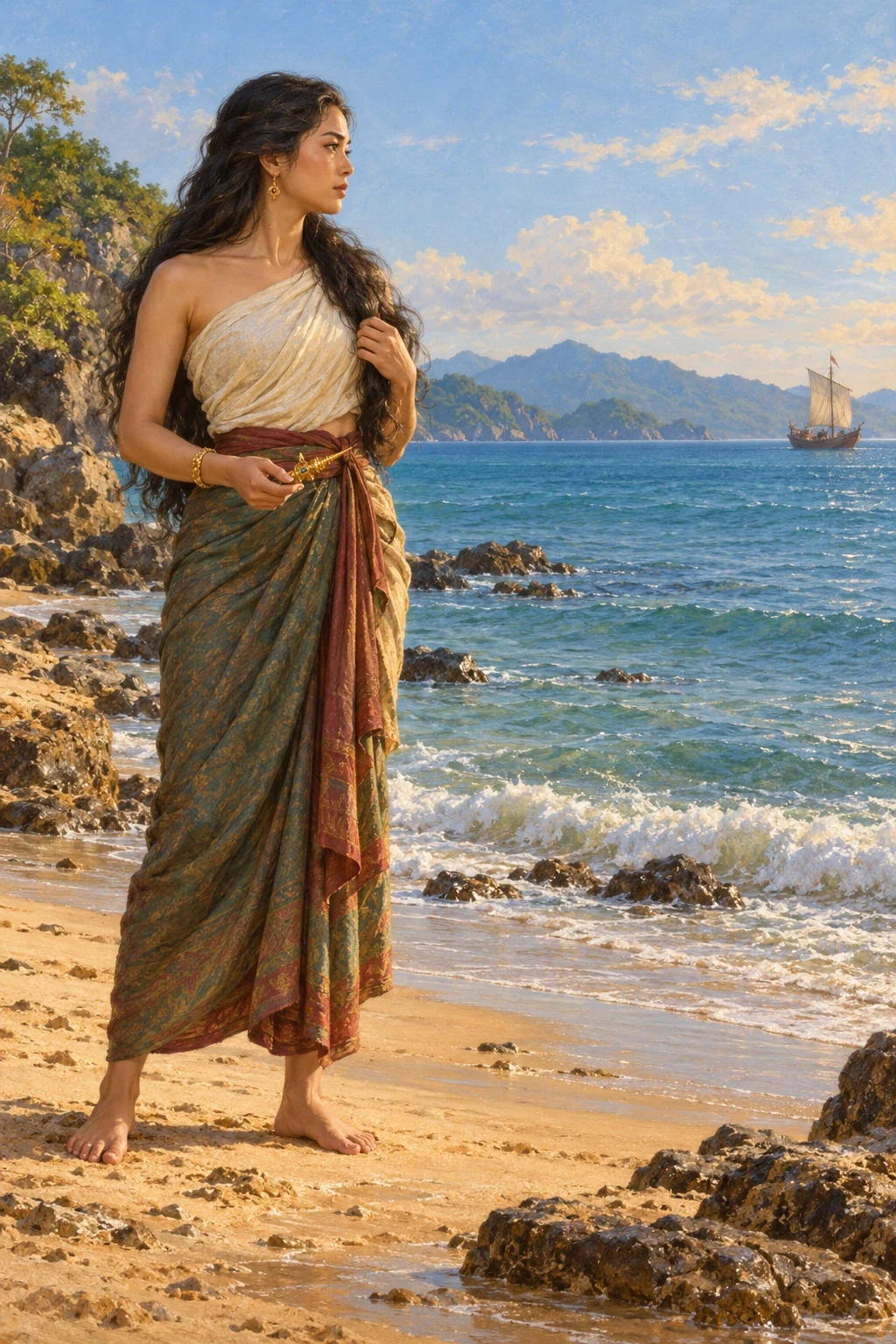
AI-generated narrative interpretation of Néang Roum-Say-Sock before casting her hairpin.
Adult appearance, attire, ornament design and coast are imagined from the literary scene, not a historical or ethnic portrait.
Overview
Néang Roum-Say-Sock is the heroine whose name titles the first narrative in Auguste Pavie’s 1903 collection. Pavie gives a French gloss connecting her name with unbound hair. Within the legend, an eminent hermit finds her as a small child on a newly opened lotus and brings her up in his retreat. The source presents a remarkable finding, without identifying her biological parents or calling her a goddess. Réachkol, the son of merchants with royal ancestry, studies with the hermit and later marries her. Her guardian gives her an exceptional ornament to hold her long hair.
Réachkol travels to Korat, where he marries Néang Mika, revealing his first marriage only afterward. Roum-Say-Sock remains at Thma-Angkiang and continues to hope for his return. She visits the farewell beach and watches passing sails. When her husband’s ship finally approaches, her joy changes to alarm as she sees the crew’s panic and the crocodile Atonn following them. Mika, discovering Réachkol’s deception, has sent the animal after him. The rescue that follows belongs to Roum-Say-Sock’s action and her guardian’s gift, not to a general claim that every person with her name possesses supernatural powers.
As Réachkol gestures farewell from the threatened vessel, she lets her hair fall about her shoulders and pulls out the gold, diamond-laden hairpin. Calling on her adoptive father, she throws it toward the creature. It lands in the sea in front of her. Its point touches the sand beneath the water, the ground rises and the sea is displaced; the ship is left upon rock, allowing Réachkol to run to her. The text links this extraordinary change with the hermit’s power and the ornament. It does not say that she can summon land at will, that the jewel strikes Atonn, or that she transforms into a landscape herself.
Her role is not limited to a patient wife or rescuer. When Mika leads an army against her, Roum-Say-Sock takes command of her own forces and fights her rival on horseback. She is tireless in the combat, but the narrator’s impression that she seems to believe herself invulnerable is not proof of an explicit immunity. After Mika tries to flee, Roum-Say-Sock captures and kills her; the ending includes cruelty and bodily violence rather than an uncomplicated benevolent victory. Returning to Réachkol, now king, she joins him in fulfilling a vow by building a nine-towered temple on the hermit’s hill.
The old guide uses the narrative to explain named hills, a former sea, ruins and relics, while acknowledging uncertainty about some burial accounts and reporting differing Siamese claims. Those are attributed landscape traditions, not archaeological confirmation. Pavie’s later travel commentary, including a separate guardian-snake encounter, must also remain distinct from the heroine’s actions. His anonymous guide expressly offers an abridgment of a previously read book; the source is not a full native-language witness. This is the heroine of one mediated literary landscape legend; the text does not establish her historicity, an innate power to create land, or the present practice of any community.
Origins & earliest records
Pavie’s chapter I, Néang Roum-Say-Sock, pp. 25–47, is attributed to an unnamed elderly guide at Teucthio who offers a short abridgment of a book he had read.
Records & interpretation
Complete chapter I; lotus/adoption and hair ornament p. 29, shoreline rescue pp. 31–33, mounted combat and aftermath pp. 34–36, guide’s landscape identifications and uncertainties pp. 37–39.
Selected bibliography
Documented works and useful reading. This is not a list of every appearance.
- 01
Contes populaires du Cambodge, du Laos et du Siam
I, Néang Roum-Say-Sock, pp. 25–47; complete introduction pp. 1–24. Collector-mediated literary landscape narrative, not independent historical or geological verification.
Family & connections
A source-supported family tree or inspiration record has not yet been compiled for this profile. Related reading below indicates a connection in subject matter, not a proven lineage or creative influence.
References
Sources supporting this profile. Linked pages have their own scope and editorial standards.
- Historical collector’s literary abridgments and attributed narrative framingPavie: original French collection, complete chapters I–II and introductionResearch access: 2026-10-21
Image credits
AI-generatedAI-generated narrative interpretation of Néang Roum-Say-Sock before casting her hairpin.
Adult appearance, attire, ornament design and coast are imagined from the literary scene, not a historical or ethnic portrait.